
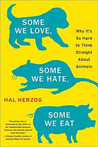
Some We Love, Some We Hate, Some We Eat: Why It's So Hard to Think Straight About Animals
"Exposes the profound, often laughable contradictions in how we love, exploit, and rationalize our relationships with animals."
- 1Our moral reasoning about animals is inherently inconsistent and emotional. Human-animal ethics are governed less by logical philosophy and more by cultural norms, personal affection, and psychological distance. We condemn dog fighting while eating factory-farmed bacon, guided by sentiment rather than principle.
- 2The 'cute factor' and perceived intelligence heavily bias our moral calculus. We assign vastly different moral worth based on an animal's appearance and perceived sentience. A puppy evokes outrage, while a lab rat or a farmed fish often elicits indifference, despite comparable capacity for suffering.
- 3Direct participation in harm creates more cognitive dissonance than passive consumption. Killing an animal oneself feels profoundly different from buying its packaged meat. This distance allows industrialized animal agriculture to function by insulating consumers from the visceral reality of production.
- 4Cultural context, not biology, primarily dictates which animals are food or friends. The classification of dogs as companions in the West and as food in parts of Asia illustrates that our categories for animals are socially constructed, arbitrary, and powerfully resistant to change.
- 5Animal rights activism and animal use often stem from similar psychological roots. Both the fervent activist and the dedicated cockfighter are driven by deep passion for animals. The book reveals how moral communities form around specific animals, creating rigid in-group/out-group dynamics.
- 6Accept moral complexity rather than seeking a perfectly consistent philosophy. The quest for a flawless, universal code of animal ethics is futile. A more honest approach acknowledges our contradictions and makes peace with incremental, context-dependent moral progress.
Hal Herzog’s 'Some We Love, Some We Hate, Some We Eat' plunges into the bewildering and paradoxical landscape of human-animal relationships, a field known as anthrozoology. With the sharp eye of a social scientist and the curiosity of an investigative journalist, Herzog maps the illogical terrain where sentiment, ethics, culture, and appetite violently collide. The book begins not with abstract philosophy, but with the visceral, everyday contradictions: the person who donates to animal shelters while wearing leather shoes, or the society that prosecutes dog abusers while systematically slaughtering billions of chickens.
Herzog structures his inquiry as a series of immersive, often unsettling field reports. He ventures into the clandestine world of cockfighting, where handlers exhibit genuine care for birds destined for violent spectacle. He observes animal rights conferences, parsing the psychological profiles of activists. He examines the clinical detachment of biomedical researchers and the obsessive devotion of pet hoarders. Each chapter serves as a case study in moral inconsistency, challenging the reader’s own unexamined assumptions. The narrative deftly blends these anecdotes with findings from psychology, evolutionary biology, and behavioral economics to explain why our brains are wired for such dissonance.
The book argues that our treatment of animals is less a product of reasoned ethical systems and more a function of cognitive biases, emotional proximity, and cultural scaffolding. Concepts like the 'cuteness' response, speciesism, and the 'meat paradox'—the mental gymnastics required to love animals while eating them—are dissected with analytical rigor and dark humor. Herzog explores how distance, both physical and psychological, facilitates mass exploitation, and how arbitrary lines are drawn between pets, pests, and protein.
Ultimately, Herzog resists offering a tidy moral resolution. Instead, the book’s significance lies in its fearless examination of ambiguity itself. It is essential reading for anyone who has ever felt a twinge of cognitive dissonance about their place in the animal kingdom. By holding a mirror to our collective hypocrisy, Herzog does not advocate for a specific ideology but for greater intellectual honesty, compelling us to confront the uncomfortable, fascinating, and deeply human mess of our moral lives.
Readers find the book intellectually thrilling and profoundly unsettling, forcing a direct confrontation with their own ethical contradictions. The engaging, anecdotal style is widely praised for making complex behavioral science accessible and darkly humorous. However, a significant contingent criticizes the author's perceived moral relativism and lack of a definitive stance, leaving some frustrated by the ambivalent conclusion. The central thesis—that human-animal ethics are inherently inconsistent—resonates powerfully, even when it discomforts.
- 1The book's central paradox: condemning animal cruelty while consuming factory-farmed meat, and the cognitive dissonance this creates.
- 2The ethical comparison between condemned practices like cockfighting and accepted industrial farming, challenging hierarchical views of animal suffering.
- 3Criticism of the author's ambivalent, non-prescriptive conclusion, with debates over whether it's intellectually honest or morally evasive.
- 4The psychological and cultural arbitrariness of classifying some animals as pets and others as food, using the dog vs. pig example.
The Essays of Warren Buffett: Lessons for Corporate America
Lawrence A. Cunningham, Warren Buffett
Out of Control
Kevin Kelly
Amusing Ourselves to Death: Public Discourse in the Age of Show Business
Neil Postman
The Creative Habit
Twyla Tharp, Mark Reiter
Stumbling on Happiness
Daniel Gilbert
The Psychology of Money: Timeless Lessons on Wealth, Greed, and Happiness
Morgan Housel

The Artist's Way
Julia Cameron
Radical Markets: Uprooting Capitalism and Democracy for a Just Society
Eric A. Posner, E. Glen Weyl

Chip War: The Quest to Dominate the World's Most Critical Technology
Chris Miller
Outliers: The Story of Success
Malcolm Gladwell

The Intelligent Investor
Benjamin Graham
The Crash Course
Chris Martenson