
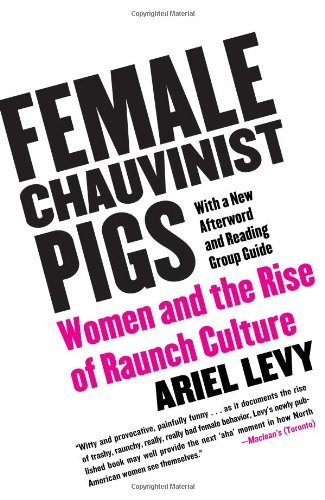
Female Chauvinist Pigs: Women and the Rise of Raunch Culture
"A trenchant critique of how the performance of raunchy, male-defined sexuality has been mistaken for a new form of female liberation."
Nook Talks
- 1Raunch culture is a performance, not authentic female desire. The book argues that the hypersexualized behavior celebrated as empowerment is often a calculated act, divorced from genuine pleasure and rooted in a desire for male approval and market success.
- 2Female Chauvinist Pigs internalize and perpetuate the male gaze. Levy posits that by objectifying themselves and other women, these figures adopt the perspective of the traditional chauvinist, reinforcing the very power structures feminism sought to dismantle.
- 3The conflation of liberation with commercial sexual availability is a false victory. True empowerment is confused with the freedom to participate in a marketplace that commodifies the female body, mistaking visibility for progress and consumer choice for political power.
- 4Youth culture adopts 'the slut uniform' as a social strategy. For many young women, provocative dress is less about personal promiscuity and more about seeking peer acceptance and navigating social hierarchies through a prescribed, sexualized identity.
- 5Feminism's unfinished project lies in defining female sexuality on its own terms. The book suggests that the greatest failure of modern feminism is its capitulation in the realm of sexuality, leaving a void filled by patriarchal fantasies masquerading as empowerment.
Ariel Levy’s 'Female Chauvinist Pigs' is a seminal work of cultural criticism that dissects the early-21st century phenomenon of 'raunch culture'—the mainstream embrace of pornographic aesthetics and attitudes by women themselves. Levy identifies the 'Female Chauvinist Pig' (FCP) as the archetype of this movement: a woman who believes that enthusiastically objectifying herself and other women constitutes a bold, liberated feminist stance. The book positions this not as progress, but as a perplexing and troubling detour in the history of women's rights, asking why the symbols of female subjugation have been recast as badges of honor.
Levy grounds her analysis in immersive reportage, venturing into the heart of the raunch industry. She interviews pornographic film stars, attends the taping of 'The Girls Next Door,' and observes the rise of 'ladette' culture, searching for the motivation behind the performance. A recurring, chilling discovery is the absence of the language of pleasure; in its place is a transactional lexicon of payment, pain, and professional obligation. This reporting reveals a stark disconnect between the marketed fantasy of sexual empowerment and the often-alienating reality of the work.
The investigation extends beyond the professional realm to everyday life, particularly among adolescent girls. Levy observes the ubiquity of the 'slut uniform'—micro-miniskirts, tube tops, and thongs—worn not out of inherent promiscuity but as a fraught social currency for acceptance and identity. The book argues that this cultural shift represents a colonization of female sexuality by a commercial, male-centric ideal, leaving little room for the development of an authentic, self-defined eroticism.
'Female Chauvinist Pigs' ultimately serves as a provocative corrective to a prevailing cultural narrative. It is essential reading for anyone interested in gender studies, media criticism, and the complex evolution of feminism. Levy challenges readers to distinguish between liberation and conformity, urging a more critical examination of what we celebrate as empowerment and a return to the foundational feminist project of defining desire and identity from the inside out.
The critical consensus views the book as a vital and provocative polemic, praised for its intellectual rigor and courage in challenging fashionable pieties. Readers laud its sharp analysis and compelling reportage, finding its core thesis more relevant than ever. However, a significant portion of the audience criticizes it as dated, overly judgmental, or reductive, arguing it dismisses female agency in sexual expression and fails to account for nuances of pleasure and power within contemporary sexuality.
- 1The book's central thesis on whether raunch culture represents empowerment or a new form of oppression.
- 2Critiques of the author's tone and methodology as being judgmental or lacking nuance about female agency.
- 3Debates on the book's contemporary relevance and whether its analysis has become dated since publication.
- 4Discussions about the author's portrayal of sex workers and the adult entertainment industry.

Amusing Ourselves to Death: Public Discourse in the Age of Show Business
Neil Postman

The Crash Course
Chris Martenson

The Essays of Warren Buffett: Lessons for Corporate America
Lawrence A. Cunningham, Warren Buffett

Bad Samaritans
Ha-Joon Chang

The Creative Habit
Twyla Tharp, Mark Reiter

The Road to Financial Freedom
Bodo Schäfer

The Artist's Way
Julia Cameron

The Almanack of Naval Ravikant
Naval Ravikant, Eric Jorgenson

Radical Markets: Uprooting Capitalism and Democracy for a Just Society
Eric A. Posner, E. Glen Weyl

Code: The Hidden Language of Computer Hardware and Software
Charles Petzold

Stumbling on Happiness
Daniel Gilbert

Breath: The New Science of a Lost Art
James Nestor