
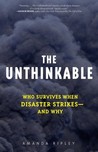
The Unthinkable: Who Survives When Disaster Strikes - and Why
"It reveals the predictable psychology of survival, transforming paralyzing fear into a set of learnable, life-saving responses."
- 1Disaster response follows a predictable three-stage arc. The human reaction to catastrophe unfolds in a sequence of denial, deliberation, and decisive action. Understanding this internal timeline allows individuals to recognize and accelerate through the initial, often fatal, phase of shock and disbelief.
- 2Training and mental rehearsal rewire the brain's fear response. Repeated simulation creates cognitive scripts that bypass the paralyzing effects of extreme stress. This mental preparation enables automatic, effective action when conscious thought is compromised, turning learned behavior into instinct.
- 3Crowds in crisis often exhibit surprising cooperation and altruism. Contrary to panic-driven stampede myths, social bonds and a collective drive for order typically emerge. This 'humanity of crowds' is a critical asset for survival, making collaboration more common than selfish chaos.
- 4Denial is the most lethal phase in a disaster. The brain's initial refusal to accept a radically changed reality consumes precious seconds or minutes. Overcoming this normalcy bias—the insistence that things are as they were—is the first and most crucial step toward survival.
- 5Survival is a function of preparation, not destiny. Fate plays less of a role than practiced habits and environmental design. Simple, proactive measures, from scanning for exits to discussing family rendezvous points, dramatically increase resilience by reducing the cognitive load during a crisis.
- 6Heroism is a learnable skill, not a mystical trait. The capacity for courageous action under duress can be cultivated through exposure to stress, mastery of skills, and a sense of responsibility. It emerges from a confluence of training, mindset, and social connection.
The Unthinkable dismantles the myth of the panicked, irrational victim to expose the intricate, often predictable psychology of human behavior in the face of catastrophe. Amanda Ripley, an investigative journalist for Time, ventures beyond the headlines of earthquakes, plane crashes, and terrorist attacks to interrogate a fundamental question: why do some people perish while others survive, and even thrive, under identical circumstances? She constructs her inquiry not as a catalog of horrors, but as a forensic examination of the split-second decisions that separate life from death.
Ripley anchors her analysis in a trilogy of real-world disasters: the cataclysmic 1917 Halifax explosion, the puzzling 1985 British Airtours plane fire, and the harrowing evacuations from the World Trade Center on 9/11. From these case studies, she identifies a universal three-stage arc of disaster response—denial, deliberation, and the decisive moment—that governs our reactions. The book then delves into the neuroscience and psychology underpinning this arc, consulting trauma experts, military researchers, and Holocaust survivors to explain how extreme fear hijacks the brain and how that response can be mitigated.
The final movement of the work is both practical and hopeful. Ripley participates in immersive disaster simulations to experience the sensory overload firsthand and explores how training, from flight attendant drills to civilian preparedness, can rewrite our neural pathways. She demonstrates that the brain’s evolutionary instincts, while often maladapted for modern threats, possess a remarkable plasticity. With the right knowledge and rehearsal, automatic, life-saving behaviors can overwrite paralyzing terror.
More than a survival manual, The Unthinkable is a profound exploration of human resilience. It argues that understanding the science of crisis is the first step toward transforming a culture of vulnerability into one of empowered preparedness. The book is essential reading for anyone responsible for the safety of others—leaders, first responders, architects—and for every individual who has ever wondered, ‘What would I do?’
Readers unanimously praise the book as a vital, eye-opening fusion of gripping narrative and practical science. The consensus finds Ripley’s journalistic approach both accessible and intellectually rigorous, transforming a morbid subject into an empowering guide. Criticisms are minor, occasionally noting the prose can become methodical when detailing case studies. The overwhelming verdict is that it is essential reading, fundamentally altering how one perceives environmental risks and personal preparedness.
- 1The critical importance of overcoming 'normalcy bias' and the lethal delay caused by denial in the initial moments of a crisis.
- 2Practical application of the book's lessons, such as consciously noting exit routes on planes and in buildings to build life-saving mental maps.
- 3Debating the book's central thesis that heroism and effective survival responses are skills that can be trained, rather than innate character traits.
Bad Samaritans
Ha-Joon Chang

The Artist's Way
Julia Cameron
Out of Control
Kevin Kelly
Breath: The New Science of a Lost Art
James Nestor

The Intelligent Investor
Benjamin Graham
Sapiens: A Brief History of Humankind
Yuval Noah Harari

Chip War: The Quest to Dominate the World's Most Critical Technology
Chris Miller
The Essays of Warren Buffett: Lessons for Corporate America
Lawrence A. Cunningham, Warren Buffett
Radical Markets: Uprooting Capitalism and Democracy for a Just Society
Eric A. Posner, E. Glen Weyl
Outliers: The Story of Success
Malcolm Gladwell

The Road to Financial Freedom
Bodo Schäfer
Amusing Ourselves to Death: Public Discourse in the Age of Show Business
Neil Postman