
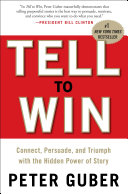
Tell to Win
"Transform passive data into an active, shared mission by mastering the ancient art of purposeful storytelling."
- 1Replace transactional data with an emotional narrative. Facts and figures alone fail to motivate. A well-crafted story embeds information within an emotional and memorable framework, transforming a pitch into a shared experience that compels action.
- 2Anchor your story in authentic personal experience. Credibility stems from vulnerability and truth. Sharing a genuine struggle or failure builds a bridge of trust with the audience, making the subsequent call to action feel earned and collaborative.
- 3Frame every narrative around the audience's benefit. A persuasive story answers 'What's in it for them?' before the question is asked. It positions the listener not as a spectator but as the hero who gains value, status, or purpose by embracing your vision.
- 4Turn listeners into active participants in the tale. The ultimate goal is to transport the audience from passive reception to co-creation. A successful story invites them to finish it with their own actions, making them viral advocates for the cause.
- 5Utilize 'state-of-the-heart' technology to sustain engagement. Digital platforms are not merely for distribution but for deepening emotional connection. They extend the story's lifecycle, allowing for ongoing interaction and reinforcing the communal commitment to the narrative.
- 6Structure your narrative with a clear emotional arc. A purposeful story follows a classic trajectory: capturing attention with a hook, building tension through conflict, and culminating in a resonant resolution that implicitly contains the desired action.
In an era saturated with data and disconnected presentations, Peter Guber’s Tell to Win posits that the fundamental currency of human connection and persuasion remains the purposeful story. The book argues that success in any field—from entrepreneurship and sales to leadership and activism—is no longer won by the most information, but by the most compelling narrative. Guber reframes everyone as being in the 'emotional transportation business,' where the ability to move people intellectually and emotionally is the critical competitive advantage.
Drawing from his decades as a film studio executive and producer, Guber systematizes the instinctual art of storytelling into a replicable strategy. He introduces the concept of the 'purposeful story,' a narrative deliberately crafted with a specific mission to ignite action. The methodology moves beyond simply telling an anecdote; it involves a strategic architecture that captures attention first, demonstrates authentic motivation, and is meticulously framed around the listener's self-interest. The process is designed to transform a monologue into a dialogue.
The book is richly illustrated with case studies from a remarkably diverse array of 'master tellers,' including Nelson Mandela, Steven Spielberg, Deepak Chopra, and Under Armour founder Kevin Plank. These examples demonstrate the universal application of narrative power, showing how a story convinced investors to fund a moonshot, built a global apparel brand from a simple idea, or mobilized a nation toward reconciliation. Guber dissects these successes, revealing the common threads of vulnerability, audience-centricity, and a clear call to action.
Ultimately, Tell to Win serves as a practical guide for leaders, entrepreneurs, and anyone who needs to persuade. It provides a tangible set of principles to craft a narrative that doesn't just inform but transports, turning passive audiences into active participants and committed partners. The book’s legacy is its demystification of storytelling as a soft skill, repositioning it as an essential hard tool for tangible achievement in the modern world.
The critical consensus finds the book's core premise compelling but suffocated by its execution. Readers acknowledge the valid power of storytelling in business, yet they are overwhelmingly frustrated by the author's relentless name-dropping and self-aggrandizement, which they perceive as diluting the instructional value. The narrative is criticized for feeling like a protracted, celebrity-studded anecdote rather than a substantive guide, leaving many feeling the central insight could have been delivered in a long-form article rather than a full book.
- 1The excessive reliance on celebrity anecdotes and name-dropping, which readers felt overshadowed the practical lessons.
- 2Debate over whether the core concept is a profound business truth or a self-evident platitude stretched into a book.
- 3Frustration with the book's structure, which some found repetitive and more focused on the author's biography than actionable methodology.

How to Win Friends & Influence People
Dale Carnegie
The Art of Contrarian Trading
Carl Futia
The Creative Habit
Twyla Tharp, Mark Reiter

The Artist's Way
Julia Cameron

Out of Control
Kevin Kelly
The Crash Course
Chris Martenson

Breath: The New Science of a Lost Art
James Nestor
The Essays of Warren Buffett: Lessons for Corporate America
Lawrence A. Cunningham, Warren Buffett

The Road to Financial Freedom
Bodo Schäfer

Just Listen: Discover the Secret to Getting Through to Absolutely Anyone
Mark Goulston
The Norwegian Method
Brad Culp

The Almanack of Naval Ravikant
Naval Ravikant, Eric Jorgenson