
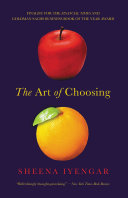
The Art of Choosing
"Master the paradox of choice by strategically limiting options to achieve greater freedom and satisfaction."
- 1Define constraints to liberate your decision-making. Paradoxically, imposing deliberate limits on your options reduces cognitive overload, focuses creativity, and leads to more confident and satisfying choices, much like an artist working within a defined medium.
- 2Recognize choice as a culturally constructed narrative. The desire for and perception of choice is not universal but shaped profoundly by cultural context, challenging the Western assumption that more autonomy is inherently and always beneficial.
- 3Distinguish between choosing and wanting. We often choose against our long-term interests due to immediate desires or social pressures. True agency requires interrogating the source of our wants and aligning choices with deeper values.
- 4Understand the neurological cost of excessive choice. An overload of options can lead to decision fatigue, anxiety, and post-choice regret, as the brain struggles to process and compare an unmanageable array of possibilities.
- 5Reframe choice architecture for better outcomes. By thoughtfully structuring how options are presented—through defaults, categorization, or phased revelation—we can guide ourselves and others toward more beneficial decisions without removing autonomy.
- 6Accept that some control is an illusion. A significant portion of our choices are influenced by subconscious biases, environmental cues, and chance. Acknowledging this fosters resilience and wiser responses to unpredictable outcomes.
Sheena Iyengar's The Art of Choosing is a seminal investigation into one of humanity's most fundamental yet misunderstood experiences: the act of selection. Moving beyond simplistic self-help, it interrogates choice as a complex psychological, cultural, and biological phenomenon. Iyengar, a pioneering social psychologist, frames the book around a central paradox: in a world that champions limitless freedom, why does an abundance of options so often lead to paralysis, dissatisfaction, and regret?
Through a series of elegant experiments and cross-cultural analyses, the book dismantles the assumption that more choice is inherently better. Iyengar reveals how our capacity for choice is bounded by cognitive limits and deeply sculpted by cultural narratives—what constitutes a 'choice' in an individualist society may be irrelevant in a collectivist one. The narrative explores the mechanics of decision-making, from the neurological substrates of preference to the irrational heuristics that frequently guide our selections in marriage, career, and consumption.
The work also delves into the architecture of choice, examining how the presentation and framing of options powerfully steer outcomes, a concept with profound implications for public policy, marketing, and personal ethics. Iyengar demonstrates that mastery lies not in pursuing infinite variety but in intelligently constructing and constraining our decision-making environments.
Ultimately, The Art of Choosing transcends its field to offer a philosophical guide for modern life. It is essential reading for anyone seeking to understand the forces that shape their decisions, aiming to convert the daily burden of selection into a deliberate practice of crafting identity, fostering well-being, and navigating a world saturated with illusory control.
Readers praise the book's profound and accessible synthesis of complex research, finding its insights on choice paralysis and cultural conditioning immediately applicable to personal and professional dilemmas. However, a significant contingent criticizes the middle sections for becoming repetitive, with some arguments feeling stretched thin across excessive anecdotal examples. The consensus positions it as a thought-provoking, if occasionally meandering, foundational text that effectively challenges the dogma of maximal choice.
- 1The book's central paradox of choice—how more options can decrease satisfaction—resonates deeply with readers navigating modern consumer and life decisions.
- 2Comparisons to Barry Schwartz's *The Paradox of Choice* and Roy Baumeister's *Willpower* are frequent, with debates on which offers more practical or scientific depth.
- 3Iyengar's cross-cultural analysis, particularly contrasting Western and Eastern perspectives on autonomy, sparks discussion about the universality of choice.
- 4The practical advice on setting self-imposed constraints is highlighted as the most actionable and transformative takeaway for overwhelmed readers.
The Essays of Warren Buffett: Lessons for Corporate America
Lawrence A. Cunningham, Warren Buffett

Code: The Hidden Language of Computer Hardware and Software
Charles Petzold
How to Win Friends & Influence People
Dale Carnegie
Blueprints: How mathematics shapes creativity
Marcus du Sautoy
The Norwegian Method
Brad Culp

The Almanack of Naval Ravikant
Naval Ravikant, Eric Jorgenson
The Creative Habit
Twyla Tharp, Mark Reiter

The Road to Financial Freedom
Bodo Schäfer

Chip War: The Quest to Dominate the World's Most Critical Technology
Chris Miller
Bad Samaritans
Ha-Joon Chang
Just Listen: Discover the Secret to Getting Through to Absolutely Anyone
Mark Goulston
Transformation in Christ
Dietrich Von Hildebrand