
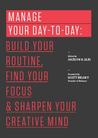
Manage Your Day-to-Day: Build Your Routine, Find Your Focus, and Sharpen Your Creative Mind
"Reclaim your creative potential by architecting a daily routine that defends focus from the chaos of constant connectivity."
- 1Architect a ritual, not just a schedule, for deep work. Creative output thrives on consistent, protected time rather than ad-hoc effort. A ritualized routine signals to the brain that it is time to enter a state of focused flow, making high-quality work inevitable rather than accidental.
- 2Treat constant connectivity as a chronic distraction to be managed. The barrage of messages and social media fragments attention and depletes mental energy. Proactively designing barriers against digital interruption is essential to preserve the cognitive space required for substantive creative thinking.
- 3Prioritize solitude as a non-negotiable creative resource. True innovation and complex problem-solving demand uninterrupted stretches of solitary concentration. Carving out and defending periods of silence is not a luxury but a fundamental prerequisite for generating original ideas.
- 4Leverage the compound interest of small, daily acts. Grand creative achievements are built not through sporadic bursts of inspiration, but through the cumulative power of modest, consistent effort applied daily. Frequency builds momentum and skill more reliably than intensity.
- 5Separate the generative phase from the editorial phase. Attempting to create and critique simultaneously stifles output. Establish distinct modes for uninhibited idea production and subsequent refinement to overcome perfectionism and maintain a productive creative rhythm.
In an era defined by relentless connectivity and fractured attention, Manage Your Day-to-Day confronts the central paradox of modern creative work: the tools designed to enhance productivity have instead become its greatest impediment. Edited by Jocelyn K. Glei for the 99U conference, this anthology assembles pragmatic wisdom from twenty established artists, psychologists, and business thinkers, including Seth Godin, Gretchen Rubin, Cal Newport, and Steven Pressfield. It moves beyond generic time-management advice to address the specific challenges of sustaining meaningful creative output amidst a world of infinite distraction.
The book is structured around four foundational pillars: building a rock-solid routine, finding and protecting focus, taming the tools of communication, and sharpening the creative mind. Each section features concise, actionable essays that dissect a particular facet of the daily struggle. Contributors explore concepts such as the necessity of creative rituals, the neurological cost of task-switching, the strategic use of solitude, and the mindful engagement with social platforms. The arguments are grounded in both personal experience and behavioral science, offering a blend of philosophical principle and tactical advice.
Rather than presenting a monolithic system, the anthology offers a toolkit of complementary strategies. Readers learn to design a daily architecture that prioritizes their most important work, to establish psychological boundaries against interruption, and to cultivate the mental habits that foster sustained innovation. The emphasis is on sustainable practice over quick fixes, advocating for small, consistent adjustments that compound into significant professional transformation.
This volume serves as an essential manual for any knowledge worker, freelancer, artist, or entrepreneur whose value derives from focused cognitive labor. Its legacy lies in reframing productivity not as a matter of squeezing more tasks into a day, but as the deliberate art of defending the conditions under which original, high-value work can occur. It is a clarion call to move from being reactive to being intentional in the design of one's creative life.
The consensus positions this book as a highly practical and accessible primer, particularly valued by freelancers and creative professionals struggling to impose structure on unstructured time. Readers consistently praise its concise, actionable format and the credibility of its contributor roster. The primary critique is its lack of depth, with many noting it serves as a compelling introduction to concepts explored more thoroughly elsewhere. It is widely seen as an effective catalyst for immediate, positive habit change, though not a definitive scholarly work on the subject.
- 1The book's greatest strength is its concise, digestible format versus criticism of its lack of substantive depth.
- 2Debate on its value for seasoned productivity readers versus its perfect utility for beginners seeking structure.
- 3The effectiveness of its anthology approach in providing diverse perspectives versus a lack of a unified system.
- 4Whether the tactical advice on managing digital distractions is genuinely implementable in modern workflows.
The Creative Habit
Twyla Tharp, Mark Reiter

The Psychology of Money: Timeless Lessons on Wealth, Greed, and Happiness
Morgan Housel

The Almanack of Naval Ravikant
Naval Ravikant, Eric Jorgenson

The Art of Contrarian Trading
Carl Futia
The Crash Course
Chris Martenson

The Artist's Way
Julia Cameron

Breath: The New Science of a Lost Art
James Nestor

Transformation in Christ
Dietrich Von Hildebrand
Boom: Bubbles and the End of Stagnation
Byrne Hobart

The Road to Financial Freedom
Bodo Schäfer

Bad Samaritans
Ha-Joon Chang

Out of Control
Kevin Kelly