
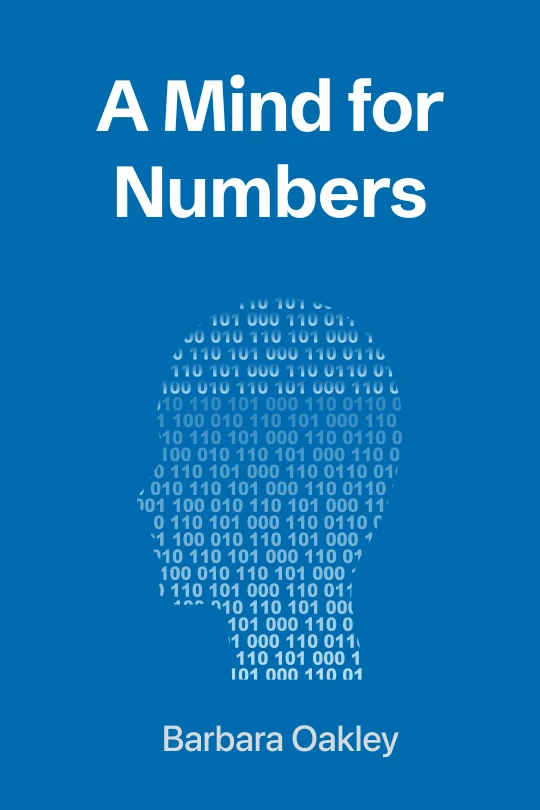
A Mind for Numbers: How to Excel at Math and Science
"Transform your learning by mastering the essential interplay between focused concentration and creative, diffuse thinking."
Nook Talks
- 1[object Object]
- 2[object Object]
- 3[object Object]
- 4[object Object]
- 5[object Object]
- 6[object Object]
A Mind for Numbers dismantles the myth that mathematical and scientific aptitude is an innate gift, arguing instead for a learnable set of cognitive tools and habits. Barbara Oakley, an engineering professor who once failed high school math, positions the book as a lifeline for anyone intimidated by quantitative fields, from struggling students to career-changers. Her central premise is that effective learning is not about brute-force memorization but about understanding how the brain naturally acquires and processes complex information.
At the heart of Oakley's methodology is the distinction between two complementary modes of thought: focused and diffuse. Focused mode is the state of concentrated attention employed when directly practicing a skill or solving a familiar problem. Diffuse mode, in contrast, is a relaxed, broad-thinking state where the mind makes unexpected connections and gains conceptual insights, often during breaks or sleep. The book provides a practical framework for strategically toggling between these modes, using techniques like the Pomodoro method for focused sessions and scheduled downtime for diffuse processing.
Oakley supplements this core theory with evidence-based strategies for overcoming common pitfalls. She advocates for active recall over passive review, the interleaving of different problem types to build flexibility, and the constructive management of procrastination and anxiety. The narrative is enriched with anecdotes from history's great scientists and inventors, illustrating how their breakthroughs often emerged from this dance between intense study and mental wandering.
Ultimately, this is a book about meta-learning—learning how to learn. Its significance extends beyond STEM, offering a universal blueprint for mastering any complex subject. It empowers readers by demystifying the learning process, replacing intimidation with a structured, neurologically-informed approach to building competence and confidence from the ground up.
The reader consensus celebrates the book as a transformative, practical guide that demystifies learning, with particular praise for the focused/diffuse model and actionable study techniques. Critics, however, find the title misleading, noting the principles apply universally beyond math and science, and some describe the prose as occasionally repetitive or anecdotal. It is widely deemed highly accessible and immediately useful for students and lifelong learners alike.
- 1The applicability of the book's techniques beyond math and science to all forms of learning and creative work.
- 2The effectiveness and personal experience with the Pomodoro Technique and active recall methods for defeating procrastination.
- 3Debates on the book's structure, with some finding the anecdotes engaging and others viewing them as padding that dilutes the core concepts.
Stumbling on Happiness
Daniel Gilbert

Code: The Hidden Language of Computer Hardware and Software
Charles Petzold

Transformation in Christ
Dietrich Von Hildebrand

Bad Samaritans
Ha-Joon Chang
The Psychology of Money: Timeless Lessons on Wealth, Greed, and Happiness
Morgan Housel

The Road to Financial Freedom
Bodo Schäfer

Breakthrough: The Quest for Life-Changing Medicines
Dr William Pao
Outliers: The Story of Success
Malcolm Gladwell

Chip War: The Quest to Dominate the World's Most Critical Technology
Chris Miller

How to Win Friends & Influence People
Dale Carnegie
The Crash Course
Chris Martenson
The Art of Contrarian Trading
Carl Futia