
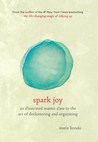
Spark Joy: An Illustrated Master Class on the Art of Organizing and Tidying Up
"Transform your home and self by systematically discarding everything that fails to elicit a visceral spark of joy."
- 1Discard by category, not by location. This systematic approach prevents the recirculation of clutter and forces a decisive confrontation with the total volume of possessions in a single category, leading to more permanent results.
- 2The 'spark joy' criterion is a somatic, not intellectual, test. Holding each item requires a physical, intuitive response. This bypasses rationalizations about utility or cost, connecting ownership directly to personal affirmation and emotional resonance.
- 3Treat your possessions with intentional respect. Folding clothing neatly and storing items upright acknowledges their service and establishes a conscious, grateful relationship with your environment, transforming maintenance from chore to ritual.
- 4Designate a specific home for every object you keep. A definitive storage location eliminates visual noise and decision fatigue, creating a self-sustaining system where tidiness becomes the default state, not a temporary achievement.
- 5Complete the discarding process before organizing what remains. Organizing clutter is merely rearranging dissatisfaction. The KonMari Method insists on a purgative, cathartic elimination first, ensuring that only meaningful items warrant the effort of placement.
- 6Visualize your ideal lifestyle to guide your decisions. This foundational step provides a personal compass for the entire process. It transforms tidying from a mechanical task into a curatorial act of designing a life that reflects your aspirations.
Spark Joy serves as the essential illustrated companion to Marie Kondo's groundbreaking KonMari Method, moving beyond philosophical principles into practical, room-by-room mastery. Where her first book established the revolutionary 'spark joy' paradigm, this volume provides the granular, visual toolkit for its execution, transforming abstract concepts into actionable daily practice.
Kondo methodically guides the reader through the tangible application of her philosophy to every domestic category: clothing, books, papers, komono (miscellany), and sentimental items. The book is distinguished by its precise, step-by-step line drawings, which demystify the famous KonMari folding technique for shirts, pants, and socks, and illustrate the ideal organization of drawers, closets, and cabinets. This visual grammar turns storage into a deliberate act of respect for one's possessions.
The manual delves into the nuanced challenges of sentimental clutter and hobby collections, offering a compassionate yet decisive framework for curating memories without being burdened by them. Kondo argues that by confronting these categories last, after practicing on less emotionally charged items, individuals develop the discernment and confidence needed to honor their past while fully inhabiting their present.
Ultimately, Spark Joy is more than a housekeeping guide; it is a treatise on intentional living. It posits that the order we create externally cultivates a corresponding internal clarity. The book is targeted at those who have embraced the initial concept and seek the detailed craftsmanship to build a lasting, joyful environment, solidifying Kondo's legacy as a philosopher of space and a pragmatist of the soul.
The consensus views this illustrated manual as the indispensable practical companion to Kondo's first book. Readers universally praise the clear, step-by-step drawings for making the folding and storage techniques accessible and foolproof. However, a significant segment finds the anthropomorphism of objects and the spiritual framing of tidying to be excessive or culturally dissonant. The book is celebrated for delivering concrete, actionable systems but critiqued by some for a tone that can feel prescriptive or overly sentimental.
- 1The indispensability of the illustrations for understanding the KonMari folding method, contrasted with the difficulty of learning it from text alone.
- 2Debate over the 'spark joy' test's subjectivity and its applicability to utilitarian or sentimental items.
- 3Discussion on whether this book should be read before or after 'The Life-Changing Magic of Tidying Up' for optimal understanding.
- 4The emotional permission the method grants to keep seemingly 'silly' mementos that genuinely bring personal happiness.
The Creative Habit
Twyla Tharp, Mark Reiter
The Norwegian Method
Brad Culp

Bad Samaritans
Ha-Joon Chang
Out of Control
Kevin Kelly
Breath: The New Science of a Lost Art
James Nestor

Chip War: The Quest to Dominate the World's Most Critical Technology
Chris Miller

Code: The Hidden Language of Computer Hardware and Software
Charles Petzold
Stumbling on Happiness
Daniel Gilbert
The Artist's Way
Julia Cameron
The Almanack of Naval Ravikant
Naval Ravikant, Eric Jorgenson

Breakthrough: The Quest for Life-Changing Medicines
Dr William Pao
Just Listen: Discover the Secret to Getting Through to Absolutely Anyone
Mark Goulston