
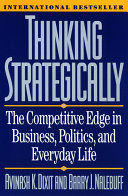
Thinking Strategically: The Competitive Edge in Business, Politics, and Everyday Life
"Master the art of anticipating others' moves to systematically outmaneuver rivals in any competitive arena."
- 1Anticipate your rival's next move to shape your own strategy. Strategic thinking requires modeling how competitors will respond to your actions. Success depends not on isolated decisions, but on predicting and influencing the interdependent choices of all players in the game.
- 2Employ credible commitments to lock in future advantages. Binding yourself to a course of action can alter an opponent's incentives. By eliminating your own ability to retreat, you force others to accommodate your position, turning potential weakness into strategic strength.
- 3Recognize and escape zero-sum thinking traps. Many interactions are not purely competitive; they contain elements of potential cooperation. Identifying opportunities for mutual gain, even within conflict, separates sophisticated strategists from mere adversaries.
- 4Analyze situations backward from the desired end result. Effective strategy uses backward induction: envision the final outcome and reason sequentially to the present. This reveals the necessary first move and prevents being outflanked by later developments.
- 5Introduce randomness deliberately to keep opponents uncertain. In some conflicts, predictability is fatal. A mixed strategy—randomizing your choices within calculated probabilities—denies rivals the ability to counter your moves, preserving your strategic autonomy.
- 6Leverage the strategic power of letting others move first. The second-mover advantage allows you to observe an opponent's commitment and then optimize your response. In sequential games, patience and observation often trump the initiative.
Avinash Dixit and Barry Nalebuff's Thinking Strategically demystifies game theory, transforming an abstract academic discipline into a practical toolkit for decision-making. The book argues that life is a series of strategic games—interactions where your best choice depends on what others choose. It moves beyond the simplistic win-lose paradigm, introducing readers to the core concepts of interdependence, payoff matrices, and equilibrium, framing everything from corporate negotiations to parenting as a strategic encounter.
The authors build their case through a cascade of vivid, accessible examples drawn from business, politics, sports, and film. They dissect the prisoner's dilemma to explain why cooperation often collapses, analyze the mechanics of credible threats in nuclear standoffs, and explore the logic of bidding in auctions. Each case study serves to illustrate a fundamental principle, such as the importance of thinking several moves ahead, the strategic value of limiting one's own options, and the counterintuitive benefits of randomized tactics in competitive situations like penalty kicks or price wars.
Beyond one-off tactics, the book provides a systematic framework for structuring strategic problems. It teaches readers to map players, their possible actions, and the sequence of moves, emphasizing the critical distinction between simultaneous and sequential games. This methodology empowers one to diagnose the underlying structure of a conflict, identify potential equilibria (like the famous Nash equilibrium), and craft moves that shift the game to a more favorable footing.
Thinking Strategically is aimed at the intellectually curious manager, entrepreneur, policy analyst, or engaged citizen. Its legacy lies in popularizing game theory as an essential component of literacy in a complex, interactive world. The book does not promise easy answers but provides a rigorous mental architecture for anticipating the behavior of rivals, partners, and markets, offering a genuine competitive edge to those who learn to see the hidden games in everyday life.
The consensus positions this work as a seminal yet challenging gateway. Readers praise its successful mission of translating dense game theory into relatable, real-world case studies, making foundational concepts accessible to a non-mathematical audience. However, a significant contingent of critics finds the presentation frustrating—they describe it as verbose and circuitous, arguing it awkwardly dances around the underlying mathematics rather than embracing it, which leads to confusion rather than clarity for those seeking a more technical foundation.
- 1The book's effectiveness as a non-mathematical introduction versus its avoidance of necessary formal rigor.
- 2Frustration with the verbose, example-heavy prose that some find illuminating and others find irritatingly indirect.
- 3The suitability of the audiobook format given the conceptual and occasionally mathematical nature of the content.
- 4Debate over whether the strategic principles are universally applicable or require significant contextual adaptation.
Bad Samaritans
Ha-Joon Chang
Stumbling on Happiness
Daniel Gilbert

The Almanack of Naval Ravikant
Naval Ravikant, Eric Jorgenson
Chip War: The Quest to Dominate the World's Most Critical Technology
Chris Miller

Breakthrough: The Quest for Life-Changing Medicines
Dr William Pao

The Artist's Way
Julia Cameron
Boom: Bubbles and the End of Stagnation
Byrne Hobart

Permanent Record
Edward Snowden
Blueprints: How mathematics shapes creativity
Marcus du Sautoy
The Essays of Warren Buffett: Lessons for Corporate America
Lawrence A. Cunningham, Warren Buffett

Just Listen: Discover the Secret to Getting Through to Absolutely Anyone
Mark Goulston
The Crash Course
Chris Martenson