
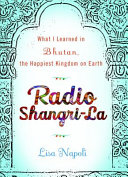
Radio Shangri-La
"A disillusioned journalist finds purpose by helping launch Bhutan's youth radio station, discovering that true happiness thrives in cultural connection, not isolation."
- 1Happiness is measured culturally, not materially. Bhutan's Gross National Happiness index prioritizes spiritual and environmental well-being over economic output, revealing that contentment stems from community and belonging rather than consumption and digital noise.
- 2Modernization is a double-edged sword for tradition. Introducing media like youth radio accelerates cultural exchange but also threatens to erode the very insulated, family-oriented values that constitute a society's foundational happiness.
- 3Purpose emerges through immersive service, not introspection. Napoli's sense of meaning arrives not from solitary reflection but from the active, challenging work of building a radio station within and for a foreign community.
- 4Cross-generational friendship illuminates life's phases. The author's relationship with a younger Bhutanese woman creates a mirror, forcing a reckoning with past choices and the construction of a deliberate future in life's second act.
- 5True travel transforms the traveler's worldview. Immersion in Bhutan's slow, intentional culture acts as a corrective lens, reframing a fast-paced, digitally saturated Western life as one of distraction rather than connection.
Radio Shangri-La is a memoir of dislocation and discovery, tracing journalist Lisa Napoli's journey from a career and existential crisis in Los Angeles to the remote Himalayan kingdom of Bhutan. Answering a serendipitous invitation, she trades the relentless pace of American media for a nation just beginning to tentatively open its doors to globalization, a place famously insulated from industrialization and dedicated to measuring its success by Gross National Happiness rather than Gross National Product.
Napoli's entry point is Kuzoo FM, the country's first youth-oriented radio station, which she helps to launch. The narrative becomes a dual study: the birthing pains of a modern media outlet in a culture without traffic lights, and the author's own personal recalibration. Through her work at the station, she witnesses firsthand the profound and paradoxical impact of introducing a broadcast medium to a populace historically shielded from external influence, observing how it simultaneously connects and potentially corrodes.
The book delves beyond the simplistic Western fantasy of an untouched Shangri-La. Napoli immerses herself in the rhythms of Bhutanese life, forming deep bonds, particularly with a young woman named Ngawang. This relationship becomes a central vessel for exploring the tensions between tradition and modernity, and the universal human struggles for identity and agency, regardless of geography.
Ultimately, this is a story about the search for purpose and the redefinition of happiness. Napoli’s experience in Bhutan serves as a prolonged meditation on what is gained and lost in the relentless march of progress, offering a poignant critique of contemporary Western life while painting a nuanced, unsentimental portrait of a kingdom at a fragile crossroads. It appeals to readers of literary travelogue and introspective memoir, providing a unique lens on culture, media, and the art of building a meaningful life.
Readers appreciate the book's unique access to a cloistered society and its reflective, mid-life perspective, finding the cultural observations compelling. However, a significant contingent criticizes the narrative as overly self-indulgent, wishing for a deeper, more reportorial focus on Bhutan itself rather than the author's personal journey. The prose is considered accessible, though some find the pacing uneven, with the latter sections focusing on local friendships resonating more powerfully than the initial setup.
- 1The tension between the author's personal memoir and the promised travelogue about Bhutan, leaving some readers wanting more cultural depth.
- 2Debate over the portrayal of Bhutan's 'happiness'—whether it is presented authentically or through a romanticized, Western lens.
- 3The ethical implications of introducing broadcast media to a traditionally insulated culture, as explored through Radio Kuzoo.
- 4The effectiveness of the cross-generational friendship with Ngawang as a narrative device to explore themes of choice and modernity.

Permanent Record
Edward Snowden

Stumbling on Happiness
Daniel Gilbert

The Book of Basketball: The NBA According to The Sports Guy
Bill Simmons

The Intelligent Investor
Benjamin Graham

Amusing Ourselves to Death: Public Discourse in the Age of Show Business
Neil Postman

Transformation in Christ
Dietrich Von Hildebrand
Radical Markets: Uprooting Capitalism and Democracy for a Just Society
Eric A. Posner, E. Glen Weyl

Code: The Hidden Language of Computer Hardware and Software
Charles Petzold

Chip War: The Quest to Dominate the World's Most Critical Technology
Chris Miller
Breath: The New Science of a Lost Art
James Nestor

The Psychology of Money: Timeless Lessons on Wealth, Greed, and Happiness
Morgan Housel
The Crash Course
Chris Martenson