
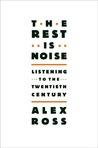
The Rest Is Noise: Listening to the Twentieth Century
"It reveals how the century's political and social cataclysms forged the sounds that still define our world."
- 1Understand music as a seismograph of political history. The book posits that the century's radical musical shifts—atonality, minimalism, avant-garde—are direct, often involuntary, responses to the pressures of totalitarianism, war, and social upheaval, not mere aesthetic choices.
- 2See the composer as a political actor, not an isolated genius. Figures like Shostakovich, Strauss, and Copland navigated perilous ideological landscapes, where artistic expression was a matter of state mandate, propaganda, or dangerous dissent, fundamentally shaping their creative output.
- 3Trace the underground lineage from classical to popular culture. It demonstrates how avant-garde techniques permeated jazz, film scores, and rock, arguing that the Velvet Underground or Hitchcock's soundtracks are unthinkable without the prior revolutions in the concert hall.
- 4Reject the narrative of classical music as a dying art. By framing composers as 'exuberantly of the present,' the work challenges the stereotype of irrelevance, showing a field perpetually reinventing itself in dialogue with a tumultuous world.
- 5Appreciate the struggle between aesthetic purity and public reception. The century-long tension between composer innovation and audience unease is presented not as a failure but as a central, defining drama of modern artistic endeavor.
Alex Ross's landmark work is not a conventional chronology of musical styles, but a profound cultural history that listens to the twentieth century through its most daring and disruptive sounds. It begins in the twilight of Vienna, where the lush romanticism of Mahler and Strauss first cracked under the weight of Freud and Schnitzler, giving birth to the unsettling atonal world of Schoenberg. Ross meticulously charts how this musical fracture mirrored the continent's political disintegration, setting the stage for an era where art would become a battleground for competing ideologies.
The narrative core follows music into the crucibles of totalitarianism, dissecting the fraught compromises of Richard Strauss in Nazi Germany and the harrowing, coded dissidence of Dmitri Shostakovich under Stalin. In parallel, it traces the exodus of genius to America, where figures like Stravinsky and Copland forged new identities, and where the optimistic patronage of the New Deal briefly created a sanctuary for sonic experiment. This geopolitical lens reveals composition as an act of survival, propaganda, or quiet resistance.
Ross then guides the reader through the postwar avant-garde frontiers—the radical serialism of Boulez, the chance operations of Cage, the electronic explorations of Stockhausen—situating them within the Cold War's technocratic anxieties and the consumer boom. The story culminates in the late-century pluralism of downtown New York and the minimalist revolt, where Reich and Glass forged a hypnotic, process-driven music that would bridge the gap to rock and pop.
Ultimately, 'The Rest Is Noise' reorients our understanding of modern culture. It argues that the century's difficult, glorious music is its essential soundtrack, a sensitive register of trauma, utopian hope, and relentless change. The book is indispensable for anyone seeking to comprehend not just the evolution of composition, but how the modern world felt, thought, and resonated.
The critical consensus celebrates Ross's rare synthesis of deep musical analysis and gripping historical narrative, rendering an ostensibly niche subject both accessible and thrilling. Readers consistently praise his ability to illuminate the fraught political contexts behind dissonant chords, making complex figures like Schoenberg or Stockhausen vividly human. A recurring critique notes the necessary compression of certain topics and a focus weighted toward the century's first half, leaving some wishing for a deeper dive into postmodern developments. The prose is widely admired for its clarity and novelistic flair, transforming academic material into a page-turner.
- 1The ethical compromises of artists like Richard Strauss under the Nazi regime, sparking debate on collaboration versus survival.
- 2The book's compelling portrayal of Shostakovich's coded dissent and personal torment under Soviet censorship.
- 3Discussions on whether Ross's narrative successfully demystifies atonal and avant-garde music for the general reader.
- 4Analysis of the American chapter, contrasting the creative freedom under the New Deal with the ideological constraints in Europe.
The Road to Financial Freedom
Bodo Schäfer

Permanent Record
Edward Snowden

The Almanack of Naval Ravikant
Naval Ravikant, Eric Jorgenson
The Essays of Warren Buffett: Lessons for Corporate America
Lawrence A. Cunningham, Warren Buffett
Out of Control
Kevin Kelly

Amusing Ourselves to Death: Public Discourse in the Age of Show Business
Neil Postman
The Psychology of Money: Timeless Lessons on Wealth, Greed, and Happiness
Morgan Housel
The Lessons of History
Will Durant
Bad Samaritans
Ha-Joon Chang

Chip War: The Quest to Dominate the World's Most Critical Technology
Chris Miller

The Intelligent Investor
Benjamin Graham
Radical Markets: Uprooting Capitalism and Democracy for a Just Society
Eric A. Posner, E. Glen Weyl