
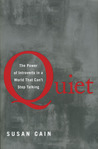
Quiet: The Power of Introverts in a World That Can't Stop Talking
"Reveals how society's extrovert bias stifles creativity and how introverted strengths drive profound innovation."
- 1Distinguish introversion from shyness or social anxiety. Introversion is a hardwired temperament characterized by a preference for less stimulating environments and deep internal processing, not a pathology or social deficit to be cured.
- 2Challenge the cultural dominance of the Extrovert Ideal. The 20th century's shift from a Culture of Character to a Culture of Personality devalued quiet contemplation, disproportionately rewarding gregariousness in schools, workplaces, and leadership.
- 3Recognize that solitude is a crucial catalyst for creativity. Breakthrough ideas and complex problem-solving often require uninterrupted, deep focus—a state frequently disrupted by the modern office's insistence on open-plan spaces and constant collaboration.
- 4Leverage introverted strengths in negotiation and leadership. Introverted leaders often excel through active listening, preparation, and empowering teams, while introverted negotiators gain advantage by asking probing questions and allowing strategic pauses.
- 5Practice strategic self-presentation as a 'pretend extrovert'. For core personal projects or profound passions, introverts can temporarily adopt extroverted traits, provided they schedule essential recovery time in solitude afterward to replenish energy.
- 6Cultivate environments that nurture introverted children. Protect a sensitive child's need for quiet and autonomy; validate their inner world rather than pushing them toward constant social performance, which can erode self-esteem.
Susan Cain's 'Quiet' mounts a formidable and necessary defense of the introverted temperament, arguing that a third to half of the population operates best in environments of lower stimulation. The book meticulously charts the historical rise of what Cain terms the 'Extrovert Ideal'—the pervasive cultural belief that the ideal self is gregarious, alpha, and comfortable in the spotlight. This ideal, she demonstrates, took root with the shift from an agrarian economy to a corporate, urban one, championed by figures like Dale Carnegie and enshrined in institutions from Harvard Business School to evangelical megachurches.
Cain grounds her cultural critique in robust psychology and neuroscience, explaining the biological underpinnings of introversion and extroversion. She explores concepts like high-reactive nervous systems and the role of neurotransmitters, establishing introversion not as a choice or a flaw, but as an innate orientation with distinct cognitive advantages. The narrative dismantles the assumption that collaboration and brainstorming are inherently superior, citing research that shows solitary work often yields more original ideas, and questions leadership models that prize charisma over competence, preparation, and deep thought.
Through a series of vivid case studies—from a brilliantly persuasive but solitude-craving public speaker to a soft-spoken, record-breaking salesman—Cain illustrates how introverts succeed by leveraging their innate strengths: listening, persistence, focused analysis, and a capacity for deep work. She examines the cultural tensions this creates, particularly for Asian-American students navigating a brash educational environment and for employees stifled by open-office plans.
Ultimately, 'Quiet' is both a manifesto and a practical guide. It calls for a radical reappraisal of how our schools, workplaces, and society are structured, advocating for a better balance between action and reflection, speaking and listening. The book empowers introverts to understand their own wiring, manage their energy, and claim their authority without betraying their true natures, while offering extroverts insight into the quiet power they may be overlooking.
The critical consensus celebrates the book as a validating and transformative manifesto for introverts, often described as life-changing. Readers deeply appreciate its research-backed authority and the profound relief of feeling seen. However, a significant contingent finds the central argument repetitive, stretched thin across excessive pages, and wishes for more actionable advice beyond the powerful initial diagnosis. The tone is occasionally critiqued as overly defensive or prone to broad generalizations about extroverts.
- 1The book's validation and 'aha moment' for lifelong introverts, who felt profoundly understood for the first time.
- 2Debates over the scientific rigor versus pop-psychology accessibility of the neurological and psychological studies cited.
- 3Criticism that the argument becomes repetitive, with the core thesis reiterated without sufficient deepening.
- 4Discussions on applying the book's principles to parenting sensitive or introverted children effectively.
- 5The practical utility of the 'pretend extrovert' strategy for managing workplace demands and social obligations.

Blueprints: How mathematics shapes creativity
Marcus du Sautoy

The Almanack of Naval Ravikant
Naval Ravikant, Eric Jorgenson
The Creative Habit
Twyla Tharp, Mark Reiter
Transformation in Christ
Dietrich Von Hildebrand

Out of Control
Kevin Kelly

The Crash Course
Chris Martenson

The Art of Contrarian Trading
Carl Futia

The Artist's Way
Julia Cameron

Code: The Hidden Language of Computer Hardware and Software
Charles Petzold
The Psychology of Money: Timeless Lessons on Wealth, Greed, and Happiness
Morgan Housel

Stumbling on Happiness
Daniel Gilbert

The Intelligent Investor
Benjamin Graham