
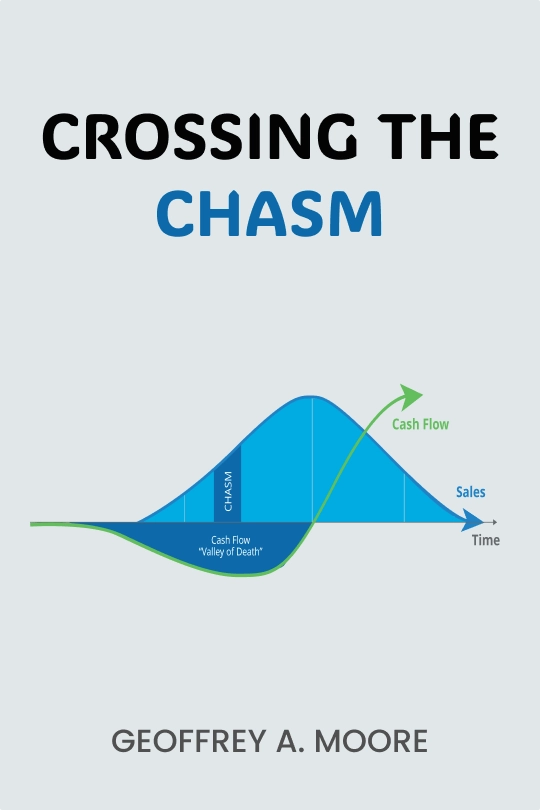
Crossing the Chasm: Marketing and Selling High-Tech Products to Mainstream Customers
"It provides the definitive strategy for moving disruptive innovations from early adopters into the lucrative mainstream market."
Nook Talks
- 1[object Object]
- 2[object Object]
- 3[object Object]
- 4[object Object]
- 5[object Object]
Geoffrey A. Moore’s seminal work dismantles the comforting illusion of a smooth continuum in high-tech product adoption. It introduces the now-ubiquitous Technology Adoption Lifecycle, a model that segments customers into psychographic groups: Innovators, Early Adopters, Early Majority, Late Majority, and Laggards. The central, perilous insight is that a profound disconnect exists between the visionary Early Adopters and the pragmatic Early Majority—a gap Moore famously terms "the chasm."
This chasm represents a strategic crisis point where countless promising innovations fail. Early Advisors are thrill-seekers who embrace technology for its own sake and tolerate imperfections in pursuit of a competitive edge. The Early Majority, however, are pragmatists who seek incremental improvement, reliability, and the safety of peer references. The book’s core argument is that marketing which captivates the former will actively repel the latter. To cross, a company must execute a radical pivot: abandon broad-based messaging and concentrate all forces on dominating a single, tightly-defined niche market—the "beachhead."
The methodology for this conquest is meticulously detailed. It involves creating a "whole product"—a complete, turnkey solution tailored to the beachhead’s specific problem—and crafting a compelling competition-based positioning. The strategy is fundamentally about using a focused victory to generate the case studies and testimonials that serve as the only credible currency for appealing to the mainstream. Moore provides a concrete tactical plan, from defining the battle to launching the invasion, transforming an abstract concept into an operational playbook.
More than a marketing manual, Crossing the Chasm is a treatise on market development strategy for disruptive technologies. Its enduring legacy lies in providing a diagnostic framework for why high-growth startups stall and a prescriptive roadmap for reigniting that growth. It is essential reading for entrepreneurs, product managers, and investors operating in any sector where innovation must find a scalable market, making it a permanent fixture in the canon of business literature.
The consensus elevates this book to canonical status, treating it as the indispensable playbook for technology commercialization. Readers, often seasoned professionals, describe it as a revelation that reframes fundamental market assumptions, providing a clear diagnostic for stalled growth and a pragmatic battle plan. Criticisms are rare but note the primary examples can feel dated; however, the core framework is universally praised for its timeless, strategic clarity. It is deemed not just informative but transformative for anyone tasked with moving an innovation beyond its initial enthusiast base.
- 1The transformative personal impact of the book's framework on professional marketing understanding and strategy.
- 2Practical application of the 'beachhead' strategy and the 'whole product' concept in real-world business scenarios.
- 3The enduring relevance of the core chasm concept versus the datedness of specific technology examples in later editions.

The Intelligent Investor
Benjamin Graham

The Road to Financial Freedom
Bodo Schäfer

Sapiens: A Brief History of Humankind
Yuval Noah Harari

Breakthrough: The Quest for Life-Changing Medicines
Dr William Pao

The Psychology of Money: Timeless Lessons on Wealth, Greed, and Happiness
Morgan Housel

Chip War: The Quest to Dominate the World's Most Critical Technology
Chris Miller

Code: The Hidden Language of Computer Hardware and Software
Charles Petzold

Breath: The New Science of a Lost Art
James Nestor
The Crash Course
Chris Martenson

Vacuum Diagrams (Xeelee Sequence, #5)
Stephen Baxter

The Artist's Way
Julia Cameron
The Creative Habit
Twyla Tharp, Mark Reiter