
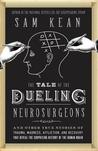
The Tale of the Dueling Neurosurgeons: The History of the Human Brain as Revealed by True Stories of Trauma, Madness, and Recovery
"The brain's deepest secrets were unlocked not in labs, but through the extraordinary lives of its most damaged survivors."
- 1Understand the brain through its catastrophic failures. Modern neuroscience was built on the careful observation of patients with severe brain injuries. These tragic cases provided a natural map, revealing how specific regions govern memory, personality, and perception.
- 2Recognize the profound link between brain structure and identity. A lesion in a precise location can dismantle a person's core self, erasing memories, altering moral character, or distorting reality. The physical organ is the undeniable seat of consciousness and personality.
- 3Appreciate the human stories behind scientific progress. Landmark discoveries often hinge on the resilience of unique individuals—patients and doctors alike. Their personal struggles and collaborations provided the raw material for our understanding of the mind.
- 4Trace the evolution from crude speculation to precise imaging. The journey from phrenology to fMRI is a history of methodological revolution. Each advance, from studying trauma to developing non-invasive scanners, offered a clearer window into the living brain.
- 5Maintain humility in the face of the brain's complexity. Despite centuries of study, the brain remains a frontier. Current models are provisional, destined to be refined or overturned by future discoveries about this intricate, three-pound universe.
Sam Kean’s The Tale of the Dueling Neurosurgeons reconstructs the sprawling, often gory, history of neuroscience through a series of pivotal human dramas. It posits that our map of the mind was not drawn in sterile laboratories but in the aftermath of personal catastrophe—through strokes, seizures, lobotomies, and horrific accidents that selectively dismantled brain function. These stories of trauma and survival became nature’s own experiments, offering early scientists a crude but powerful lens onto the organ’s secret geography.
Kean organizes this history thematically, guiding the reader from foundational discoveries about brain localization to the intricate systems governing memory, language, and emotion. We encounter the famous case of Phineas Gage, whose personality transformed after an iron rod pierced his frontal lobe, and delve into the poignant world of Henry Molaison (patient H.M.), whose inability to form new memories illuminated the mechanics of memory consolidation. Each chapter uses a central case study as a narrative anchor, explaining the scientific principles revealed and the researchers who interpreted them, from Broca and Penfield to more contemporary figures.
The narrative is as much about the flawed, brilliant, and sometimes dueling scientists as it is about their patients. It captures the field’s evolution from mere speculation to a sophisticated science, highlighting how technological leaps—from early anatomy to modern imaging—changed the questions we could ask. Kean deftly explains complex concepts like neuroplasticity, synaptic pruning, and the split-brain experiments with clarity and narrative flair, never losing sight of the human cost and resilience at the heart of each discovery.
This book serves as both an accessible primer and a compelling humanistic chronicle. It is targeted at the curious general reader who seeks to understand not just how the brain works, but how we came to know what we know. By framing neuroscience within unforgettable true stories, Kean ensures that the science feels immediate, visceral, and deeply connected to the enduring mystery of human identity.
The consensus praises Kean's exceptional ability to render complex neuroscience into engaging, narrative-driven science writing. Readers consistently highlight the book's accessibility and warm, witty tone, which makes a dense subject feel like a collection of fascinating historical anecdotes. Criticisms are mild, focusing occasionally on a desire for more rigorous chronological structure or deeper scientific detail, but most agree it succeeds perfectly as a primer for the casually curious. The overwhelming sentiment is one of delighted enlightenment.
- 1The book's balance between accessible, humorous storytelling and substantive scientific explanation, which some found perfect and others wished was more rigorous.
- 2Discussions comparing this work to Kean's earlier book, *The Disappearing Spoon*, and debates about which succeeds better in popularizing its respective scientific field.
- 3The ethical dimensions of building a science upon the tragedies of brain-damaged patients, and the human stories behind the clinical cases.
- 4Readers sharing personal follow-up interests, specifically in reading more about patient H.M. (Henry Molaison) and Clive Wearing, prompted by Kean's coverage.
The Lessons of History
Will Durant
The Almanack of Naval Ravikant
Naval Ravikant, Eric Jorgenson

Transformation in Christ
Dietrich Von Hildebrand

Bad Samaritans
Ha-Joon Chang
Breath: The New Science of a Lost Art
James Nestor
The Book of Basketball: The NBA According to The Sports Guy
Bill Simmons

The Intelligent Investor
Benjamin Graham
Outliers: The Story of Success
Malcolm Gladwell
The Creative Habit
Twyla Tharp, Mark Reiter

Code: The Hidden Language of Computer Hardware and Software
Charles Petzold

Chip War: The Quest to Dominate the World's Most Critical Technology
Chris Miller
The Psychology of Money: Timeless Lessons on Wealth, Greed, and Happiness
Morgan Housel