
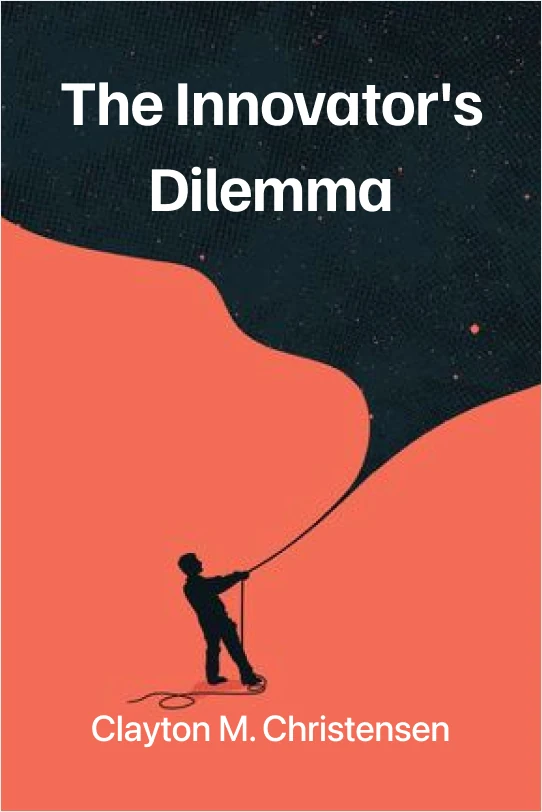
The Innovator's Dilemma: The Revolutionary Book that Will Change the Way You Do Business
"Established companies fail by perfecting their products for existing customers, leaving them vulnerable to disruptive technologies from below."
Nook Talks
- 1[object Object]
- 2[object Object]
- 3[object Object]
- 4[object Object]
- 5[object Object]
- 6[object Object]
Clayton Christensen’s seminal work, The Innovator’s Dilemma, dismantles the comforting myth that well-managed companies fail because they become bureaucratic or risk-averse. Instead, he presents the paradoxical thesis that they fail precisely because they excel at the practices taught in every business school: listening to customers, investing in higher-margin products, and pursuing aggressive, sustaining innovation. The book introduces the critical distinction between sustaining technologies, which improve existing product performance for mainstream customers, and disruptive technologies, which initially underperform on key metrics but offer new attributes like simplicity, convenience, or lower cost.
Christensen builds his case through a series of compelling historical analyses, from the disk drive and excavator industries to steel manufacturing. He demonstrates how leading firms, following rational profit-maximizing logic, consistently cede emerging markets to disruptive entrants. These disruptors begin at the bottom of the market, serving overlooked customers or creating entirely new consumption contexts. As the disruptive technology matures, its performance eventually meets the needs of the mainstream, at which point the incumbent’s established customer base, cost structure, and organizational processes render it incapable of responding effectively.
The book’s framework identifies five principles of disruptive innovation: that companies depend on customers and investors for resources; that small markets cannot solve the growth needs of large firms; that markets that do not exist cannot be analyzed; that an organization’s capabilities reside more in its processes and values than in its resources; and that technology supply may not equal market demand. Christensen argues that the very management discipline that drives success in stable environments becomes a lethal disability when facing disruption.
The Innovator’s Dilemma transcends its business school origins to offer a profound theory of competitive response and organizational inertia. Its legacy is a foundational lens for understanding technological change, corporate strategy, and the vulnerabilities of success. The book is essential reading not only for executives and entrepreneurs but for anyone seeking to understand why industry leaders are often the last to see the wave that will eventually engulf them.
The critical consensus venerates the book's core theoretical framework as genuinely revolutionary and enduringly relevant, a masterpiece of business analysis that explains a pervasive pattern of industrial failure. Readers consistently praise its historical case studies and the powerful, clarifying lens of 'disruptive innovation.' However, a significant contingent finds the proposed solutions—primarily spinning out autonomous organizations—less convincing and underdeveloped compared to the diagnostic brilliance of the dilemma itself. The prose is acknowledged as dense, academic, and demanding, placing it firmly in the realm of serious strategy rather than accessible pop-business.
- 1The enduring relevance and predictive power of the disruptive innovation framework decades after publication.
- 2The perceived weakness of the book's solutions compared to the strength of its problem diagnosis.
- 3Apple's business model as a potential counter-example or evolution of Christensen's thesis.
- 4The academic, dense prose style that makes for challenging but rewarding reading.
- 5The book's profound influence on major tech leaders and corporate strategy.
No Rules Rules: Netflix and the Culture of Reinvention
Reed Hastings, Erin Meyer
The Norwegian Method
Brad Culp
The Creative Habit
Twyla Tharp, Mark Reiter
Chip War: The Quest to Dominate the World's Most Critical Technology
Chris Miller

The Psychology of Money: Timeless Lessons on Wealth, Greed, and Happiness
Morgan Housel
The Crash Course
Chris Martenson

Just Listen: Discover the Secret to Getting Through to Absolutely Anyone
Mark Goulston

The Artist's Way
Julia Cameron

How to Win Friends & Influence People
Dale Carnegie

Code: The Hidden Language of Computer Hardware and Software
Charles Petzold
Transformation in Christ
Dietrich Von Hildebrand

Breakthrough: The Quest for Life-Changing Medicines
Dr William Pao