
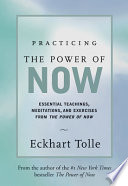
Practicing the Power of Now: Essential Teachings, Meditations, and Exercises from the Power of Now
"Liberate yourself from mental suffering by dissolving identification with the thinking mind and anchoring consciousness in the present moment."
- 1Disidentify from the incessant voice in your head. The egoic mind is a source of chronic anxiety and dissatisfaction. Recognizing yourself as the awareness behind your thoughts is the first step toward inner freedom and peace.
- 2Accept the present moment completely as it is. Resistance to 'what is' creates psychological pain and stress. True power lies not in changing circumstances, but in surrendering to the reality of the Now without judgment.
- 3Observe your emotions as a detached witness. Emotions are conditioned reactions of the mind-body. By watching them without being consumed, you break their hold and prevent them from fueling further negative thought patterns.
- 4Access a deeper consciousness through inner-body awareness. Focusing attention on the subtle energy field within your body provides an anchor to the present, quieting the mind and connecting you to a dimension beyond form and thought.
- 5Transform ordinary activities into portals of presence. Daily routines like walking or washing dishes can become profound meditations. Performing them with total attention imbues them with a sense of stillness and sacredness.
- 6Understand that the past and future are mental constructs. Psychological time is an illusion that perpetuates suffering. All problems are created by the mind dwelling on a remembered past or an imagined future, never in the actual Now.
Eckhart Tolle's "Practicing the Power of Now" distills the core teachings of his seminal work into a practical manual for spiritual awakening. It addresses the fundamental human condition of being trapped in the mind's relentless narrative—a state of identification with thought that generates a continuous undercurrent of anxiety, regret, and projection. The book posits that this mental noise creates a false self, the ego, which thrives on conflict and time, obscuring our true nature as timeless, conscious presence.
Tolle systematically deconstructs the illusion of psychological time, arguing that the past is merely a memory trace and the future an anticipation, both occurring in the present moment of thought. He introduces the critical practice of becoming the "watcher" of one's mind, observing thoughts and emotions without judgment to create a space of inner stillness. This shift from content to consciousness is the essence of enlightenment, accessible not through accumulation of knowledge but through a profound inner realization.
The text provides concrete exercises and meditations to cultivate this state, such as focusing on the inner energy field of the body or surrendering to the "isness" of the present moment, even in difficult situations. It guides the reader to transform mundane activities into portals of presence, thereby dissolving the habitual resistance that causes stress and unhappiness. Tolle emphasizes that the Now is the only point of access to a deeper intelligence and the true source of joy, creativity, and solutions to life's challenges.
This work serves as both an entry point for new seekers and a vital toolkit for those familiar with Tolle's philosophy, aiming to translate intellectual understanding into lived experience. Its significance lies in offering a direct path out of mental suffering, appealing to anyone weary of the ego's dramas and seeking a grounded, transformative spirituality free from dogma.
The consensus views this volume as a potent but challenging practical companion. Readers deeply value its distillation of core concepts into actionable exercises and its quotable, mantra-like prose, which many return to for recentering. However, a significant portion finds the repetitive, abstract nature of the teachings difficult to grasp or apply consistently, leading to frustration. It is widely seen as most effective when consumed in small, reflective doses rather than as a linear read.
- 1The practical utility of the exercises versus the abstract, repetitive nature of the core philosophical concepts.
- 2Whether the book succeeds as a standalone guide or requires prior familiarity with Tolle's 'The Power of Now'.
- 3The effectiveness of the 'observer' technique for managing anxiety and breaking cycles of overthinking.
Just Listen: Discover the Secret to Getting Through to Absolutely Anyone
Mark Goulston
Boom: Bubbles and the End of Stagnation
Byrne Hobart
Blueprints: How mathematics shapes creativity
Marcus du Sautoy
The Creative Habit
Twyla Tharp, Mark Reiter

Code: The Hidden Language of Computer Hardware and Software
Charles Petzold
Bad Samaritans
Ha-Joon Chang
Transformation in Christ
Dietrich Von Hildebrand
The Crash Course
Chris Martenson
Out of Control
Kevin Kelly
The Essays of Warren Buffett: Lessons for Corporate America
Lawrence A. Cunningham, Warren Buffett
Breath: The New Science of a Lost Art
James Nestor
The Art of Contrarian Trading
Carl Futia