
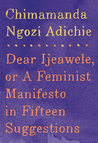
Dear Ijeawele, or a Feminist Manifesto in Fifteen Suggestions
"A blueprint for raising a daughter to reject societal constraints and claim her full, uncompromised humanity."
- 1Reject 'Feminism Lite' and conditional equality. True feminism is absolute, not a concession. The idea that a man 'allows' a woman to work or have ambition is a patriarchal bargain, not liberation. Equality must be the baseline, not a privilege granted.
- 2Teach her that 'because you are a girl' is never a reason. This phrase is the root of gendered limitation. It teaches girls to accept arbitrary constraints on their behavior, interests, and ambitions. Undermining this logic is foundational to fostering critical thought and self-determination.
- 3Separate likeability from integrity and selfhood. A woman's primary job is not to be pleasing. Prioritizing likeability often demands the suppression of one's authentic self, opinions, and ambitions. Teach her to value honesty and self-respect over universal approval.
- 4Debunk the myth of biological determinism in domestic roles. The association of women with cooking and care is social, not biological. Challenging this at home normalizes shared responsibility. It frees daughters from predetermined scripts and sons from emotional incompetence.
- 5Criticize traits in women and men with equal rigor. Disparate criticism reveals a bias against women, not the trait itself. Applying one standard to men and another, harsher standard to women perpetuates a double bind that limits female expression and power.
- 6Normalize difference and reject universalizing personal experience. True humility lies in recognizing that one's own standards and life are not the default for humanity. This fosters empathy, counters prejudice, and creates space for diverse ways of being in the world.
Chimamanda Ngozi Adichie’s 'Dear Ijeawele' transforms a personal letter into a public manifesto, distilling the expansive philosophy of feminism into fifteen direct, actionable principles for raising a daughter. The book emerges from a simple, profound question posed by a childhood friend: How does one raise a girl to be a feminist? Adichie’s response rejects abstract theory in favor of grounded, daily practice, framing feminism not as a distant ideology but as a lens for navigating the world from infancy.
Adichie structures her argument around the dismantling of pervasive social conditioning. She begins with the foundational act of language, urging the rejection of the phrase “because you are a girl” as justification for any limitation. The suggestions then systematically address spheres of life where gender roles are enforced: from toys and clothing to marriage and career. A central target is what Adichie terms “Feminism Lite”—the hollow, conditional version of equality where men are framed as benevolent gatekeepers “allowing” women rights, thereby preserving the core of patriarchal authority.
The manifesto is equally concerned with internal psychology as with external injustice. Adichie advises teaching a girl to prize her authentic self over being “likeable,” to understand that she is a subject, not an object for approval. She argues for the importance of reading, of financial independence, and of seeing marriage as a joyful partnership of equals, not an achievement. Crucially, the suggestions are framed for a daughter but are implicitly instructions for reshaping the world she will inhabit, calling on parents to model equality in their own relationships.
'Dear Ijeawele' is a work of pragmatic philosophy, a guide that is both intimate and universal. Its significance lies in its accessibility and clarity, offering a concrete entry point into feminist thought for parents, educators, and anyone questioning ingrained gender norms. It asserts that raising a feminist is an act of continuous, conscious rebellion against a sexist world, and provides the tools to begin that work from the nursery onward.
The critical consensus celebrates the book as a potent, accessible distillation of feminist philosophy into indispensable daily practice. Readers are universally captivated by Adichie’s eloquent clarity and the practical wisdom of her fifteen suggestions, finding them both intellectually rigorous and immediately applicable. The primary critique, though minor, is that its concise, epistolary format feels more like an expanded essay than a fully developed book, leaving some desiring more depth or case studies. It is overwhelmingly hailed as an essential primer, a gift for new parents, and a clarifying read for anyone seeking a foundational understanding of modern feminism.
- 1The power and necessity of rejecting the phrase 'because you are a girl' as a foundational feminist act.
- 2Debates over 'Feminism Lite' and the danger of conditional male approval masquerading as equality.
- 3The imperative to teach girls to prioritize authenticity and self-respect over being 'likeable'.
- 4Appreciation for the book's concise, letter format versus desires for a more expansive, detailed treatment.

The Intelligent Investor
Benjamin Graham

Transformation in Christ
Dietrich Von Hildebrand

Bad Samaritans
Ha-Joon Chang

The Psychology of Money: Timeless Lessons on Wealth, Greed, and Happiness
Morgan Housel

The Essays of Warren Buffett: Lessons for Corporate America
Lawrence A. Cunningham, Warren Buffett

Permanent Record
Edward Snowden

The Road to Financial Freedom
Bodo Schäfer

Chip War: The Quest to Dominate the World's Most Critical Technology
Chris Miller

Radical Markets: Uprooting Capitalism and Democracy for a Just Society
Eric A. Posner, E. Glen Weyl

Just Listen: Discover the Secret to Getting Through to Absolutely Anyone
Mark Goulston

The Art of Contrarian Trading
Carl Futia

Amusing Ourselves to Death: Public Discourse in the Age of Show Business
Neil Postman