
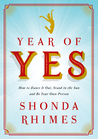
Year of Yes: How to Dance It Out, Stand In the Sun and Be Your Own Person
"A transformative manifesto for the over-committed and under-connected, proving that courage is a habit built one affirmative choice at a time."
- 1Cultivate courage as a daily, actionable practice. Rhimes reframes courage not as an innate trait but as a muscle built through consistent, small acts of saying 'yes' to discomfort, thereby dismantling the paralysis of fear and perfectionism.
- 2Define your own personhood outside of professional success. The memoir argues that identity built solely on work is a fragile construct; true fulfillment requires consciously claiming space in personal, familial, and social spheres with equal authority.
- 3Embrace the liberating power of radical honesty. By committing to speak difficult truths—to others and to herself—Rhimes demonstrates how authenticity dissolves resentment and forges more genuine, sustainable relationships.
- 4Reject the glorification of busyness and isolation. The narrative exposes the 'no' of overwork and introversion as a shield that ultimately breeds loneliness, advocating for intentional engagement as the antidote to a hollow life.
- 5Prioritize self-care as a non-negotiable foundation. Rhimes details how saying 'yes' to herself—through health, boundaries, and joy—was the prerequisite that made all other affirmative choices sustainable and meaningful.
In Year of Yes, Shonda Rhimes, the prolific showrunner behind cultural touchstones like Grey’s Anatomy and Scandal, turns her incisive storytelling lens inward. The book chronicles a pivotal, self-imposed experiment born from a casual yet devastating critique from her sister: for one year, Rhimes would consciously say 'yes' to every opportunity that frightened her. This premise unfolds not as a simplistic self-help gimmick, but as a profound interrogation of the armor built by success, the isolating nature of introversion, and the quiet misery of a life lived in avoidance.
Rhimes structures her journey around a series of challenging commitments: saying yes to public speaking, to play, to difficult conversations, and most crucially, to herself. She dissects the anatomy of her fears with the same precision she applies to a plot twist, revealing how a fortress of professional achievement had walled her off from authentic human connection and personal joy. The narrative moves beyond mere social acceptance, delving into the harder 'yesses' of setting boundaries, ending toxic relationships, and prioritizing physical health, framing self-care as the ultimate act of courage.
What emerges is a textured portrait of reinvention. Rhimes details the visceral anxiety of stepping onto a stage, the liberation of dancing without inhibition, and the seismic shift in her identity as a mother, friend, and leader. The book operates on two levels: as a candid memoir of a singular year and as a treatise on the mechanics of behavioral change, arguing that action precedes feeling, and that confidence is forged in the doing.
Year of Yes transcends the celebrity memoir genre to offer a universally resonant blueprint for intentional living. Its primary audience is anyone who feels trapped by their own success, habits, or fears—the overworked, the people-pleasers, the hesitant. Rhimes’s legacy here is not her television empire, but her demonstration that the most powerful story we can write is the one where we choose to show up as the protagonist of our own lives.
The critical consensus celebrates the book's raw relatability and transformative message, particularly resonating with introverts and high-achievers who recognize their own fears in Rhimes's candid anxiety. Readers are profoundly moved by her vulnerability on motherhood, self-doubt, and the struggle to claim joy. Some critique the structure as occasionally repetitive or note that the celebrity anecdotes can feel distant, but these are minor quibbles against the overwhelming sentiment that the core thesis is empowering and authentically delivered.
- 1The profound relatability of Rhimes's social anxiety and introversion, which readers found validating and deeply personal.
- 2Debates on the book's structure, with some finding the conversational, episodic style engaging and others desiring a more linear narrative.
- 3The impact of her candid confessions about the difficulties and guilt of motherhood, which sparked significant discussion and empathy.
- 4Discussions on the applicability of the 'Year of Yes' concept beyond a celebrity's privileged life, weighing its universal message against specific circumstances.
Just Listen: Discover the Secret to Getting Through to Absolutely Anyone
Mark Goulston

The Road to Financial Freedom
Bodo Schäfer
How to Win Friends & Influence People
Dale Carnegie

Code: The Hidden Language of Computer Hardware and Software
Charles Petzold
Transformation in Christ
Dietrich Von Hildebrand

Bad Samaritans
Ha-Joon Chang

Out of Control
Kevin Kelly
Breath: The New Science of a Lost Art
James Nestor

Sapiens: A Brief History of Humankind
Yuval Noah Harari

The Intelligent Investor
Benjamin Graham
The Book of Basketball: The NBA According to The Sports Guy
Bill Simmons
Breakthrough: The Quest for Life-Changing Medicines
Dr William Pao