
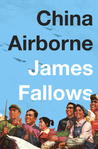
China Airborne
"China's audacious aerospace ambition is the definitive test case for its transformation from imitator to global innovator."
- 1View aerospace as a national crucible for systemic innovation. The aviation industry serves as a concentrated laboratory where China's capacity for original engineering, safety culture, and complex systems integration faces its most public and consequential trial.
- 2Understand the profound tension between state control and entrepreneurial energy. The central paradox of modern China lies in its attempt to harness bottom-up market dynamism within a rigid top-down political framework, a conflict vividly illustrated in its aviation development.
- 3Recognize aviation infrastructure as a driver of hyper-urbanization. The construction of hundreds of new airports is not merely about transportation; it actively reshapes economic geography, accelerating the shift of population and capital into interior megacities.
- 4Decouple technological acquisition from indigenous innovation capability. Purchasing foreign companies like Cirrus provides immediate technology, but true aerospace supremacy requires cultivating a deep, self-sustaining culture of research, design, and safety protocol from the ground up.
- 5Analyze China's ambition through the lens of historical analogy. The scale and potential impact of China's aviation push mirrors transformative national projects like America's transcontinental railroad, promising to redefine internal connectivity and global economic standing.
James Fallows uses China's monumental push into aerospace as the central narrative to dissect the nation's broader struggle for modernization. More than a business story, it is an account of a civilization-scale attempt to leap from being the world's factory to becoming its premier innovator, using the technically unforgiving, safety-critical domain of aviation as its proving ground. The book frames this ambition not as a niche industrial policy, but as a catalytic project poised to accelerate China's hyper-growth and hyper-urbanization, reshaping its economic geography as profoundly as 19th-century railroads reshaped the United States.
Fallows grounds this macro-ambition in the granular reality of China's contemporary aviation landscape. He documents the chaotic, often perilous state of general aviation, where private pilots navigate a labyrinth of bureaucratic restrictions, unreliable infrastructure, and airspace dominated by the military. This stark baseline highlights the audacity of the national goal: to build a world-class industry from a foundation of systemic disorder. The narrative is populated by the engineers in Xi'an's aerospace city, Western executives navigating joint ventures, and visionary—sometimes dubious—entrepreneurs seeking to ride the wave of state investment.
The analysis extends beyond manufacturing to encompass the entire ecosystem: the scramble to train tens of thousands of new pilots and mechanics, the geopolitical maneuvering behind aircraft purchases, and the social implications of connecting remote regions via air. Fallows examines the inherent tension in China's model, asking whether true innovation can be bureaucratically mandated or if it requires the creative chaos of a more open society. He details the strategic acquisitions of American firms like Cirrus, probing whether this represents a shortcut to technology or the seed of genuine, organic capability.
Ultimately, China Airborne positions the aerospace endeavor as the definitive test case for China's developmental model. It is a work of diagnostic journalism that asks whether a state-capitalist system can master the complex, iterative, and safety-obsessed culture required for global aerospace leadership. The book's significance lies in its method: using a single, high-stakes industry to illuminate the promises, contradictions, and global implications of China's rise, offering a crucial framework for understanding what this ascent means for international competition, technological sovereignty, and the future of innovation.
Readers value the book's unique, aviation-focused lens as a revealing portal into China's developmental mechanics, praising Fallows's accessible synthesis of technical detail and geopolitical analysis. The central critique hinges on a perceived lack of definitive conclusion; some find the diagnostic approach intellectually honest, while others desire a more prescriptive or predictive stance on China's ultimate success or failure. The prose is consistently lauded for its clarity and narrative drive, transforming a complex industrial topic into a compelling story of national ambition.
- 1The feasibility of China achieving true aerospace innovation versus remaining a skilled assembler of foreign technology.
- 2The inherent dangers and systemic chaos within China's current general aviation and air traffic control infrastructure.
- 3The geopolitical implications of China's aerospace rise for Boeing, Airbus, and Western technological dominance.
- 4The role of state planning versus market forces in driving complex, safety-critical technological advancement.
The Crash Course
Chris Martenson

The Psychology of Money: Timeless Lessons on Wealth, Greed, and Happiness
Morgan Housel

Breakthrough: The Quest for Life-Changing Medicines
Dr William Pao

Stumbling on Happiness
Daniel Gilbert

Vacuum Diagrams (Xeelee Sequence, #5)
Stephen Baxter

Just Listen: Discover the Secret to Getting Through to Absolutely Anyone
Mark Goulston

The Art of Contrarian Trading
Carl Futia

Permanent Record
Edward Snowden

Sapiens: A Brief History of Humankind
Yuval Noah Harari

The Intelligent Investor
Benjamin Graham

Out of Control
Kevin Kelly

Code: The Hidden Language of Computer Hardware and Software
Charles Petzold