
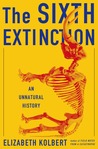
The Sixth Extinction: An Unnatural History
"A masterful chronicle of humanity's role as the planet's new catastrophic force, rewriting the very definition of a species."
- 1Humans are the primary driver of the current mass extinction. Unlike past extinctions from asteroids or volcanism, the sixth is anthropogenic, propelled by habitat destruction, climate change, species translocation, and ocean acidification—all direct consequences of human activity.
- 2Extinction is a process, not a single event. Kolbert traces the slow-motion collapse of ecosystems, from bat colonies decimated by fungus to coral reefs bleaching, demonstrating how cumulative, interconnected stresses lead to irreversible loss.
- 3Understand extinction as a concept with a history. The book explores how the very idea of extinction was radical when proposed, challenging the notion of a fixed, divinely created natural order and paving the way for evolutionary theory.
- 4Witness the profound interconnectedness of global systems. Actions in one hemisphere—carbon emissions, invasive species transport—cascade into consequences worldwide, proving that no ecosystem is an isolated ark in the Anthropocene.
- 5Confront the ethical paradox of human exceptionalism. Our unique intelligence and mobility, the traits that allowed *Homo sapiens* to dominate, are the same forces now eroding planetary biodiversity, forcing a reckoning with our legacy.
- 6Recognize conservation as a complex, tragic endeavor. Efforts to save species often involve desperate, Frankensteinian measures—frozen zoos, assisted migration—highlighting the profound intervention now required to mitigate a crisis of our own making.
Elizabeth Kolbert’s The Sixth Extinction constructs a gripping, panoramic narrative of life and loss on a planetary scale. It begins not with a distant asteroid, but with a present-day fungus wiping out bat populations in New York, establishing the book’s central, unsettling premise: we are living through a mass extinction event, and the agent of destruction is Homo sapiens. Kolbert grounds this colossal claim in the deep history of paleontology, revisiting the five previous cataclysms that reshaped life on Earth, while meticulously documenting the unfolding sixth across continents and oceans.
Through a series of vivid field reports, Kolbert becomes our guide to the front lines of ecological collapse. She descends with scientists into a warming, acidifying ocean to witness the bleaching of the Great Barrier Reef, tracks the frantic translocation of species like the golden frog in Panama, and examines the bones of great auks and mastodons—casualties of past human expansion. Each chapter focuses on a different extinction driver, from ocean acidification and deforestation to invasive species and climate change, weaving discrete tragedies into a coherent, damning pattern. The methodology is interdisciplinary, merging geology, chemistry, biology, and anthropology to trace the fingerprints of human influence.
The book also performs crucial intellectual archaeology, exploring how the concept of extinction itself emerged in the scientific imagination. Figures like Georges Cuvier, who first posited that species could disappear, and Charles Darwin, who grappled with the grim mechanics of natural selection, provide a historical framework for understanding our current crisis. This context elevates the narrative from a catalog of loss to a story about how humans learned to see—and now must confront—their own catastrophic power.
Ultimately, The Sixth Extinction is more than an ecological audit; it is a profound inquiry into what it means to be human in an age we dominate. It argues that our capacity for global alteration is our species’ most defining and dangerous trait, a legacy that will persist in the fossil record long after our cities have crumbled. The book is essential reading for anyone seeking to comprehend the magnitude of the Anthropocene, written with the narrative force of a thriller and the sober authority of a scientific treatise.
The critical consensus celebrates Kolbert’s exceptional synthesis of complex science into a compelling, accessible, and deeply human narrative. Readers are unanimously gripped by her immersive, first-person reportage, which makes abstract ecological crises visceral and immediate. The primary critique, echoed even by admirers, is the profound emotional weight of the subject matter—the relentless parade of loss can feel overwhelming. Nonetheless, the book is hailed as a seminal, essential work that successfully marries literary elegance with urgent scientific literacy, leaving an indelible mark on its audience.
- 1The emotional impact of the book's relentless, depressing subject matter versus its essential educational value.
- 2Praise for Kolbert's engaging, narrative-driven style that makes complex scientific concepts accessible and compelling.
- 3Discussions on human culpability and the ethical paradox of our intelligence being the cause of planetary crisis.
- 4Debate over the feasibility and morality of technological interventions like assisted migration and frozen zoos.

Amusing Ourselves to Death: Public Discourse in the Age of Show Business
Neil Postman

The Intelligent Investor
Benjamin Graham

The Essays of Warren Buffett: Lessons for Corporate America
Lawrence A. Cunningham, Warren Buffett
Transformation in Christ
Dietrich Von Hildebrand
Breath: The New Science of a Lost Art
James Nestor

The Psychology of Money: Timeless Lessons on Wealth, Greed, and Happiness
Morgan Housel

Code: The Hidden Language of Computer Hardware and Software
Charles Petzold
The Crash Course
Chris Martenson

Outliers: The Story of Success
Malcolm Gladwell

Chip War: The Quest to Dominate the World's Most Critical Technology
Chris Miller
Radical Markets: Uprooting Capitalism and Democracy for a Just Society
Eric A. Posner, E. Glen Weyl

The Road to Financial Freedom
Bodo Schäfer