

The Wisdom of Crowds
"Harnessing the collective intelligence of diverse, independent groups yields superior decisions to any single expert."
- 1Crowds outperform experts under specific conditions. A group's collective judgment surpasses that of even the most brilliant individual, but only when the group is structured correctly. This is not a mystical phenomenon but a function of statistical aggregation and error cancellation.
- 2Diversity of opinion is the foundational requirement. A wise crowd must be composed of individuals with different information, perspectives, and cognitive styles. Homogeneity leads to groupthink and eliminates the very advantage of collective intelligence.
- 3Ensure independence within the group's members. Individuals must form their judgments without being unduly influenced by others. Social pressure and cascades of imitation corrupt the aggregation process, leading to herd behavior and poor outcomes.
- 4Decentralization allows for local knowledge to flourish. Effective crowd wisdom relies on people using their private, specialized information. Centralized command structures often stifle this local expertise, preventing it from contributing to the collective solution.
- 5A reliable method for aggregating opinions is essential. Diverse, independent judgments are useless without a mechanism—like a market price, a vote, or an averaging algorithm—to synthesize them into a single, coherent collective verdict.
- 6Recognize the pathologies that make crowds foolish. Crowds fail spectacularly through coordination problems, information cascades, and emotional contagion. Understanding these failure modes is as critical as knowing the principles for success.
James Surowiecki's The Wisdom of Crowds dismantles a deep-seated cultural assumption: that expertise is the sole province of brilliant individuals or small, elite committees. The book's central, counterintuitive thesis posits that under the right conditions, a large, diverse collection of independent people will consistently make better predictions and decisions than any single expert, no matter how knowledgeable. This is not a claim about mob psychology or the "average" opinion, but a demonstrable statistical reality with profound implications for business, politics, science, and everyday life.
Surowiecki builds his case through a captivating tour of empirical evidence and historical anecdotes. He recounts the famous 1906 county fair experiment where the average guess of a crowd about an ox's weight was nearly perfect, and examines the efficiency of prediction markets and the open-source development of Linux. The narrative then rigorously explores the necessary conditions for collective intelligence to emerge: diversity of opinion, independence of members from one another, decentralization, and a method for aggregating private judgments into a collective decision. These pillars form the architecture of a wise crowd.
The analysis also confronts the obvious counterexamples—market bubbles, political fiascoes like the Bay of Pigs, and tragic engineering failures like the Challenger disaster. Surowiecki argues these are not failures of the crowd principle itself, but failures to meet its conditions, often succumbing to herd behavior, social influence, and corrupted information flows. The final section applies this framework to contemporary institutions, questioning top-down corporate management, centralized intelligence agencies, and the design of democratic processes.
Ultimately, the book serves as both a theoretical framework and a practical guide. It challenges leaders to design systems that harvest decentralized intelligence rather than relying on a mythical oracle. For the general reader, it offers a new lens through which to understand everything from financial markets to internet culture, arguing that the key to solving complex problems often lies not in finding the smartest person, but in organizing the collective wisdom of the many.
Readers respect the book's robust, research-backed thesis and its compelling core examples, finding the central idea powerfully persuasive. However, a significant consensus criticizes the prose as dry, academic, and repetitive, lacking the narrative flair of comparable pop-science works. The material is deemed intellectually rewarding for those interested in sociology or economics, but its density makes it a slower, more demanding read than anticipated, falling short of being truly accessible to a broad audience.
- 1The book's dry, thesis-like academic tone versus the engaging style of authors like Malcolm Gladwell.
- 2The compelling evidence for crowds outperforming experts, contrasted with historical examples of catastrophic crowd failure.
- 3Debate over the book's accessibility and whether its repetitive structure undermines its powerful central idea.

Sapiens: A Brief History of Humankind
Yuval Noah Harari
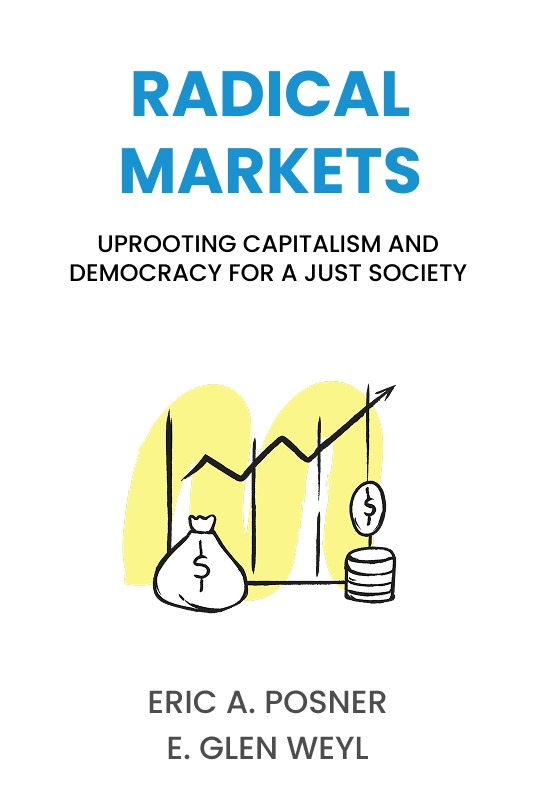
Radical Markets: Uprooting Capitalism and Democracy for a Just Society
Eric A. Posner, E. Glen Weyl

The Psychology of Money: Timeless Lessons on Wealth, Greed, and Happiness
Morgan Housel
Bad Samaritans
Ha-Joon Chang

Just Listen: Discover the Secret to Getting Through to Absolutely Anyone
Mark Goulston

Breath: The New Science of a Lost Art
James Nestor

Stumbling on Happiness
Daniel Gilbert
The Crash Course
Chris Martenson

How to Win Friends & Influence People
Dale Carnegie

Amusing Ourselves to Death: Public Discourse in the Age of Show Business
Neil Postman

The Art of Contrarian Trading
Carl Futia

Code: The Hidden Language of Computer Hardware and Software
Charles Petzold