
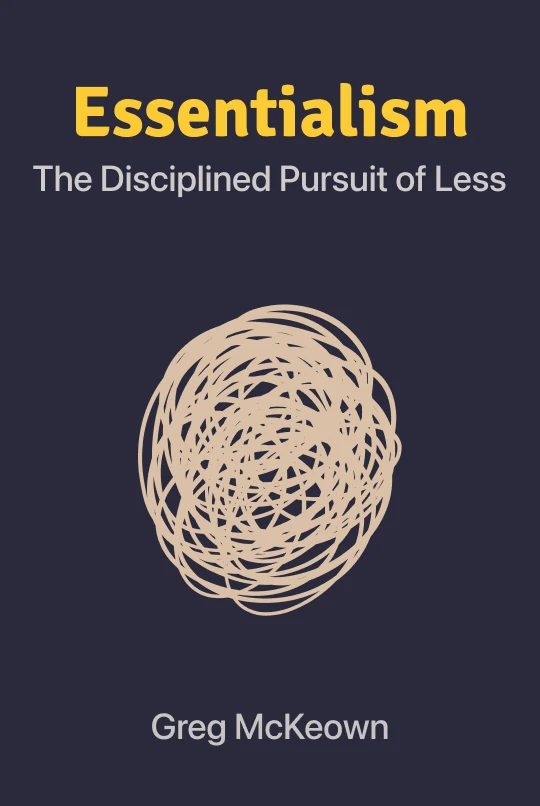
Essentialism: The Disciplined Pursuit of Less
"Reclaim your time and energy by systematically eliminating the nonessential to focus on what truly matters."
Nook Talks
- 1Discern the vital few from the trivial many. Essentialism begins with the rigorous practice of evaluation, applying strict criteria to separate what is absolutely indispensable from the merely noisy or urgent, forming the foundation for all subsequent action.
- 2Eliminate non-essentials with ruthless consistency. Once identified, non-essential tasks, commitments, and clutter must be removed. This act of subtraction creates the space and bandwidth required for meaningful contribution.
- 3Establish and defend clear personal boundaries. Without explicit boundaries, others will dictate your priorities. Defining and communicating limits protects your time and energy for essential pursuits.
- 4Create systems to make execution effortless. Remove obstacles and design routines that automate or simplify essential actions. The goal is to make the right path the path of least resistance.
- 5Adopt a mindset of trade-offs and strategic 'no's. Every 'yes' to a non-essential is a 'no' to an essential one. Embracing this trade-off empowers deliberate choice and prevents dilution of effort.
- 6Define a precise personal or professional mission. A clear, actionable mission statement acts as a compass for all decisions, ensuring alignment between daily activities and overarching purpose.
Essentialism confronts the modern epidemic of busyness and distraction, positing that the path to a meaningful and productive life lies not in doing more, but in doing less, better. Greg McKeown argues that we have lost the ability to discern what is truly essential, becoming stretched thin by the unending demands of a non-essentialist culture that celebrates having it all. The book frames this not as a time-management problem, but as a fundamental failure of personal and professional strategy.
The core methodology of Essentialism is presented as a systematic discipline with three key movements: Explore, Eliminate, and Execute. The exploration phase involves creating space to discern, listening deeply, and applying rigorous criteria to identify the few vital contributions that matter most. Elimination is the practice of cutting out the trivial many—saying no with grace, setting boundaries, and overcoming the fear of missing out. Execution involves removing obstacles, building buffers, and creating routines that make essential acts almost effortless.
McKeown draws on a wide range of examples from business, leadership, and personal life, illustrating how the disciplined pursuit of less enables higher levels of contribution and satisfaction. He distinguishes essentialism from minimalism, noting it is not about deprivation but about making the wisest possible investment of one's time and energy. The philosophy is framed as a continuous practice, not a one-time decluttering event.
Ultimately, Essentialism is a manifesto for regaining control in an out-of-control world. Its primary audience includes overwhelmed professionals, leaders, and anyone feeling overworked yet underutilized. The book's enduring significance lies in its countercultural challenge to the dogma of 'more,' offering a structured, principled framework for achieving focus and purpose in both work and life.
The consensus positions Essentialism as a vital wake-up call for the perpetually busy, praised for its powerful core philosophy and actionable framework that resonates deeply with readers feeling overwhelmed. Critics, however, find the execution repetitive and padded, arguing that the central insight could be effectively delivered in a long-form article rather than a full book. The work is universally deemed accessible and its principles highly applicable, though some note the examples skew toward corporate leadership.
- 1The transformative power of the book's core message for readers feeling their lives are spiraling out of control.
- 2Debate over the book's necessity versus its repetitive structure, with many feeling the concept is stretched too thin.
- 3The practical application of setting and defending boundaries, often cited as the most impactful personal takeaway.
- 4The book's relevance beyond business, applying equally to personal life, family time, and overall life design.
No Rules Rules: Netflix and the Culture of Reinvention
Reed Hastings, Erin Meyer
The Art of Contrarian Trading
Carl Futia
The Crash Course
Chris Martenson
Breath: The New Science of a Lost Art
James Nestor
Stumbling on Happiness
Daniel Gilbert
Chip War: The Quest to Dominate the World's Most Critical Technology
Chris Miller
Just Listen: Discover the Secret to Getting Through to Absolutely Anyone
Mark Goulston

Code: The Hidden Language of Computer Hardware and Software
Charles Petzold
The Artist's Way
Julia Cameron
How to Win Friends & Influence People
Dale Carnegie
The Essays of Warren Buffett: Lessons for Corporate America
Lawrence A. Cunningham, Warren Buffett
The Almanack of Naval Ravikant
Naval Ravikant, Eric Jorgenson