
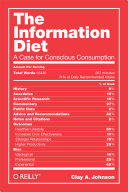
The Information Diet
"Reclaim your attention and intellect by curating your media consumption as deliberately as you choose your food."
- 1Treat information consumption like a nutritional diet. Just as junk food harms the body, low-quality, affirming information—'junk info'—degrades critical thinking and civic health. Conscious selection, not mere reduction, builds mental fitness.
- 2Recognize how 'Big Info' exploits your confirmation bias. Commercial media platforms profit by feeding you content that confirms pre-existing beliefs, creating addictive ideological feedback loops that prioritize engagement over truth or nuance.
- 3Develop data literacy and attention fitness as core disciplines. Actively cultivate the skill to source, verify, and contextualize information, while training your focus to resist the engineered distractions of digital environments.
- 4Intentionally consume across ideological lines. To combat filter bubbles and partisan groupthink, deliberately engage with credible sources that challenge your worldview, fostering intellectual humility and a more complete understanding.
- 5Become an engaged participant in the information economy. Use your attention and subscriptions to reward ethical, transparent information providers, shaping the market away from sensationalism and toward substantive journalism.
In an age of unprecedented data abundance, Clay A. Johnson diagnoses a modern malaise: information obesity. We are, he argues, gluttonous consumers of digital content—emails, social feeds, videos, news alerts—that is often as nutritionally empty as junk food, leaving us intellectually malnourished and politically polarized. The problem is not merely volume but the engineered nature of our consumption, where algorithms serve us a tailored diet of affirming, engaging, and frequently inflammatory content that confirms our biases rather than challenging our minds.
The book constructs its case by examining the economic incentives of 'Big Info,' the industrial-media complex that profits from our attention. Johnson details how platforms, from cable news to high-traffic websites, optimize for clicks and engagement, often at the expense of truth or depth. This creates a vicious cycle where consumers seek comfort and affirmation, and providers deliver precisely that, leading to entrenched filter bubbles and a erosion of shared factual reality. The proposed solution is not abstinence but a conscious, disciplined diet.
Johnson’s methodology is prescriptive, advocating for the development of 'data literacy' and 'attention fitness.' He guides the reader toward becoming a savvy information forager—learning to identify quality sources, cross-reference claims, and understand the provenance of data. Crucially, he argues for intentional ideological diversity in one's media intake to break the hold of partisan echo chambers.
Ultimately, The Information Diet is a civic-minded manifesto for the digital citizen. It targets anyone feeling overwhelmed by the news cycle, trapped in online arguments, or concerned about societal fragmentation. Its legacy lies in framing personal media consumption not as a passive habit but as an ethical and intellectual practice with profound implications for individual sanity and democratic resilience.
The consensus finds a compelling core premise—the analogy of information to food—that is brilliantly insightful yet imperfectly executed. Readers praise its vital warnings about confirmation bias and the toxic economics of attention-driven media. However, a significant faction criticizes the book for veering into extended political commentary, which feels tangential to the promised focus on broader digital addiction, making the latter sections seem unbalanced and narrowly focused on news consumption.
- 1The book's shift from general digital wellness to specific political media critique, which some found off-topic and limiting.
- 2The strength and utility of the central 'junk information' metaphor for understanding modern cognitive overload.
- 3Whether the solutions provided are actionable for everyday internet use beyond curating news sources.

The Artist's Way
Julia Cameron
Out of Control
Kevin Kelly
Just Listen: Discover the Secret to Getting Through to Absolutely Anyone
Mark Goulston
Stumbling on Happiness
Daniel Gilbert
The Essays of Warren Buffett: Lessons for Corporate America
Lawrence A. Cunningham, Warren Buffett
The Art of Contrarian Trading
Carl Futia
Blueprints: How mathematics shapes creativity
Marcus du Sautoy
Bad Samaritans
Ha-Joon Chang
The Psychology of Money: Timeless Lessons on Wealth, Greed, and Happiness
Morgan Housel

Permanent Record
Edward Snowden
Transformation in Christ
Dietrich Von Hildebrand
Sapiens: A Brief History of Humankind
Yuval Noah Harari