
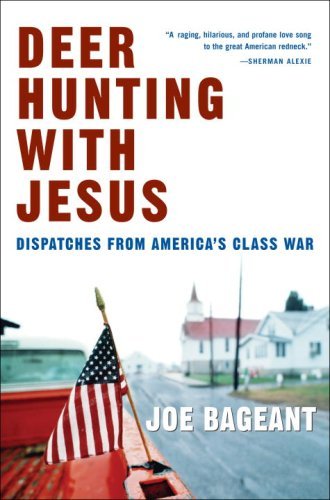
Deer Hunting with Jesus: Dispatches from America's Class War
"A raw, empathetic autopsy of the white working class, revealing the economic and cultural traps that fuel America's unacknowledged civil war."
- 1Understand the economic betrayal of the white working class. Bageant dissects how financial systems—predatory lending, outsourced jobs, and crippling healthcare costs—systematically exploit the poor, binding them in debt while obscuring the true source of their hardship.
- 2Decode the political paradox of voting against self-interest. The book argues that cultural identity, rooted in guns, religion, and regional pride, consistently trumps economic logic, making conservative platforms a vessel for dignity rather than policy.
- 3Recognize the 'American Hologram' of virtual reality. A corporatized media landscape sells a distracting national myth of prosperity and freedom, preventing a clear-eyed collective recognition of systemic class stratification and decline.
- 4Appreciate the deep cultural roots of Scots-Irish tradition. Bageant traces a lineage of defiance, honor, and deep-seated distrust of authority, explaining contemporary attitudes toward government and outsiders as a historical inheritance, not mere ignorance.
- 5Confront the left's failure to engage meaningfully. Progressives are critiqued for their condescension and cultural disconnect, having abandoned the language of class for a politics of identity that alienates the very people it should organize.
- 6See gun culture as a complex pillar of identity. Firearms are framed not as a political totem but as a tangible source of autonomy, tradition, and skill in a world that offers the working class little other control.
Joe Bageant’s Deer Hunting with Jesus is a blistering, firsthand ethnography of the white working poor in his hometown of Winchester, Virginia. Returning after decades away, Bageant finds a community in quiet collapse—a permanent underclass where factory jobs vanish, debt is a life sentence, and faith, firearms, and fatalism provide the primary solace. He frames this not as anecdotal hardship but as dispatches from an active, if unrecognized, class war, where the casualties are measured in foreclosed homes and opioid-addled despair.
Bageant meticulously documents the mechanisms of this war. He explores 'white trashonomics,' the predatory credit and housing markets that ensnare the poor, and the deliberate outsourcing of industrial work that dismantles community bedrock. The narrative then pivots to the cultural bulwarks his neighbors erect against this economic siege: an evangelical faith that offers explanatory magic for suffering, a gun culture rooted in Scots-Irish traditions of self-reliance, and a visceral politics that prizes honor and cultural belonging over material interest. These chapters dissect the paradox of people voting for policies that exacerbate their poverty, arguing they are purchasing dignity and identity in a marketplace that offers them little else.
The book’s power lies in its hybrid form—part memoir, part polemic, part tragicomedy. Bageant writes with the aching familiarity of a native son, profiling his brother, a demon-casting pastor, and childhood friends facing early graves from preventable diseases. He condemns the 'American Hologram,' the televised illusion of shared prosperity that distracts from this grim reality. His tone oscillates between righteous fury and deep empathy, refusing to caricature his subjects even as he lays bare the self-destructive strands of their culture.
Ultimately, Deer Hunting with Jesus serves as a crucial corrective for a polarized nation. It is essential reading for progressives who misunderstand the heartland and for any citizen bewildered by the country’s political fractures. Bageant offers no easy solutions but insists that acknowledging the humanity and complex reality of this enormous segment of America is the first, non-negotiable step toward any meaningful dialogue or change.
The consensus positions this book as a vital, eye-opening, and brutally honest portrait of an overlooked America. Readers praise its empathetic clarity and Bageant’s unique authority as a sympathetic insider. The primary critique is not of its thesis but of its execution: some find the prose rambling, repetitious, or occasionally veering into a cynical rant that undermines its moral authority. It is universally acknowledged as challenging and uncomfortable, more valued for its essential perspective than for literary polish.
- 1The book's central paradox: why the white working class votes against its own economic interests.
- 2Debates over Bageant's tone—is he empathetic or condescending toward his subjects?
- 3The accuracy and poignancy of his depiction of 'white trashonomics' and debt ensnarement.
- 4The effectiveness of his 'American Hologram' theory in explaining political disengagement.
- 5The relevance of its 2007 analysis to contemporary political landscapes and populist movements.

How to Win Friends & Influence People
Dale Carnegie

Amusing Ourselves to Death: Public Discourse in the Age of Show Business
Neil Postman
The Essays of Warren Buffett: Lessons for Corporate America
Lawrence A. Cunningham, Warren Buffett

Code: The Hidden Language of Computer Hardware and Software
Charles Petzold

The Art of Contrarian Trading
Carl Futia

The Artist's Way
Julia Cameron
Transformation in Christ
Dietrich Von Hildebrand

Just Listen: Discover the Secret to Getting Through to Absolutely Anyone
Mark Goulston
Radical Markets: Uprooting Capitalism and Democracy for a Just Society
Eric A. Posner, E. Glen Weyl

Bad Samaritans
Ha-Joon Chang

The Almanack of Naval Ravikant
Naval Ravikant, Eric Jorgenson

The Creative Habit
Twyla Tharp, Mark Reiter