
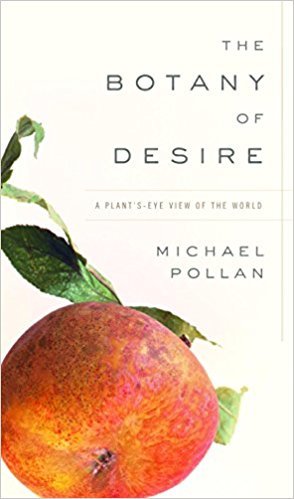
The Botany of Desire: A Plant's-Eye View of the World
"Reveals how four plants domesticated humanity to fulfill our deepest desires for sweetness, beauty, intoxication, and control."
Nook Talks
- 1Adopt a plant's-eye view of human history. Human cultivation is not a one-way act of domination but a reciprocal evolutionary partnership. Plants like the apple and potato have expertly manipulated human desires to ensure their own global propagation and genetic success.
- 2Understand desire as an evolutionary force. Fundamental human yearnings—for sweetness, beauty, intoxication, and control—are not merely cultural but powerful drivers of natural selection. Plants that successfully tap into these desires are granted extraordinary evolutionary advantages.
- 3See the apple as a vehicle for sweetness and alcohol. The apple's genetic diversity, championed by figures like Johnny Appleseed, served the human desire for hard cider as much as for fruit. Its story dismantles the myth of a singular, perfect apple, celebrating instead its fermented, democratic history.
- 4Recognize beauty as a potent biological strategy. The tulip's mesmerizing beauty triggered a speculative mania that nearly bankrupted Holland. This demonstrates how a purely aesthetic trait can wield immense economic and cultural power, proving its evolutionary utility.
- 5Question the illusion of control in agriculture. The monoculture of the genetically modified potato creates a fragile, predictable system, making it more vulnerable to pests. True control in nature is often an illusion, and diversity remains a critical defense.
- 6Acknowledge intoxication as a profound human drive. Cannabis satisfies a deep-seated desire to alter consciousness, a desire so powerful that humans risk legal peril to cultivate it. The plant's chemistry directly engages with the human brain, ensuring its devoted cultivation.
Michael Pollan's The Botany of Desire provocatively inverts the traditional narrative of human domestication. It argues that by satisfying four fundamental human desires—sweetness, beauty, intoxication, and control—certain plants have cleverly guided our behavior to ensure their own survival and proliferation. This is not a history of gardening but a biography of a reciprocal relationship, asking who is truly the domesticator and who the domesticated.
The book unfolds through four case studies, each a deep cultural and biological history. The apple, synonymous with sweetness, is revealed through the lens of Johnny Appleseed as a vehicle for hard cider, its genetic diversity a testament to human thirst. The tulip’s breathtaking beauty is examined as the engine of Tulipomania, a speculative frenzy that shows aesthetic allure as a formidable evolutionary force. Cannabis is presented as the fulfiller of our desire for intoxication, its psychoactive chemistry forging a bond so powerful it transcends legal sanction.
Finally, the potato represents the desire for control, culminating in the modern paradox of the genetically modified NewLeaf potato. Pollan details how this attempt at total agricultural dominion creates new vulnerabilities, arguing that monoculture is a brittle, risky strategy. Each narrative weaves together science, history, and personal reflection to illustrate the complex dance of co-evolution.
Ultimately, the book challenges our anthropocentric worldview, positioning plants as active participants in history with their own agendas. It is essential reading for anyone interested in environmental philosophy, the history of agriculture, or the hidden intelligence of the natural world, offering a paradigm shift that is both humbling and illuminating.
Readers are captivated by the book's ingenious premise and accessible, narrative-driven science, finding the plant's-eye perspective both revelatory and persuasive. The consensus praises Pollan's engaging storytelling, particularly the sections on Johnny Appleseed and the Tulipomania. A recurring critique points to a perceived lack of depth in the marijuana chapter and a sense that the provocative central thesis is occasionally more tantalizing than thoroughly proven. Nonetheless, it is widely regarded as a foundational and mind-expanding entry in popular science writing.
- 1The provocative central thesis of plants domesticating humans, which readers find either brilliantly illuminating or slightly overstated and anthropomorphic.
- 2The strength and entertainment value of the historical narratives, especially the Johnny Appleseed and Dutch tulip craze sections.
- 3Perceived weaknesses in the marijuana chapter, with some finding it less substantive or compelling compared to the other plant profiles.
- 4The book's ability to fundamentally shift one's perspective on humanity's relationship with the natural world.

Chip War: The Quest to Dominate the World's Most Critical Technology
Chris Miller

Permanent Record
Edward Snowden

Out of Control
Kevin Kelly

Transformation in Christ
Dietrich Von Hildebrand

The Artist's Way
Julia Cameron

The Art of Contrarian Trading
Carl Futia
The Lessons of History
Will Durant
The Creative Habit
Twyla Tharp, Mark Reiter

The Intelligent Investor
Benjamin Graham

The Almanack of Naval Ravikant
Naval Ravikant, Eric Jorgenson

Just Listen: Discover the Secret to Getting Through to Absolutely Anyone
Mark Goulston
Outliers: The Story of Success
Malcolm Gladwell