
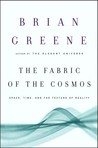
The Fabric of the Cosmos: Space, Time, and the Texture of Reality
"Reveals the universe's hidden architecture, transforming our intuitive understanding of space, time, and reality itself."
Nook Talks
- 1Space and time are dynamic, malleable entities. They are not a passive backdrop but the very fabric of the cosmos, capable of stretching, warping, and intertwining, as revealed by Einstein's theory of general relativity.
- 2Quantum mechanics dismantles classical locality and certainty. The quantum realm operates on probability and entanglement, where particles influence each other instantaneously across vast distances, challenging our notions of separate objects and definite reality.
- 3Cosmology points to a universe born from a quantum fluctuation. The prevailing inflationary model suggests our vast cosmos originated in a spectacular, rapid expansion from a subatomic seed, a concept that reframes the question of origins.
- 4String theory proposes a universe woven from vibrating filaments. This leading candidate for a 'theory of everything' posits that all particles and forces are manifestations of tiny, vibrating strings existing in multiple hidden dimensions of space.
- 5The arrow of time is an emergent property of entropy. Time's one-way direction is not fundamental but arises from the statistical tendency of systems to move from order to disorder, linking cosmic history to everyday experience.
- 6Reality may be one of many in a vast multiverse. Inflationary and string theories naturally suggest our universe could be a single bubble in a frothy multiverse, a radical re-contextualization of existence.
Brian Greene's The Fabric of the Cosmos is a profound exploration of the fundamental nature of reality, undertaking the monumental task of explaining modern physics' most counterintuitive concepts without relying on formal mathematics. It begins by dismantling our Newtonian instincts, revealing space and time not as absolute and separate stages but as a unified, dynamic entity—spacetime—that bends, stretches, and dictates the motion of celestial bodies.
Greene then guides the reader into the bizarre quantum arena, where particles exist in clouds of probability and can be "entangled" across cosmic distances, acting as a single entity. This sets the stage for cosmology's grand narrative: the inflationary Big Bang, which describes how our entire observable universe erupted from a quantum seed. The journey culminates in the frontiers of theoretical physics, particularly string theory and its vision of a universe built from vibrating, multi-dimensional filaments.
The book's final impact lies in its synthesis, suggesting that these disparate theories—relativity, quantum mechanics, cosmology, and strings—are converging on a new understanding of reality's deepest layers. It is written for the intellectually curious layperson, aiming not just to inform but to fundamentally alter the reader's perception of the everyday world, revealing the extraordinary drama of physics unfolding beneath the surface of common experience.
The consensus celebrates Greene as a masterful elucidator of profoundly difficult concepts, making cutting-edge cosmology and string theory accessible through vivid analogies and a patient, narrative style. Critics, however, note a significant difficulty spike in the final sections, where the concepts of quantum gravity and multiverses strain the metaphorical approach, leaving some readers desiring more concrete formalism. The book is widely respected as a demanding but rewarding intellectual expedition.
- 1Praise for Greene's exceptional skill in using metaphor to explain highly abstract concepts without mathematics.
- 2Debate over the book's escalating difficulty, particularly in the final chapters on string theory and quantum mechanics.
- 3Discussion on the mind-bending implications of concepts like the multiverse, entropy as time's arrow, and quantum entanglement.

Outliers: The Story of Success
Malcolm Gladwell

Stumbling on Happiness
Daniel Gilbert

Chip War: The Quest to Dominate the World's Most Critical Technology
Chris Miller
Code: The Hidden Language of Computer Hardware and Software
Charles Petzold

Bad Samaritans
Ha-Joon Chang

The Road to Financial Freedom
Bodo Schäfer
The Psychology of Money: Timeless Lessons on Wealth, Greed, and Happiness
Morgan Housel

The Art of Contrarian Trading
Carl Futia
Sapiens: A Brief History of Humankind
Yuval Noah Harari

How to Win Friends & Influence People
Dale Carnegie
Vacuum Diagrams (Xeelee Sequence, #5)
Stephen Baxter
The Artist's Way
Julia Cameron