
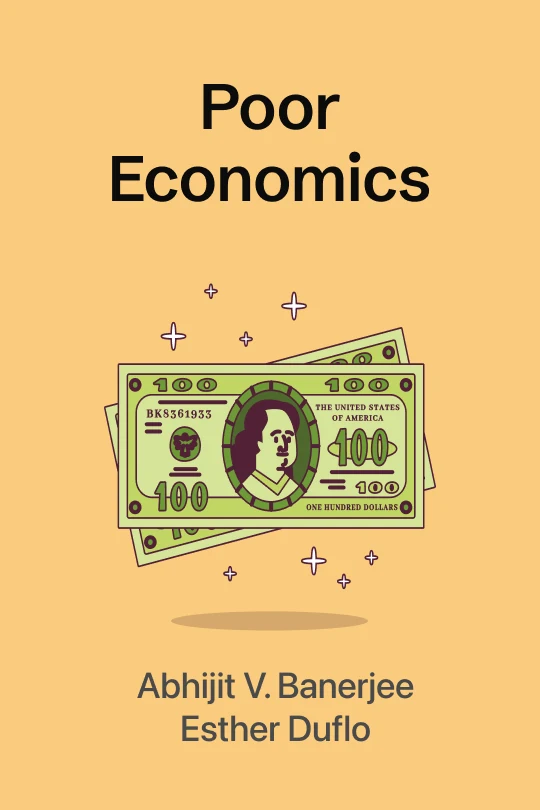
Poor Economics: A Radical Rethinking of the Way to Fight Global Poverty
"Replaces grand theories of poverty with evidence-based, granular insights into the actual lives and decisions of the poor."
- 1[object Object]
- 2[object Object]
- 3[object Object]
- 4[object Object]
- 5[object Object]
- 6[object Object]
Poor Economics dismantles the grand, often ideological narratives that have long dominated the discourse on global poverty. Abhijit Banerjee and Esther Duflo, pioneers in applying randomized controlled trials to development economics, argue that to effectively fight poverty, we must first understand the specific, granular realities of how the poor live, make choices, and navigate constraints. The book positions itself not as a polemic for or against aid, but as a plea for an evidence-based, experimental approach that treats poverty as a set of concrete, addressable problems.
Through fieldwork spanning dozens of countries, the authors investigate questions central to well-being: Why do the poor, who could benefit tremendously from preventive healthcare, so often forgo cheap and effective treatments? Why might a hungry family spend a windfall on a television rather than more nutritious food? The answers lie in a nuanced understanding of the psychology of scarcity, where stress and short-term survival logic can override long-term planning. The book meticulously examines the real-world performance of popular interventions like microfinance, revealing a complex picture where loans often fund consumption rather than enterprise.
The methodology is the message. By championing RCTs—which compare outcomes between a group that receives an intervention and a control group that does not—Banerjee and Duflo provide a toolkit to cut through intuition and political bias. This approach has evaluated the efficacy of everything from teacher attendance incentives in India to deworming programs in Kenya, generating actionable insights about what truly improves lives. It reveals how small, carefully designed nudges, such as providing subtle commitment devices for savings or simplifying bureaucratic processes, can have disproportionate positive effects.
Ultimately, the book’s impact lies in its radical pragmatism. It is targeted at policymakers, NGO workers, and anyone frustrated by the stale debate between unchecked aid and pure market solutions. Its legacy is a shift in perspective: viewing the poor not as caricatures to be saved or ignored, but as complex economic agents whose behaviors, when properly understood, can guide the design of more humane and effective policies to build a world beyond poverty.
The critical consensus celebrates the book as a vital, ground-level corrective to the abstract theorizing that plagues development economics. Readers praise its empirical rigor and compassionate, granular focus on the lived experience of poverty, which makes the subject feel newly tangible and urgent. A common critique points to a occasionally disjointed narrative structure and a prose style that, while clear, can feel more academic than literary. Nonetheless, it is widely regarded as an essential and accessible text that successfully bridges the gap between scholarly research and practical, humane policy insight.
- 1The effectiveness and ethical implications of using randomized controlled trials in social policy and economic development.
- 2Critical analysis of microfinance, debating whether it empowers the poor or entraps them in debt cycles.
- 3The book's position in the wider debate between the large-scale aid approaches of Sachs and the skeptical, market-driven critiques of Easterly.
- 4Discussion on the psychological 'tax' of scarcity and how poverty shapes decision-making in seemingly irrational ways.

Out of Control
Kevin Kelly

The Almanack of Naval Ravikant
Naval Ravikant, Eric Jorgenson
The Creative Habit
Twyla Tharp, Mark Reiter
Bad Samaritans
Ha-Joon Chang

Chip War: The Quest to Dominate the World's Most Critical Technology
Chris Miller

Amusing Ourselves to Death: Public Discourse in the Age of Show Business
Neil Postman
Stumbling on Happiness
Daniel Gilbert
The Art of Contrarian Trading
Carl Futia

The Artist's Way
Julia Cameron
Breath: The New Science of a Lost Art
James Nestor
Radical Markets: Uprooting Capitalism and Democracy for a Just Society
Eric A. Posner, E. Glen Weyl

Code: The Hidden Language of Computer Hardware and Software
Charles Petzold