
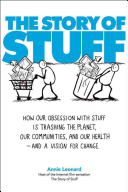
The Story of Stuff
"It exposes the toxic lifecycle of our possessions and offers a blueprint for a sustainable, just, and fulfilling alternative."
- 1Trace the entire lifecycle of your possessions. Every product follows a linear path of extraction, production, distribution, consumption, and disposal. Understanding this 'materials economy' reveals the hidden environmental and social costs embedded in cheap goods.
- 2Reject the engineered cycle of perceived obsolescence. Our economy is designed to make products seem unfashionable or unrepairable, fueling endless consumption. This manipulative strategy sacrifices planetary health and personal well-being for corporate profit.
- 3Recognize that externalized costs are paid by people and the planet. The low price of consumer goods often excludes the true cost: polluted ecosystems, exploited labor, and community health crises. These burdens are shifted to the most vulnerable populations worldwide.
- 4Understand that overconsumption fails to deliver happiness. The relentless pursuit of more Stuff traps us in a cycle of work, debt, and disposal, eroding leisure time, community connections, and genuine life satisfaction without delivering on its promise.
- 5Shift from a growth-at-all-costs to a sustainability paradigm. The current economic model, predicated on infinite growth on a finite planet, is in systemic crisis. A viable future requires prioritizing ecological integrity, social equity, and well-being over mere GDP expansion.
- 6Embrace your agency as a citizen over your identity as a consumer. Real change requires moving beyond individual green consumption to collective action—advocating for policy reforms, corporate accountability, and redesigning systems to support a circular, regenerative economy.
Annie Leonard’s The Story of Stuff dismantles the comforting myth of our consumer society, revealing it as a linear and lethal system in crisis. The book meticulously tracks the journey of everyday objects—from the mining of raw materials to the final resting place in a landfill or incinerator—framing this as a five-stage ‘materials economy.’ This journey is not a neutral process but an engine of ecological devastation and social injustice, fueled by a doctrine of perpetual economic growth that the planet’s biophysical limits cannot sustain.
Leonard illuminates the deliberate mechanisms that keep this system running, most notably the concept of ‘perceived obsolescence,’ where products are designed to be discarded long before their functional life ends. She visits factories and dumps from Haiti to China, documenting how the true costs of cheap electronics, clothing, and packaging are externalized onto factory workers, mining communities, and frontline populations who bear the health consequences of toxic pollution. The narrative compellingly argues that the convenience of disposable goods is a Faustian bargain, trading short-term ease for long-term systemic ruin.
The analysis extends into the home, showing how this toxic cycle invades personal health through chemicals in household items and children’s products, creating a bizarre paradox where our possessions actively undermine our well-being. More profoundly, Leonard interrogates the psychological contract of consumption, demonstrating how the pursuit of Stuff fails to fulfill its promise of happiness, instead trapping individuals in a stressful cycle of work, spend, and discard that erodes time, community, and life satisfaction.
Ultimately, The Story of Stuff is a foundational text for the modern environmental and economic justice movements. While unflinching in its diagnosis, the book is fundamentally optimistic, providing a clear-eyed vision for change. It calls for a transition from a linear, extractive economy to a circular, regenerative one, empowering readers to move beyond their role as passive consumers to become engaged citizens advocating for systemic redesign. Its legacy is that of a wake-up call and a manual, making the invisible chains of our consumption visible and breakable.
The consensus positions the book as an essential, galvanizing primer. Readers universally praise its ability to translate complex global systems into an accessible and compelling narrative, describing it as a transformative, eye-opening experience that fundamentally alters daily perception. The primary critique is not of its content but of its tone; some find the relentless cataloguing of environmental and social ills to be overwhelmingly depressing, muting the impact of its concluding vision for change. Its clarity is celebrated as its greatest strength, making a daunting subject urgent and comprehensible.
- 1The book's transformative power in altering daily perception and making consumption habits visible.
- 2Debate over the balance between alarming factual exposition and the optimistic call to action.
- 3Praise for its exceptional accessibility in explaining complex systems like the WTO and global supply chains.
- 4Its role as a foundational text that connects personal consumption to global systemic injustice.
Radical Markets: Uprooting Capitalism and Democracy for a Just Society
Eric A. Posner, E. Glen Weyl
Breath: The New Science of a Lost Art
James Nestor
The Creative Habit
Twyla Tharp, Mark Reiter

Just Listen: Discover the Secret to Getting Through to Absolutely Anyone
Mark Goulston

The Road to Financial Freedom
Bodo Schäfer

Amusing Ourselves to Death: Public Discourse in the Age of Show Business
Neil Postman
Sapiens: A Brief History of Humankind
Yuval Noah Harari

How to Win Friends & Influence People
Dale Carnegie

Permanent Record
Edward Snowden

The Artist's Way
Julia Cameron

The Intelligent Investor
Benjamin Graham
Transformation in Christ
Dietrich Von Hildebrand