
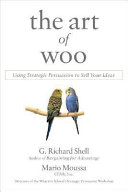
The Art of Woo
"Transforms persuasion from argument into a systematic, relationship-based strategy for winning genuine commitment."
- 1Map the social and political landscape before pitching. Effective persuasion begins with a diagnostic analysis of organizational networks, decision-makers, and hidden influencers. This reconnaissance turns the social environment from an obstacle into a navigable map.
- 2Identify and adapt to your listener's persuasion channel. People process ideas through distinct channels like authority, logic, or vision. Matching your style to their preferred channel bypasses resistance and creates immediate cognitive resonance.
- 3Convert relational and credibility barriers into strategic assets. Negative history or low credibility are not terminal flaws. The framework provides methods to reframe relationships and rebuild trust, transforming weaknesses into foundations for new alliances.
- 4Anchor your pitch in a compelling, evidence-based narrative. Beyond data, a successful pitch weaves facts into a story that connects to the listener's values and self-interest. It makes the idea personally meaningful and intellectually undeniable.
- 5Secure commitments by managing the politics of approval. The final yes is often a political act. This requires anticipating objections, orchestrating endorsements, and designing implementation steps that protect allies and neutralize opposition.
- 6Self-diagnose your own default persuasion style. Understanding whether you naturally rely on logic, charisma, or authority reveals blind spots. Conscious style-switching becomes a powerful tool for engaging different personalities.
The Art of Woo reframes persuasion not as mere rhetoric or manipulation, but as a systematic, strategic process of winning people over—an essential skill for anyone whose success depends on influence rather than authority. Authors G. Richard Shell and Mario Moussa resurrect Aristotle's timeless principles of ethos, pathos, and logos, placing them within the complex social ecosystems of modern organizations. The book argues that the highest form of persuasion, Woo (Winning Others Over), is fundamentally relational, aiming for mutual advantage and lasting commitment rather than a one-time transactional victory.
At its core, the book presents a rigorous four-step methodology. It begins with surveying your situation: refining your idea, mapping the organizational decision-making network, and diagnosing the preferred "persuasion channels" of your audience. The authors identify six such channels—including authority, logic, and vision—through which individuals naturally process ideas. The subsequent step involves confronting barriers, such as credibility deficits or conflicting interests, with tactical advice on converting these obstacles into leverage. The process culminates in making a resonant pitch and, crucially, securing commitments by deftly navigating the political landscape to ensure follow-through.
The work is deeply pragmatic, filled with diagnostic tools, case studies, and self-assessments. It guides the reader through identifying their own persuasion style and then adapting it to connect with others. The framework acknowledges that selling an idea is as much about understanding psychology and social dynamics as it is about the idea's inherent quality. This moves persuasion beyond presentation skills into the realm of strategic relationship management.
Its significance lies in providing a comprehensive, ethical blueprint for influence in knowledge-based economies. Targeted at entrepreneurs, managers, and professionals, The Art of Woo bridges the gap between intellectual insight and practical execution. It establishes persuasion as a disciplined art form essential for leadership, innovation, and driving change within any collaborative human enterprise.
Readers consistently praise the book for its actionable, systematic framework, hailing it as a definitive guide to ethical influence that transcends simple sales techniques. The synthesis of classical rhetoric with modern organizational psychology is celebrated for its intellectual depth and immediate practicality. A recurring critique notes that the initial diagnostic phases require significant time and social intelligence, potentially daunting those seeking quick tips. The consensus affirms its value for any professional seeking to advance ideas in complex, consensus-driven environments.
- 1The practical utility of the self-diagnostic tool for identifying one's default persuasion style and its blind spots.
- 2Debates on the time investment required for the initial 'surveying and mapping' phase versus the need for quick persuasion.
- 3Discussion of the six persuasion channels and which are most effective in hierarchical versus collaborative cultures.
- 4The ethical boundary between strategic relationship-building and perceived manipulation within the Woo framework.
The Creative Habit
Twyla Tharp, Mark Reiter
The Essays of Warren Buffett: Lessons for Corporate America
Lawrence A. Cunningham, Warren Buffett
Boom: Bubbles and the End of Stagnation
Byrne Hobart

Chip War: The Quest to Dominate the World's Most Critical Technology
Chris Miller
The Art of Contrarian Trading
Carl Futia

Code: The Hidden Language of Computer Hardware and Software
Charles Petzold

Breakthrough: The Quest for Life-Changing Medicines
Dr William Pao

Just Listen: Discover the Secret to Getting Through to Absolutely Anyone
Mark Goulston

Sapiens: A Brief History of Humankind
Yuval Noah Harari
The Norwegian Method
Brad Culp

Out of Control
Kevin Kelly

The Almanack of Naval Ravikant
Naval Ravikant, Eric Jorgenson