
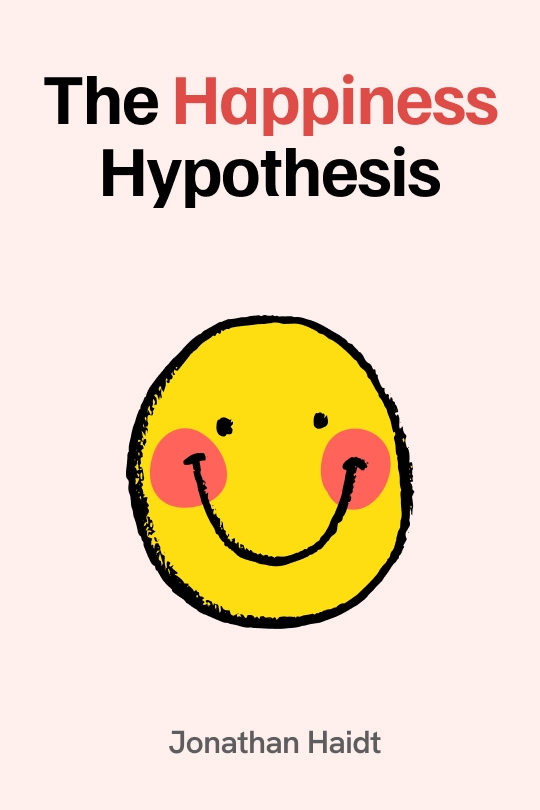
The Happiness Hypothesis: Finding Modern Truth in Ancient Wisdom
"A psychological bridge between ancient maxims and modern science, revealing the architecture of a meaningful life."
- 1[object Object]
- 2[object Object]
- 3[object Object]
- 4[object Object]
- 5[object Object]
- 6[object Object]
Jonathan Haidt’s The Happiness Hypothesis performs a unique kind of intellectual alchemy, testing the enduring proverbs of ancient philosophical and religious traditions against the rigorous findings of modern psychology and neuroscience. The book asks a deceptively simple question: what do the world’s great wisdom traditions get right about human flourishing, and where does contemporary science confirm, refine, or overturn their claims? Haidt serves as an erudite guide, translating maxims like “what doesn’t kill you makes you stronger” and “the golden rule” into the language of evolutionary psychology, neuroplasticity, and social science.
Central to the exploration is Haidt’s famous metaphor of the mind as a rider on an elephant, where the conscious, reasoning rider represents our controlled processes and the massive, emotional elephant symbolizes our automatic, intuitive responses. True happiness and virtue, he argues, come not from the rider’s sheer willpower but from the skilled training of the elephant. This framework organizes the investigation into core components of the good life: the role of love and attachment, the conditions for fulfilling work, the vital importance of virtue and ethical behavior grounded in reciprocity, and the paradoxical benefits of adversity, which can lead to post-traumatic growth.
The analysis extends into the architecture of morality itself, introducing Haidt’s Moral Foundations Theory. He posits that human moral intuition is built upon several innate psychological systems—such as care/harm, fairness/cheating, loyalty/betrayal, authority/subversion, and sanctity/degradation—which cultures combine and emphasize in different ratios. This theory illuminates deep political and cultural divides, explaining why left and right often seem to speak different moral languages. The book also rigorously examines practical prescriptions for happiness, from cognitive-behavioral therapy and meditation to pharmaceutical interventions, assessing their neurological mechanisms and efficacy.
Ultimately, The Happiness Hypothesis argues that the ‘highest’ form of happiness involves connection to something larger than the self—a sense of purpose, belonging, or sacredness that transcends individual concerns. It is a work of synthesis aimed at the intellectually curious reader, offering not a simplistic self-help manual but a deeply researched, nuanced map of human nature. It provides the conceptual tools to build a life of greater meaning, resilience, and satisfaction by understanding the ancient wisdom now validated by modern science.
The consensus praises Haidt's synthesizing genius and the compelling 'rider and elephant' metaphor, finding the early chapters on practical psychology particularly insightful. A significant contingent, however, feels the book loses its cohesive focus in later sections, meandering into academic tangents on morality and politics that dilute the core thesis on happiness. While appreciated for its intellectual depth, some readers found the shift away from direct application and the exploration of the 'sacred' less accessible and more abstract than the promising, evidence-based start.
- 1The shift from actionable self-help in early chapters to abstract academic discourse in later sections.
- 2The power and utility of the central 'rider on the elephant' metaphor for understanding behavior change.
- 3Debate over the book's cohesion and whether the digressions into morality and politics enhance or distract from the theme of happiness.
- 4The scientific validation of ancient wisdom, particularly regarding adversity (post-traumatic growth) and reciprocity.

The Artist's Way
Julia Cameron
Boom: Bubbles and the End of Stagnation
Byrne Hobart
The Psychology of Money: Timeless Lessons on Wealth, Greed, and Happiness
Morgan Housel
Blueprints: How mathematics shapes creativity
Marcus du Sautoy

Transformation in Christ
Dietrich Von Hildebrand

The Road to Financial Freedom
Bodo Schäfer

The Norwegian Method
Brad Culp

Code: The Hidden Language of Computer Hardware and Software
Charles Petzold
Stumbling on Happiness
Daniel Gilbert
The Essays of Warren Buffett: Lessons for Corporate America
Lawrence A. Cunningham, Warren Buffett
Breakthrough: The Quest for Life-Changing Medicines
Dr William Pao
The Creative Habit
Twyla Tharp, Mark Reiter