
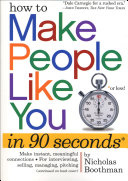
How to Make People Like You in 90 Seconds or Less
"Master the science of instant rapport through synchronized attitude, body language, and sensory-specific communication."
- 1Establish rapport through conscious synchronization of attitude and body language. Instant connection is not accidental but engineered. By deliberately aligning your posture, gestures, and facial expressions with another person, you create a subconscious signal of similarity and trust, bypassing initial skepticism.
- 2Identify and mirror the other person's primary sensory preference. People process the world visually, auditorily, or kinesthetically. Using language that matches their dominant sense—like 'I see your point' for a visual person—creates immediate understanding and makes your communication feel intuitively correct.
- 3Cultivate a genuine, open attitude as your foundational social tool. Technique is hollow without sincere intent. An attitude of curiosity and goodwill is the non-negotiable prerequisite that makes tactical communication ethical and effective, transforming interaction from transaction to connection.
- 4Structure the critical first 90 seconds with open-ended questions and attentive listening. The initial moments set the relational trajectory. Employing questions that invite elaboration, combined with focused listening, demonstrates immediate value and interest, compelling the other person to engage further.
- 5Use the principle of 'like attracts like' to overcome perceived differences. Consciously finding and emphasizing common ground, however small, triggers a powerful psychological bias. This perceived similarity builds a bridge, making subsequent persuasion or collaboration feel natural and mutually beneficial.
Nicholas Boothman’s 'How to Make People Like You in 90 Seconds or Less' posits that successful human interaction, whether in business, love, or daily life, is not a mysterious art but a learnable science of connection. Drawing from Neuro-Linguistic Programming (NLP) and practical psychology, the book argues that the fleeting window following an introduction is decisive, establishing the tone for all future relations. It dismantles the notion that charisma is innate, presenting it instead as a series of replicable behaviors centered on the concept of 'synchrony'—the deliberate alignment of one’s own communicative output with that of another.
The methodology is built on a tripartite framework: synchronizing attitude, body language, and voice tone. Boothman contends that a consciously adopted attitude of openness and curiosity is the essential foundation, which must then be physically manifested. The book provides a detailed lexicon of nonverbal cues—from posture and gesture to eye contact and facial expression—teaching readers to first observe and then subtly mirror their counterpart to build unconscious rapport. This physical alignment is complemented by vocal pacing and tonality, creating a multisensory experience of harmony.
A core technical component involves identifying a person’s primary representational system: visual, auditory, or kinesthetic. Boothman provides diagnostic questions and phrases to discern whether someone thinks in pictures, sounds, or feelings, and instructs the reader to tailor their language accordingly. Speaking someone’s 'sensory language' bypasses cognitive filters, making communication feel intuitively correct and deeply understood. The book also covers practical strategies for opening conversations, employing effective compliments, and reading subtle eye-accessing cues that signal a person’s internal thought process.
Ultimately, the book serves as a tactical field manual for anyone whose success depends on the quality of their face-to-face interactions. It targets sales professionals, managers, negotiators, and even those navigating personal relationships, offering a structured, time-bound approach to transforming strangers into willing collaborators. Its legacy lies in demystifying the mechanics of likability, framing it not as manipulation but as the skilled and ethical practice of empathetic communication, where the goal is mutual understanding and benefit.
The readership is sharply divided, producing a polarized consensus. Advocates, often self-identified introverts or professionals, praise the book for its actionable, structured techniques for building instant rapport, finding the NLP-based framework genuinely useful for improving intentional communication. Detractors dismiss the work as insubstantial repackaging of classic Dale Carnegie principles, criticizing its length as gratuitously padded and its title as gimmicky. A significant point of ethical contention arises around whether its methods constitute skillful connection or calculated manipulation, a debate that hinges entirely on the user's perception of the practitioner's sincerity.
- 1The ethical line between skillful communication and psychological manipulation, especially regarding mirroring and sensory language.
- 2The book's value for introverts seeking structured strategies to navigate social situations with more confidence and control.
- 3Criticism that the core content is a diluted rehash of older self-help classics, merely stretched to book length.
The Norwegian Method
Brad Culp

Out of Control
Kevin Kelly

The Fifth Discipline
Peter M. Senge

The Essays of Warren Buffett: Lessons for Corporate America
Lawrence A. Cunningham, Warren Buffett

The Road to Financial Freedom
Bodo Schäfer

How to Win Friends & Influence People
Dale Carnegie

Code: The Hidden Language of Computer Hardware and Software
Charles Petzold

Sapiens: A Brief History of Humankind
Yuval Noah Harari

Chip War: The Quest to Dominate the World's Most Critical Technology
Chris Miller

The Psychology of Money: Timeless Lessons on Wealth, Greed, and Happiness
Morgan Housel

Breakthrough: The Quest for Life-Changing Medicines
Dr William Pao

Stumbling on Happiness
Daniel Gilbert