
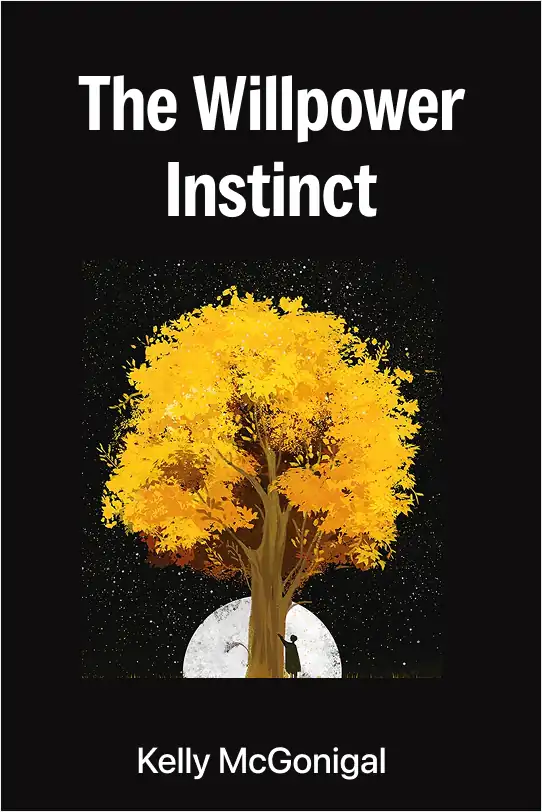
The Willpower Instinct: How Self-Control Works, Why It Matters, and What You Can Do to Get More of It
"Reconceive willpower as a trainable biological instinct, not a moral failing, to systematically strengthen self-control."
- 1[object Object]
- 2[object Object]
- 3[object Object]
- 4[object Object]
- 5[object Object]
- 6[object Object]
- 7[object Object]
The Willpower Instinct dismantles the pervasive cultural myth of willpower as a simple test of character, repositioning it instead as a complex biological instinct susceptible to scientific understanding and systematic training. Health psychologist Kelly McGonigal synthesizes a decade of research from neuroscience, psychology, and medicine to argue that self-control is a mind-body response, a function of the prefrontal cortex that is profoundly affected by physiology, environment, and belief.
McGonigal’s framework is built on the central metaphor of willpower as a muscle—one that can be strengthened with practice but also fatigues with overuse. The book introduces the core components of self-control: the 'I will' power to take action, the 'I won't' power to resist temptation, and the foundational 'I want' power that connects present choices to deeper values. It then explores the saboteurs of this system, including stress, sleep deprivation, and the insidious 'moral licensing' effect, where a virtuous act creates permission for subsequent indulgence.
The text is operational, providing readers with specific strategies derived from clinical studies. These include mindfulness meditation to increase prefrontal cortex activity, physiological 'pause and plan' techniques to counter stress hijacking, and the strategic use of small, consistent challenges to build self-control stamina. McGonigal meticulously explains how nutrition, exercise, and even brief exposure to green space serve not as mere lifestyle advice but as direct levers for cognitive resource renewal.
Ultimately, the book’s significance lies in its demystification and democratization of self-control. By translating abstract virtue into a trainable skill set, it offers a pragmatic path forward for anyone aiming to improve health, productivity, or personal relationships. Its legacy is a shift from guilt-driven resolution to a compassionate, evidence-based science of personal change, making it essential reading for the perpetually striving modern individual.
The consensus celebrates the book as a revelatory and personally resonant synthesis of science and practical strategy. Readers frequently describe profound 'aha' moments, finding their own struggles with procrastination and impulse perfectly diagnosed. The muscle metaphor and actionable exercises are universally praised for transforming an abstract concept into a manageable practice. Criticisms are mild, occasionally noting some repetition of core concepts or a desire for even more advanced techniques, but these are far outweighed by appreciation for its accessible, non-judgmental, and empowering approach.
- 1The revelatory impact of the 'willpower as a muscle' metaphor, which reframes failure as fatigue rather than moral weakness.
- 2Practical utility of the 'I will,' 'I won't,' and 'I want' framework for structuring personal goals and identifying psychological leverage.
- 3Widespread personal identification with the described patterns of self-sabotage, stress hijacking, and the moral licensing effect.
- 4Debates on the most effective daily exercises for strengthening willpower, from meditation to small habit challenges.

Out of Control
Kevin Kelly
The Art of Contrarian Trading
Carl Futia
The Crash Course
Chris Martenson
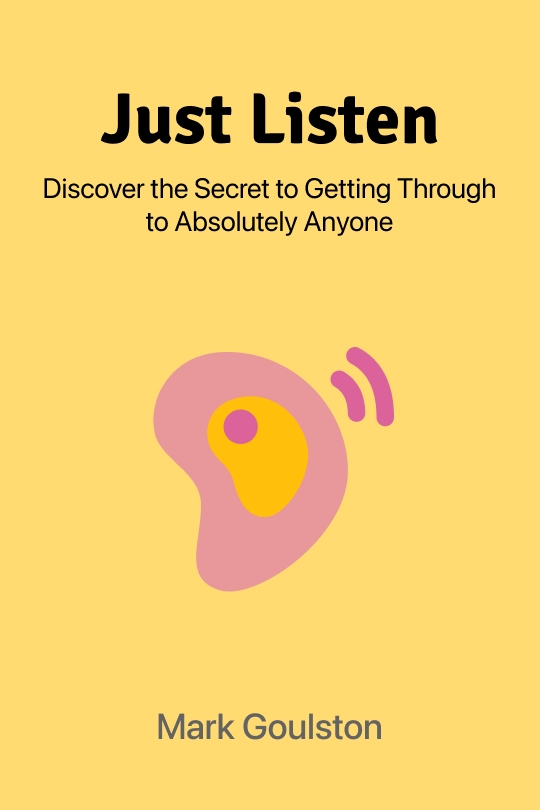
Just Listen: Discover the Secret to Getting Through to Absolutely Anyone
Mark Goulston
How to Win Friends & Influence People
Dale Carnegie

Breakthrough: The Quest for Life-Changing Medicines
Dr William Pao

Chip War: The Quest to Dominate the World's Most Critical Technology
Chris Miller
Blueprints: How mathematics shapes creativity
Marcus du Sautoy
The Psychology of Money: Timeless Lessons on Wealth, Greed, and Happiness
Morgan Housel
The Artist's Way
Julia Cameron
Code: The Hidden Language of Computer Hardware and Software
Charles Petzold
The Creative Habit
Twyla Tharp, Mark Reiter