
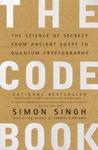
The Code Book: The Science of Secrecy from Ancient Egypt to Quantum Cryptography
"Decodes history's hidden battles, revealing how ciphers have shaped wars, nations, and the very fabric of modern privacy."
Nook Talks
- 1Cryptography is the ultimate intellectual weapon of history. Its development and breaking have directly decided the fates of empires, monarchs, and entire wars, proving that information security is a primary driver of geopolitical power.
- 2Understand the fundamental shift from steganography to cryptography. Secrecy evolved from merely hiding a message's existence to scrambling its content, a conceptual leap that created the formal science of codes and ciphers we recognize today.
- 3Grasp the mathematical elegance behind classical encryption methods. Systems like the Caesar shift, Vigenère cipher, and the Enigma machine are built on logical, often beautiful, mathematical principles that Singh renders accessible without oversimplification.
- 4Recognize the human drama in the codebreaking process. Cryptanalysis is not a dry technical exercise but a fierce intellectual duel, populated by brilliant, obsessive personalities from Mary, Queen of Scots to Alan Turing.
- 5Trace the revolution from symmetric to public-key cryptography. The invention of asymmetric encryption, a seemingly paradoxical concept, was the logistical breakthrough that enabled secure digital communication and modern e-commerce.
- 6Confront the existential threat quantum computing poses to encryption. The book culminates by exploring how quantum mechanics could shatter current cryptographic protocols, initiating a new arms race for post-quantum cryptographic solutions.
Simon Singh's The Code Book presents nothing less than a secret history of the world, told through the lens of cryptography. It argues that the struggle to conceal and reveal information—the making and breaking of codes—has been a decisive, yet often invisible, force in human affairs. From the clay tablets of ancient Mesopotamia to the diplomatic intrigues of Renaissance Europe, Singh establishes encryption as a constant companion to power, conspiracy, and war.
The narrative is propelled by a series of pivotal historical episodes where cryptography played a starring role. It details how the coded letters of Mary, Queen of Scots, sealed her fate; how the breaking of the French cipher known as the grand chiffre influenced European politics; and how the Allied breaking of the German Enigma and Japanese Purple ciphers arguably shortened World War II by years. Each case study is paired with remarkably clear technical explanations of the ciphers themselves, from simple substitution to complex polyalphabetic machines, demystifying the mathematics without sacrificing intellectual rigor.
Singh then guides the reader through the twentieth century's cryptographic revolution, culminating in the development of public-key cryptography by Whitfield Diffie, Martin Hellman, and Ralph Merkle. This conceptual breakthrough, which allows two parties to establish a secure connection over an open channel, is presented as the foundational innovation that made the internet a viable space for commerce and private communication. The book concludes by peering into the future, examining the promise and peril of quantum cryptography, which leverages the laws of physics to create potentially unbreakable codes.
More than a technical manual, The Code Book is a work of scientific and historical synthesis. It is targeted at the intellectually curious layperson, offering a compelling gateway into a complex field. By weaving together clear exposition, human drama, and grand historical sweep, Singh permanently alters the reader's understanding of how hidden patterns of information have silently shaped the course of civilization.
The critical consensus celebrates Singh's masterful synthesis as a paradigm of scientific storytelling. Readers are unanimously captivated by the seamless weaving of dense cryptographic theory with thrilling historical narrative, achieving a rare clarity that neither condescends nor obscures. The World War II sections, particularly the chronicle of Bletchley Park, are repeatedly singled out as narrative high points. The primary critique, albeit minor, notes that the book's later chapters on digital and quantum cryptography have inevitably aged, given the field's rapid advancement since publication.
- 1The brilliant balance between accessible mathematical explanation and gripping historical narrative, making complex concepts feel like a thriller.
- 2The pivotal role of Bletchley Park and the Enigma machine in WWII, highlighted as a landmark moment in intellectual history.
- 3The book's foundational role in demystifying cryptography for a general audience, serving as a perfect introductory text.
- 4Discussions on the evolving relevance of its chapters on digital security and quantum cryptography in the modern age.
The Lessons of History
Will Durant
The Essays of Warren Buffett: Lessons for Corporate America
Lawrence A. Cunningham, Warren Buffett

The Artist's Way
Julia Cameron
Sapiens: A Brief History of Humankind
Yuval Noah Harari
Bad Samaritans
Ha-Joon Chang

Outliers: The Story of Success
Malcolm Gladwell

The Almanack of Naval Ravikant
Naval Ravikant, Eric Jorgenson
Chip War: The Quest to Dominate the World's Most Critical Technology
Chris Miller

Vacuum Diagrams (Xeelee Sequence, #5)
Stephen Baxter
The Psychology of Money: Timeless Lessons on Wealth, Greed, and Happiness
Morgan Housel

Code: The Hidden Language of Computer Hardware and Software
Charles Petzold

Breath: The New Science of a Lost Art
James Nestor