
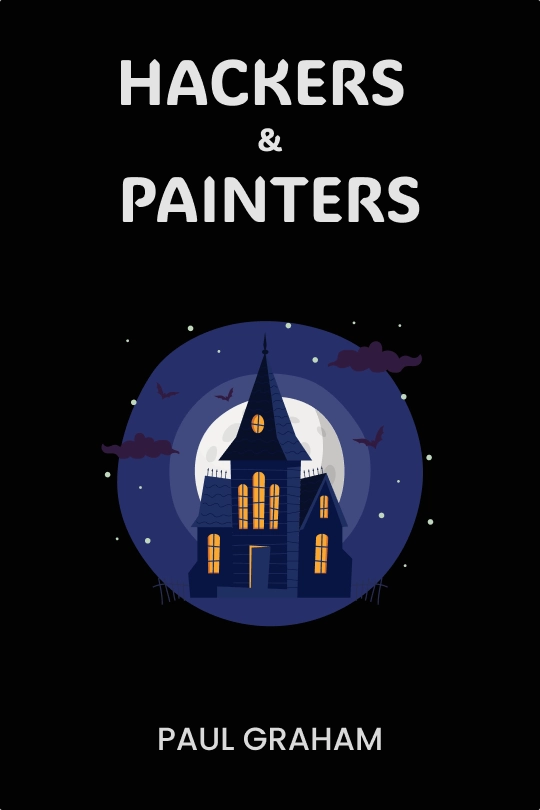
Hackers & Painters: Big Ideas from the Computer Age
"Reveals the creative soul of the hacker as an artist, entrepreneur, and architect of our digital world."
- 1[object Object]
- 2[object Object]
- 3[object Object]
- 4[object Object]
- 5[object Object]
- 6[object Object]
- 7[object Object]
Paul Graham’s Hackers & Painters is a seminal collection of essays that reframes the digital revolution not as a tale of engineering, but of artistry and iconoclasm. Graham, a programmer, venture capitalist, and essayist, posits that the creators of our software-saturated world—hackers—are the intellectual descendants of Renaissance painters and craftsmen. Their medium is code, and their driving force is a blend of deep curiosity, aesthetic sensibility, and a desire to make beautiful, useful things. The book serves as both a manifesto for this creative class and an anthropological study of their values, which often run counter to the established norms of business and academia.
Graham dismantles the misnomer of "computer science," arguing that hacking is a practice closer to the intuitive, iterative process of building or painting than to the formal methodologies of science. He explores the economic underpinnings of this world in his famous essay "How to Make Wealth," distinguishing wealth creation from mere money-making and championing startups as the modern engine for such creation. Further essays delve into the tools of the trade, mounting a vigorous and persuasive defense of powerful, expressive programming languages, with Lisp presented as the pinnacle—a language that grants its users a decisive strategic advantage.
The collection’s scope extends beyond pure technology into the social and intellectual conditions that foster innovation. In "What You Can't Say," Graham examines the mechanisms of social taboo and argues that the ability to identify and question contemporary heresies is a prerequisite for genuine thought. He traces the revenge of the intellectually curious "nerd," from marginalized schoolyard figure to the architect of the 21st century, analyzing how their outsider status shaped a culture obsessed with substance and meritocracy.
Hackers & Painters ultimately provides a coherent philosophy for the digital age. Its lasting impact lies in its synthesis of practical advice for entrepreneurs and programmers with a broader, humanistic critique of work, creativity, and societal convention. The book is essential reading for anyone building with technology, investing in ideas, or seeking to understand the forces and personalities that have designed the world we now inhabit.
The reader consensus celebrates the book's foundational and inspirational quality, valuing its lucid essays on wealth creation, startup philosophy, and the hacker mindset as timeless. Graham's passionate advocacy for Lisp and powerful programming languages is frequently cited as a transformative perspective, even by those who do not adopt the language. Criticisms are mild and pragmatic, noting that some technological references feel dated, but this does not diminish the core intellectual framework. The work is universally praised for its crisp, thought-provoking prose and its ability to articulate a coherent world-view for technical creators.
- 1The persuasive, almost evangelical argument for Lisp as the most powerful programming language and its practical relevance.
- 2The economic philosophy in 'How to Make Wealth' and its application to startups and personal career strategy.
- 3The central metaphor linking the creative processes of hackers and painters as a defining thesis.
- 4The analysis of 'nerd' psychology and social dynamics, which resonates deeply with many in the tech community.
- 5The concept of identifying social heresies ('What You Can't Say') as a tool for independent thinking.
The Creative Habit
Twyla Tharp, Mark Reiter
Code: The Hidden Language of Computer Hardware and Software
Charles Petzold
The Art of Contrarian Trading
Carl Futia
The Psychology of Money: Timeless Lessons on Wealth, Greed, and Happiness
Morgan Housel

Just Listen: Discover the Secret to Getting Through to Absolutely Anyone
Mark Goulston
Transformation in Christ
Dietrich Von Hildebrand
Vacuum Diagrams (Xeelee Sequence, #5)
Stephen Baxter
Bad Samaritans
Ha-Joon Chang
How to Win Friends & Influence People
Dale Carnegie
The Road to Financial Freedom
Bodo Schäfer
The Almanack of Naval Ravikant
Naval Ravikant, Eric Jorgenson
The Artist's Way
Julia Cameron