
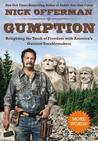
Gumption: Relighting the Torch of Freedom with America's Gutsiest Troublemakers
"A rugged, whiskey-soaked tour of American character, championing the defiantly practical individuals who built the nation with their hands and will."
- 1Redefine American heroism through practical craftsmanship. True greatness is found not in abstract ideals but in tangible skill and the quiet dignity of building something useful, from a piece of furniture to a more equitable society.
- 2Embrace a secular, humanist philosophy of self-reliance. The book posits that meaning and morality are derived from personal responsibility, critical thought, and community contribution, rather than from religious doctrine.
- 3Find inspiration in the stubbornness of principled dissent. Progress often depends on the gumption of troublemakers who challenge convention, demonstrating that polite agreement is less valuable than earnest, constructive disagreement.
- 4Integrate humor and irreverence into serious discourse. Anecdotes about woodworking and meat become philosophical vectors, arguing that levity is not antithetical to depth but a necessary tool for engaging with complex ideas.
- 5Connect historical legacy to contemporary personal action. By linking figures like Washington to modern artists, the narrative creates a living tradition, suggesting that the torch of freedom is relit through daily, deliberate choices.
Nick Offerman’s Gumption is less a standard history text and more a personal pilgrimage through the American ethos, guided by twenty-one individuals who embody, for the author, the nation's core spirit of defiant self-reliance. Framed as a secular sermon from a woodshop, the book constructs an alternative pantheon where founding fathers like George Washington and Benjamin Franklin stand alongside countercultural icons like Willie Nelson and Conan O’Brien, unified by their shared commitment to craft, integrity, and a certain rakish independence.
The biographical sketches are not exhaustive academic portraits but intimate appreciations, filtered through Offerman’s distinctive voice—a blend of erudition, folksy wisdom, and unabashed irreverence. Each chapter serves as a case study in applied character, examining how its subject’s specific talents—be it Roosevelt’s conservationist vigor, Eleanor Roosevelt’s diplomatic fortitude, or the artistic tenacity of a lesser-known craftsperson—forged a life of consequence. The methodology is anecdotal and philosophical, often digressing into Offerman’s own reflections on woodworking, agriculture, and the virtues of a well-cured steak.
This approach deliberately blurs the line between historical analysis and personal memoir, using the selected lives as mirrors for Offerman’s own values. The narrative threads connecting a pioneer like Frederick Douglass to a modern musician like Jeff Tweedy are woven from a consistent philosophy: that meaningful liberty is exercised through hands-on creation and principled dissent. The book argues that America’s foundational energy persists not in its institutions, but in the stubborn, creative grit of its individual troublemakers.
Ultimately, Gumption functions as a humanist manifesto for a pragmatic age, targeting readers weary of cynical political discourse and hungry for models of tangible, virtuous action. Its legacy lies in recasting patriotism as a personal workshop project, suggesting that the torch of freedom is maintained not through grand rhetoric, but through the daily, deliberate application of skill, humor, and unwavering personal integrity.
The consensus celebrates Offerman’s distinctive, witty voice and his eclectic, inspiring choice of subjects, which successfully blends humor with genuine historical insight. Readers consistently praise the book’s ability to make them admire both the profiled Americans and the author himself. However, a significant and vocal critique centers on Offerman’s overt secularism and dismissive tone toward organized religion, which some found alienating and unnecessarily provocative within an otherwise uplifting narrative.
- 1Offerman's charismatic and witty narrative voice as the primary driver of the book's appeal and readability.
- 2The author's explicitly secular, humanist perspective and its polarizing effect on religious readers.
- 3The eclectic and personal selection of 'great Americans,' spanning from founding fathers to modern comedians and musicians.
- 4The book's structure as a series of biographical appreciations rather than a linear argument or deep historical analysis.
The Creative Habit
Twyla Tharp, Mark Reiter

The Almanack of Naval Ravikant
Naval Ravikant, Eric Jorgenson
The Book of Basketball: The NBA According to The Sports Guy
Bill Simmons
Sapiens: A Brief History of Humankind
Yuval Noah Harari

How to Win Friends & Influence People
Dale Carnegie

Out of Control
Kevin Kelly
Breath: The New Science of a Lost Art
James Nestor

The Intelligent Investor
Benjamin Graham

Code: The Hidden Language of Computer Hardware and Software
Charles Petzold

Just Listen: Discover the Secret to Getting Through to Absolutely Anyone
Mark Goulston
Transformation in Christ
Dietrich Von Hildebrand
The Lessons of History
Will Durant