
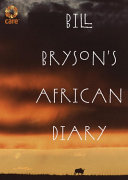
Bill Bryson's African Diary
"A witty, sobering dispatch from Kenya that transforms a charity trip into a masterclass in compassionate observation."
Nook Talks
- 1Confront the jarring reality of postcolonial urban poverty. The visceral depiction of Nairobi's Kibera slum, with its staggering density and disease, dismantles any romanticized Western notion of Africa, grounding the narrative in urgent human need.
- 2Observe how dedicated NGOs wage a grinding war on suffering. Bryson shadows CARE professionals, revealing their pragmatic, unglamorous battle against systemic poverty and corruption, highlighting the complex machinery of international aid.
- 3Let landscape and history correct preconceived caricatures. The vastness of the Great Rift Valley and the human fossil record in Nairobi's museum counter simplistic narratives, framing Kenya as a cradle of humanity, not just a site of crisis.
- 4Maintain humor as a tool for processing profound disparity. The author's trademark wryness persists, not as escapism but as a lens to navigate the emotional whiplash between breathtaking beauty and gut-wrenching deprivation.
- 5Recognize that one nation cannot encapsulate an entire continent. The diary consciously documents a specific Kenyan experience, implicitly arguing against the reductive tendency to treat Africa as a monolithic entity.
In late 2002, Bill Bryson accepted an invitation from the humanitarian organization CARE International to visit Kenya, a journey that would confront his own media-fed preconceptions of Africa. Armed with memories of jungle serials and a romanticized view from 'Out of Africa,' Bryson lands in Nairobi expecting clichés but is immediately engulfed by the continent's vibrant, complex reality. This slim volume, structured as a travel diary, documents his week-long immersion with the clear-eyed purpose of raising funds and awareness for CARE's anti-poverty work.
Bryson’s narrative oscillates between the staggering scale of human suffering and the majestic sweep of natural history. He guides the reader through the overwhelming confines of the Kibera slum, where poverty is rendered in intimate, devastating detail. These dispatches from the front lines of aid are juxtaposed with visits to sites of profound anthropological significance, such as the National Museum's fossil collections, and the breathtaking geography of the Great Rift Valley. The journey itself becomes a character, marked by a teeth-rattling train ride to Mombasa and a harrowing flight through a violent storm.
The diary’s power lies in its synthesis of observation and context. Bryson seamlessly weaves explanations of Kenya’s colonial legacy, economic challenges, and social structures into his daily accounts, educating without lecturing. He portrays the CARE workers not as saints but as determined professionals engaged in a pragmatic, often frustrating struggle against systemic obstacles. The prose carries his signature wit, but it is a darker, more reflective humor, tempered by the gravity of his surroundings.
Ultimately, this work serves as both a poignant snapshot of a nation in transition and a model for ethical travel writing. It is targeted at readers seeking to understand contemporary Africa beyond headlines, through the flawed but perceptive gaze of a master storyteller. The book’s legacy is its demonstration that a brief visit, when handled with humility and intellectual curiosity, can yield insights of lasting resonance, all while directing tangible support to the causes it describes.
The consensus acknowledges the book's charitable purpose and Bryson's engaging prose but critiques its limited scope, feeling the title promises a continental survey it does not deliver. Readers value the educational socioeconomic insights and the poignant, unvarnished look at Kenyan poverty and CARE's work. However, many find the tone unexpectedly somber, missing the author's typical levity, and consider the work more a compelling extended essay than a substantive addition to his travel canon.
- 1Debate over the misleading title 'African Diary' for a book solely about Kenya, seen as a reductive continental generalization.
- 2Appreciation for the seamless integration of Kenya's complex socioeconomic and colonial history into the travel narrative.
- 3Discussion on the book's darker, more sober tone compared to Bryson's other works, attributed to the grim subject matter.
- 4The value of the book's proceeds going to CARE International as a primary justification for purchase and praise.

Stumbling on Happiness
Daniel Gilbert

The Almanack of Naval Ravikant
Naval Ravikant, Eric Jorgenson

How to Win Friends & Influence People
Dale Carnegie
Radical Markets: Uprooting Capitalism and Democracy for a Just Society
Eric A. Posner, E. Glen Weyl
Sapiens: A Brief History of Humankind
Yuval Noah Harari
The Lessons of History
Will Durant

The Road to Financial Freedom
Bodo Schäfer

Amusing Ourselves to Death: Public Discourse in the Age of Show Business
Neil Postman
Transformation in Christ
Dietrich Von Hildebrand

The Intelligent Investor
Benjamin Graham
The Book of Basketball: The NBA According to The Sports Guy
Bill Simmons

Permanent Record
Edward Snowden