
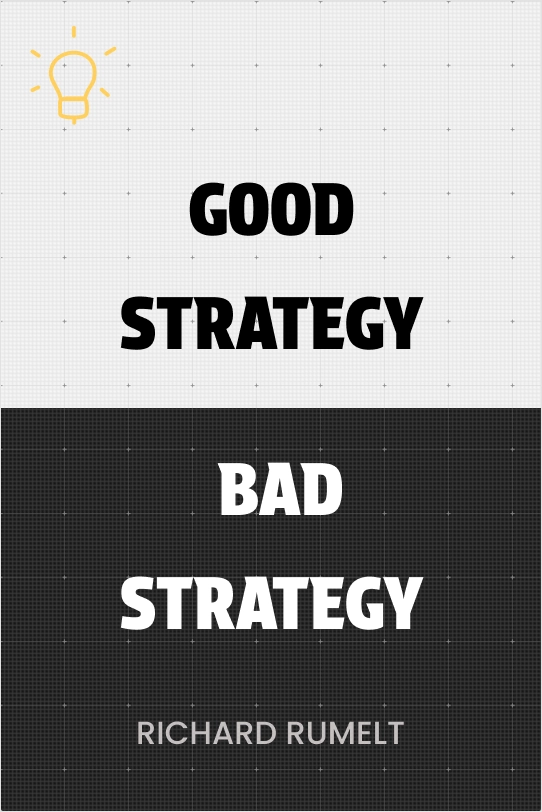
Good Strategy Bad Strategy: The Difference and Why It Matters
"It replaces motivational fluff with a rigorous, actionable kernel for diagnosing challenges and concentrating power."
Nook Talks
- 1[object Object]
- 2[object Object]
- 3[object Object]
- 4[object Object]
- 5[object Object]
- 6[object Object]
In a corporate and organizational landscape cluttered with empty visions and financial targets masquerading as plans, Richard Rumelt’s Good Strategy/Bad Strategy performs a vital act of intellectual clarification. The book argues that true strategy is a rare and disciplined response to challenge, not a feel-good statement of ambition. Rumelt begins by mercilessly dissecting the hallmarks of “bad strategy”: the fluff of undifferentiated buzzwords, the failure to confront the core problem, and the substitution of strategic thinking with simplistic goal-setting or leadership exhortations.
At the heart of Rumelt’s framework lies the deceptively simple “kernel” of good strategy, comprised of three elements: a clear diagnosis that cuts through complexity to name the critical challenge; a guiding policy that establishes an approach for overcoming that challenge; and a set of coherent actions designed to carry out the guiding policy. This kernel provides a universal template, applicable from Silicon Valley boardrooms to military campaigns. Rumelt then elaborates on the sources of strategic power—such as leverage, proximate objectives, and chain-link systems—that allow a well-constructed kernel to achieve disproportionate results.
The book’s argument is brought to life through a compelling series of case studies spanning business, nonprofit, and military history. Rumelt analyzes the strategic brilliance behind Apple’s turnaround under Steve Jobs, the incoherence that led to the decline of General Motors, and the strategic missteps in the Iraq War. These examples demonstrate how insight, not just analysis, is the catalyst for powerful strategy, revealing hidden asymmetries and points of leverage.
Good Strategy/Bad Strategy is ultimately a treatise on rigorous thought and decisive action for leaders in any field. It moves beyond abstract theory to offer pragmatic tools for diagnosing reality and concentrating effort. Its lasting impact is to restore the words “strategy” and “insight” to their proper, weighty meanings, providing a necessary antidote to the muddled thinking that pervades modern organizational life.
The critical consensus praises the book's foundational and clarifying framework, hailing the 'kernel' concept as a transformative lens for cutting through managerial noise. Readers consistently value the potent historical and business case studies that ground the theory. A recurring critique, however, targets the latter sections on 'sources of power' as less cohesive and impactful than the brilliant initial dissection of good versus bad strategy, with some finding the prose occasionally repetitive.
- 1The transformative clarity of the core 'kernel' framework (diagnosis, guiding policy, coherent action) for practical strategy.
- 2The effectiveness and memorability of the book's historical and business case studies in illustrating strategic principles.
- 3Debate over the cohesion and value of the later chapters on the 'sources of power' compared to the strong foundational concepts.
Bad Samaritans
Ha-Joon Chang
The Creative Habit
Twyla Tharp, Mark Reiter

How to Win Friends & Influence People
Dale Carnegie

The Fifth Discipline
Peter M. Senge

The Artist's Way
Julia Cameron

Code: The Hidden Language of Computer Hardware and Software
Charles Petzold

Out of Control
Kevin Kelly

No Rules Rules: Netflix and the Culture of Reinvention
Reed Hastings, Erin Meyer

Stumbling on Happiness
Daniel Gilbert

Chip War: The Quest to Dominate the World's Most Critical Technology
Chris Miller

The Psychology of Money: Timeless Lessons on Wealth, Greed, and Happiness
Morgan Housel

Breath: The New Science of a Lost Art
James Nestor