
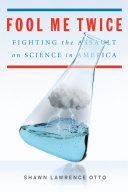
Fool Me Twice: Fighting the Assault on Science in America
"A trenchant defense of empiricism against the political and media forces eroding America's capacity for rational governance."
- 1Democracy requires an informed, scientifically literate citizenry to function. The American experiment, as conceived by Jefferson and Franklin, presupposes a public capable of engaging with evidence. The deliberate undermining of scientific consensus represents a direct threat to the foundational logic of self-governance.
- 2Journalistic false balance actively distorts public understanding of science. The media's insistence on presenting 'both sides' of settled scientific issues, like climate change, grants illegitimate parity to fringe views. This elevates opinion over evidence and manufactures artificial controversy where none exists.
- 3Political antiscience is a strategic, well-funded assault on policy. Denialism on issues from vaccines to climate is not ignorance but a calculated political project. It aims to paralyze regulatory action by sowing doubt, protecting entrenched economic interests from evidence-based reform.
- 4Scientific illiteracy in government creates a critical governance deficit. With less than 2% of Congress having a professional science background, legislative bodies lack the fundamental literacy to address complex modern challenges, from pandemics to environmental collapse, leading to magical thinking as policy.
- 5The 'Climategate' scandal was a masterclass in manufactured outrage. The misrepresentation of technical scientific jargon as conspiracy revealed how complex, nuanced research can be weaponized by bad-faith actors to discredit entire fields and derail essential public discourse.
Shawn Lawrence Otto’s Fool Me Twice is a forensic examination of the systemic and deliberate erosion of science’s role in American public life and policy. It posits that the nation’s founding compact—a republic dependent on an informed electorate—is unraveling under the strain of complex, science-driven challenges and a concerted political effort to replace empirical reasoning with ideology. The book frames this not as an academic concern but as an existential crisis for democratic governance, where decisions on climate, energy, health, and education are increasingly severed from factual reality.
Otto meticulously documents the mechanisms of this assault, beginning with the profound scientific illiteracy within the U.S. Congress and the media’s failure to accurately communicate scientific consensus. He dissects the journalistic norm of false equivalence, which grants fringe viewpoints equal weight with established science, thereby corrupting public understanding. The narrative delves into specific case studies, including the orchestrated controversy of 'Climategate,' where stolen emails were willfully misconstrued to undermine climate science, and the popular but deeply flawed counterarguments presented in works like SuperFreakonomics.
The analysis extends to the political economy of denialism, tracing how corporate interests and ideological movements fund campaigns to sow doubt on issues from evolution to vaccine safety. Otto argues this creates a feedback loop: a poorly informed public elects scientifically illiterate leaders, who then enact policies that further degrade educational and informational systems. The result is a government passing resolutions denying climate change while the physical world manifests its consequences.
Ultimately, Fool Me Twice serves as both a dire warning and a call to arms. It is essential reading for anyone concerned with the integrity of public discourse, the functionality of democracy in the 21st century, and the urgent need to rebuild a civic culture that respects evidence, expertise, and the scientific method as non-negotiable pillars of societal survival and progress.
Readers overwhelmingly praise the book as a vital, clarion call, hailing its rigorous and impassioned defense of science as a civic necessity. The consensus finds Otto’s synthesis of political strategy, media failure, and historical context both enlightening and profoundly alarming. A common critique, however, notes the prose can become dense with detail, and some wish for more visual aids to clarify complex data narratives. The work is universally regarded as accessible to a non-specialist but demanding in its intellectual seriousness.
- 1The media's 'false balance' doctrine and its catastrophic role in distorting public understanding of scientific consensus.
- 2In-depth analysis and debunking of the 'Climategate' scandal as a deliberate misinformation campaign.
- 3Critique of the scientific illiteracy in Congress and its direct impact on ineffective national policy.
- 4The evaluation of popular counter-arguments, specifically the treatment of *SuperFreakonomics*' flawed climate solutions.
Stumbling on Happiness
Daniel Gilbert

Outliers: The Story of Success
Malcolm Gladwell
Radical Markets: Uprooting Capitalism and Democracy for a Just Society
Eric A. Posner, E. Glen Weyl
The Lessons of History
Will Durant

Code: The Hidden Language of Computer Hardware and Software
Charles Petzold

The Road to Financial Freedom
Bodo Schäfer

The Artist's Way
Julia Cameron

Permanent Record
Edward Snowden
Bad Samaritans
Ha-Joon Chang
Amusing Ourselves to Death: Public Discourse in the Age of Show Business
Neil Postman

Chip War: The Quest to Dominate the World's Most Critical Technology
Chris Miller

Out of Control
Kevin Kelly