
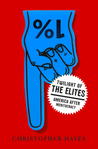
Twilight of the Elites: America After Meritocracy
"Meritocracy's promise of equal opportunity has produced an insular, self-perpetuating elite that corrodes public trust and institutional competence."
- 1Meritocracy inevitably creates a self-perpetuating elite class. The mechanisms designed to reward merit—standardized testing, selective education—become tools for the elite to hoard opportunity and transmit advantage to their children, solidifying a new aristocracy.
- 2Elite insularity breeds catastrophic institutional failure. Social distance from the general populace leads to groupthink and a detachment from consequences, resulting in systemic failures like the financial crisis and the Iraq War.
- 3Inequality of outcome destroys equality of opportunity. Extreme income disparity allows the wealthy to purchase superior education and access, rendering the meritocratic ladder a fiction for those not born into privilege.
- 4The social contract fractures under a crisis of authority. Repeated elite failures—in finance, government, and media—evaporate public trust, creating a vacuum where populist anger and conspiracy theories can flourish.
- 5The 'Fail Decade' exposed meritocracy's fundamental corruption. The sequential implosions of Wall Street, Congress, and the Catholic Church in the 2000s were not isolated events but symptoms of a meritocratic system rotting from the top down.
- 6Trans-partisan activism is necessary to restore balance. Addressing corrosive inequality requires a coalition that transcends traditional left-right divides, harnessing the energy of both the Tea Party and Occupy movements toward tax and policy reform.
Christopher Hayes’s "Twilight of the Elites" presents a trenchant diagnosis of America’s institutional decay, tracing its source to the paradoxical failures of the meritocratic ideal. The book argues that the post-1960s project of creating a fair, competitive system for selecting leaders has instead spawned a new, more entrenched elite. This elite, convinced of its own righteousness through the very mechanisms that selected it, has become socially isolated, ethically complacent, and prone to spectacular, cascading failures that define what Hayes terms the "Fail Decade."
Hayes meticulously charts how meritocracy’s core mechanisms—standardized testing, elite education, and competitive professional tournaments—function not as engines of mobility but as filters that legitimize inequality. Those who ascend are acculturated into a caste that justifies its position through the language of earned success, blinding itself to the structural advantages it enjoys. This insularity creates what he calls the "iron law of oligarchy," where every meritocratic institution eventually devises ways to close ranks and perpetuate itself, severing the connection between talent and opportunity for the broader populace.
The analysis moves from theory to vivid historical autopsy, examining case studies of elite failure: the Catholic Church sex abuse cover-ups, the intelligence and planning debacles of the Iraq War, the Wall Street recklessness that triggered the 2008 financial collapse, and the bureaucratic indifference evident in the response to Hurricane Katrina. In each, Hayes identifies a pattern of groupthink, corrupted incentive structures, and a profound distance between decision-makers and the consequences of their actions.
Ultimately, the book is a work of prescient social criticism that frames our contemporary crisis of authority. It posits that restoring trust requires confronting the inequality that meritocracy exacerbates, suggesting that a trans-partisan political realignment may be the only path to reforming a system that is forgiving at the top and ruthlessly punitive at the bottom. "Twilight of the Elites" serves as an essential framework for understanding the populist upheavals and deep institutional skepticism that define twenty-first-century American politics.
Readers acclaim the book's prescient and compelling thesis, finding it a vital key to understanding modern political disillusionment and the rise of populist figures. The argument is praised for its clarity and forceful synthesis of disparate societal failures into a coherent critique of meritocratic decay. Some critics find the proposed solutions less developed than the diagnostic analysis, wishing for a more concrete policy roadmap. The writing is consistently described as accessible and engaging, translating complex sociological ideas into a urgent and readable narrative.
- 1The book's eerie prescience regarding the populist rise and election of Donald Trump following its publication.
- 2Debate over whether Hayes's critique condemns meritocracy itself or merely its corrupted, unequal implementation.
- 3Discussion of the "Fail Decade" case studies and which institutional collapse most powerfully illustrates the elite failure thesis.
- 4Analysis of the proposed solution: is trans-partisan activism a realistic path to reform or an optimistic abstraction?
Radical Markets: Uprooting Capitalism and Democracy for a Just Society
Eric A. Posner, E. Glen Weyl

Amusing Ourselves to Death: Public Discourse in the Age of Show Business
Neil Postman

Sapiens: A Brief History of Humankind
Yuval Noah Harari

The Almanack of Naval Ravikant
Naval Ravikant, Eric Jorgenson

Permanent Record
Edward Snowden

The Psychology of Money: Timeless Lessons on Wealth, Greed, and Happiness
Morgan Housel

Chip War: The Quest to Dominate the World's Most Critical Technology
Chris Miller
Stumbling on Happiness
Daniel Gilbert
The Crash Course
Chris Martenson

Out of Control
Kevin Kelly
The Essays of Warren Buffett: Lessons for Corporate America
Lawrence A. Cunningham, Warren Buffett

The Lessons of History
Will Durant