
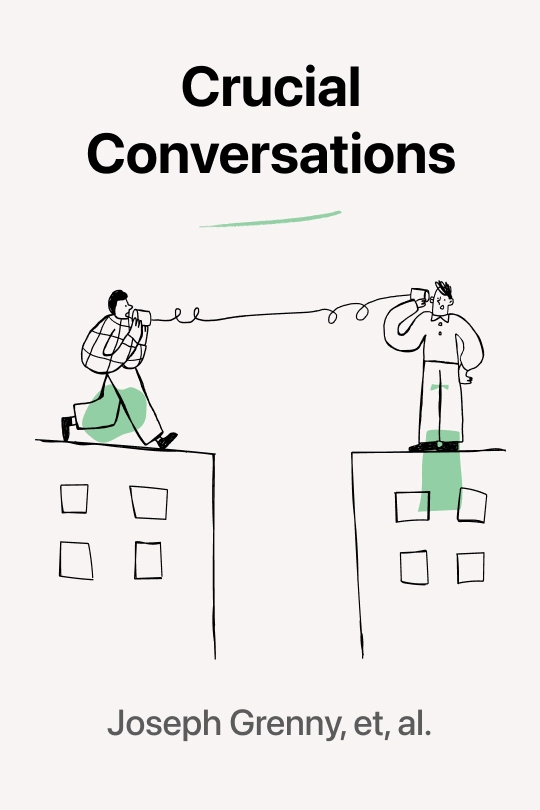
Crucial Conversations : Tools for Talking When Stakes Are High
"Master the art of dialogue to transform high-stakes conflict into collaboration and results."
Nook Talks
- 1Make the conversation safe before addressing content. Psychological safety is the prerequisite for honest dialogue. When people feel threatened, they resort to silence or violence; establishing mutual purpose and respect disarms defensiveness and opens the path to productive talk.
- 2Separate facts from your story to master your emotions. Emotions are self-generated narratives built on observed facts. By consciously distinguishing the objective event from your subjective interpretation, you regain control and can choose a more constructive response.
- 3Start with heart by clarifying your true purpose. Anchor yourself in what you genuinely want for yourself, the other person, and the relationship. This internal clarity prevents you from being hijacked by pride or fear during the emotional heat of a crucial moment.
- 4State your path: share facts, tell your story, ask for others' paths. A structured approach to speaking persuasively begins with uncontestable facts, explains your tentative conclusion, and then sincerely invites the other person's perspective, creating a shared pool of meaning.
- 5Listen actively when others move to silence or violence. Anger or withdrawal is a signal of felt unsafe. Listen for the underlying meaning, paraphrase to confirm understanding, and probe gently to restore safety and return to a mutual dialogue.
- 6Move from dialogue to decisive action and clear follow-up. A successful conversation must culminate in a clear decision—whether by command, consultation, vote, or consensus—with specific agreements on who will do what by when, ensuring ideas translate into results.
Crucial Conversations dismantles the mystery of why we often fail in our most important discussions. It defines a crucial conversation as any interaction where stakes are high, opinions vary, and emotions run strong—the very moments that determine the quality of our relationships, careers, and organizations. The book posits that the ability to handle these moments skillfully is not an innate talent but a learnable set of competencies, and it provides a systematic framework to navigate them from breakdown to breakthrough.
The methodology is built on a foundation of self-awareness and intentionality. It begins with "Starting with Heart," urging individuals to focus on what they truly want from the conversation, a move that prevents common derailments like seeking victory or punishing the other party. The core operational skill is creating and maintaining a "Pool of Shared Meaning," where all participants feel safe enough to contribute their perspectives without fear. The book provides concrete tools for building this safety, such as establishing mutual purpose and mutual respect, and for speaking persuasively without provoking defensiveness through the "STATE" method (Share your facts, Tell your story, Ask for others’ paths, Talk tentatively, Encourage testing).
Equally critical is the skill of listening. When others retreat into silence (withholding meaning) or escalate into violence (forcing meaning), the book teaches strategies to listen for underlying emotions and meanings, to paraphrase, and to probe, thereby restoring safety and returning to dialogue. This is not mere technique; it requires a genuine shift in one's internal narrative, learning to separate observable facts from the emotionally charged stories we tell ourselves about those facts.
Ultimately, Crucial Conversations is a pragmatic field manual for professional and personal life. Its impact lies in translating complex psychological and communication theory into actionable steps, making it essential for leaders, managers, team members, and anyone seeking to transform conflict into collaboration. The book’s legacy is its demonstration that the most difficult conversations, when handled well, become catalysts for innovation, trust, and aligned action.
The consensus hails this as a profoundly practical and transformative guide, distinct from generic business advice. Readers consistently praise its actionable framework for defusing conflict and building psychological safety, noting its immediate applicability in both professional and personal spheres. A recurring critique points to a degree of repetition in the text and a style some find overly formulaic, yet even these reviewers concede the underlying principles are invaluable. The book is widely regarded as accessible, with its real-world examples making complex interpersonal dynamics manageable.
- 1The transformative power of focusing on 'what I really want' to reframe heated personal and professional arguments.
- 2Debate on whether the 'STATE' method feels like a rigid formula or an essential script for difficult talks.
- 3The practical challenge of separating facts from stories in the heat of the moment to manage one's own emotions.
- 4High praise for the concept of creating psychological safety as the non-negotiable foundation for any crucial conversation.

Bad Samaritans
Ha-Joon Chang

Out of Control
Kevin Kelly

Code: The Hidden Language of Computer Hardware and Software
Charles Petzold

The Psychology of Money: Timeless Lessons on Wealth, Greed, and Happiness
Morgan Housel

Breath: The New Science of a Lost Art
James Nestor

No Rules Rules: Netflix and the Culture of Reinvention
Reed Hastings, Erin Meyer

Chip War: The Quest to Dominate the World's Most Critical Technology
Chris Miller

Permanent Record
Edward Snowden

The Fifth Discipline
Peter M. Senge

The Essays of Warren Buffett: Lessons for Corporate America
Lawrence A. Cunningham, Warren Buffett
The Creative Habit
Twyla Tharp, Mark Reiter

The Art of Contrarian Trading
Carl Futia