
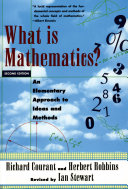
What is Mathematics?
"It restores the soul of mathematics, transforming abstract rules into a living, coherent story of intellectual discovery."
- 1Mathematics is a unified landscape, not a collection of drills. The book presents mathematics as an interconnected intellectual ecosystem, where concepts from number theory inform geometry and calculus, revealing a discipline driven by curiosity rather than rote procedure.
- 2True understanding requires grasping the 'why' behind the 'how'. It argues that mathematical literacy decays into mechanical application without a foundational comprehension of the principles and historical problems that gave rise to its methods and notations.
- 3Begin with concrete problems to ascend to abstract ideas. Courant and Robbins employ a pedagogical method that anchors complex theories in tangible puzzles and physical analogies, building a conceptual ladder from the familiar to the profound.
- 4Mathematical beauty lies in elegant proofs and deep connections. The text curates proofs and constructions that demonstrate the aesthetic dimension of mathematics, where simplicity and power converge, offering intrinsic intellectual reward beyond utility.
- 5Independent chapters invite nonlinear, curiosity-driven exploration. The modular structure liberates the reader from a forced march, allowing a personalized journey through topics from projective geometry to the Continuum Hypothesis based on interest.
- 6The frontier of mathematics is alive with solved and open problems. Ian Stewart's new chapter grounds the classic text in modern progress, detailing the proofs of landmark conjectures like Fermat's Last Theorem, illustrating the field's ongoing evolution.
What Is Mathematics? confronts a central crisis in education: the reduction of a profound, creative discipline to a sterile set of memorized algorithms. Courant and Robbins wrote not as mere expositors, but as evangelists for mathematical meaning. Their mission is to rebuild the connective tissue between technical skill and genuine understanding, to demonstrate that mathematics is a realm of ideas as vibrant and narrative-driven as any work of literature or journalism.
Proceeding from the natural numbers, the book constructs a grand tour of the mathematical world. It explores the conceptual foundations of the number system, unveils the intuitive logic of geometrical constructions, and demystifies the calculus as a tool for capturing motion and change. The journey continues into more abstract territories—topology, projective geometry, and the nature of infinity—but always with a focus on the motivating questions and the elegance of the solutions. The chapters are largely self-contained, allowing the reader to delve into Fermat’s theorem or the Four-Color Problem without being a passive follower of a linear curriculum.
The methodology is Socratic, favoring problem-solving and heuristic reasoning over axiomatic pronouncements. It shows mathematics in the making, emphasizing how mathematicians think rather than just what they know. This approach reveals the subject as an organic whole, where insights from algebra illuminate problems in geometry, creating a cohesive intellectual story.
This second edition, augmented by Ian Stewart, bridges the classic and the contemporary. It serves as both a timeless introduction to mathematical thinking for the curious beginner and a refreshing synthesis for the seasoned scholar or educator, reaffirming the book's status as a portal to the soul of the discipline.
The readership is sharply divided, creating a polarized consensus. A passionate cohort venerates the book as a masterpiece of exposition—a transformative, beautifully written portal that makes higher mathematics accessible and thrilling, often cited as an ideal gift for the precocious student. An equally vocal faction finds it a profound failure in its core mission, criticizing its abrupt, often abstract presentation as daunting and poorly scaffolded for true beginners, more akin to an encyclopedia than a guided tour. The central critique is a lack of pedagogical hooks for the non-specialist.
- 1The book's suitability as a gift for talented high school students versus its intimidating, encyclopedia-like density for beginners.
- 2Praise for the elegant writing and holistic view of mathematics as a unified story, contrasted with frustration over its abstract leaps.
- 3Debate over whether the algebra and analysis sections provide brilliant insight or if the broad topical coverage is ultimately overwhelming.
- 4Specific endorsement of the chapter on fractals as a highlight of abstract yet compelling mathematical exposition.

How to Win Friends & Influence People
Dale Carnegie
Transformation in Christ
Dietrich Von Hildebrand

Out of Control
Kevin Kelly
Sapiens: A Brief History of Humankind
Yuval Noah Harari
The Psychology of Money: Timeless Lessons on Wealth, Greed, and Happiness
Morgan Housel
Outliers: The Story of Success
Malcolm Gladwell
The Creative Habit
Twyla Tharp, Mark Reiter
The Crash Course
Chris Martenson
The Art of Contrarian Trading
Carl Futia
The Lessons of History
Will Durant
The Essays of Warren Buffett: Lessons for Corporate America
Lawrence A. Cunningham, Warren Buffett
The Artist's Way
Julia Cameron