
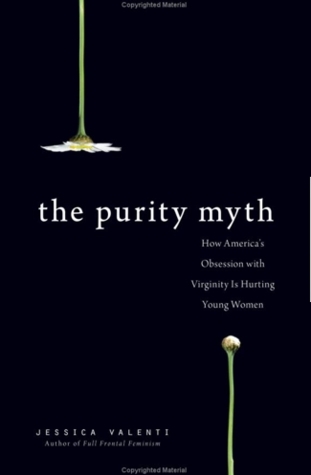
The Purity Myth: How America's Obsession with Virginity is Hurting Young Women
"It dismantles the patriarchal valuation of female morality through sexual history, freeing women from a corrosive cultural script."
- 1Decouple female morality from sexual behavior. The book argues that a woman's ethical character should be judged by values like honesty and kindness, not by her virginity or sexual history, which is a patriarchal construct designed for control.
- 2Recognize the hypocrisy of the purity-industrial complex. Valenti exposes how abstinence-only education, media, and religious institutions profit from and perpetuate a damaging obsession with chastity, often while ignoring male sexuality entirely.
- 3Understand purity as a political tool, not a virtue. The concept of purity has historically been used to regulate women's bodies, restrict their autonomy, and justify public shaming, serving social control rather than genuine ethical development.
- 4Reject the virgin/whore binary as a measure of worth. This false dichotomy reduces women's complex humanity to a single sexual metric, creating a culture where women are either infantilized virgins or dehumanized sluts, with no dignified middle ground.
- 5Critique the convergence of abstinence culture and hypersexualized media. The book analyzes how the opposing forces of puritanical abstinence messaging and exploitative 'Girls Gone Wild' pornography both derive value from reducing women to their sexual status.
- 6Build a future based on comprehensive sexuality education. The solution lies in replacing fear-based abstinence curriculum with honest, empowering education that treats sexuality as a normal aspect of human development, not a perilous commodity.
In "The Purity Myth," Jessica Valenti launches a trenchant cultural critique of America's singular fixation on female virginity, positioning it not as a benign social more but as a pervasive and damaging ideology. She argues that this obsession forms the bedrock of a system that equates a young woman's entire moral worth with her sexual history, creating a reductive and impossible standard. This framework, Valenti contends, is propagated across a surprising spectrum—from government-funded abstinence-only programs to the voyeuristic spectacle of reality television—all of which conspire to define girls primarily through their sexuality.
Valenti meticulously traces the historical and religious roots of the purity concept, demonstrating how it has been weaponized to control women's autonomy and justify public punishment for sexual activity. She dissects the modern "purity-industrial complex," where rings, balls, and pledges commodify chastity, and contrasts this with a media landscape that simultaneously hypersexualizes young women. This dual pressure, she reveals, leaves no room for a healthy, integrated female identity; a woman is either a pristine object to be protected or a degraded object to be consumed.
The analysis extends to the political arena, where Valenti examines how rhetoric around purity and abstinence is leveraged for policy goals, often at the direct expense of women's health and education. She deconstructs the flawed logic of abstinence-until-marriage programs, highlighting their empirical failures and their role in perpetuating shame and misinformation. The book serves as both a diagnosis of a corrosive social myth and a manifesto for its dismantling, advocating for a shift in values from sexual status to substantive character.
Ultimately, "The Purity Myth" is a foundational text of contemporary feminism, aimed at readers seeking to understand the structural forces shaping gender norms. Its legacy lies in empowering a generation to reject a paradigm that limits female potential, arguing convincingly that true liberation requires severing the archaic link between a woman's body and her soul.
Readers largely praise the book's vital and eye-opening thesis, crediting it with articulating a pervasive cultural pressure they felt but could not name. Many describe it as a transformative, empowering read that validates personal experience. Criticisms focus on a perceived lack of depth in certain historical analyses and a writing style some find repetitive or overly polemical for an academic text. The consensus is that its core argument remains powerfully relevant and necessary, even if its execution occasionally prioritizes persuasive force over nuanced exploration.
- 1The book's validation of personal experience for women who felt shamed by purity culture, described as 'putting words to a feeling.'
- 2Debates on the writing style, with some finding it refreshingly direct and others criticizing it as overly simplistic or rant-like.
- 3Discussions about the book's relevance to readers from conservative religious backgrounds versus those from more secular upbringings.
- 4Analysis of whether the book adequately addresses intersections of race, class, and sexuality in the experience of the purity myth.
Breath: The New Science of a Lost Art
James Nestor

Amusing Ourselves to Death: Public Discourse in the Age of Show Business
Neil Postman

How to Win Friends & Influence People
Dale Carnegie
Stumbling on Happiness
Daniel Gilbert
Bad Samaritans
Ha-Joon Chang

Code: The Hidden Language of Computer Hardware and Software
Charles Petzold

The Road to Financial Freedom
Bodo Schäfer

The Psychology of Money: Timeless Lessons on Wealth, Greed, and Happiness
Morgan Housel
The Art of Contrarian Trading
Carl Futia

The Essays of Warren Buffett: Lessons for Corporate America
Lawrence A. Cunningham, Warren Buffett
Radical Markets: Uprooting Capitalism and Democracy for a Just Society
Eric A. Posner, E. Glen Weyl

Permanent Record
Edward Snowden