
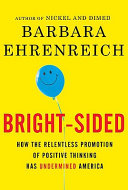
Bright-sided
"A trenchant critique of how mandatory optimism fosters personal blame and enables national-scale financial and cultural recklessness."
- 1Trace positive thinking's evolution from fringe therapy to cultural dogma. Ehrenreich documents its journey from a 19th-century metaphysical healing practice to a compulsory, profit-driven ideology embedded in religion, medicine, and corporate culture, stripping it of its historical context.
- 2Identify the direct link between positive thinking and economic crisis. The book argues that the business world's institutionalized refusal to consider negative outcomes, like mortgage defaults, created a collective blindness that precipitated the 2008 financial collapse.
- 3Recognize the personal tyranny of relentless positivity. It exposes how the mandate to be optimistic leads to victim-blaming, where failure is attributed to a poor mental attitude rather than systemic problems, causing profound psychological harm.
- 4Distinguish between hope and the coercion of positive thought. Ehrenreich champions clear-eyed, rational hope grounded in reality, rejecting the fraudulent, commercially packaged optimism that demands the suppression of legitimate fear and criticism.
- 5Critique the pseudo-scientific legitimization of positive psychology. The work dismantles the academic and medical endorsement of positive thinking, challenging its purported health benefits and its role in deflecting attention from social and political analysis.
- 6Call for existential courage over delusional cheer. The final argument is for a stance of courageous realism—facing life's uncertainties and injustices with clarity and a commitment to tangible action, not magical thinking.
In "Bright-Sided," Barbara Ehrenreich launches a formidable investigation into America's cult of compulsory optimism, tracing its curious lineage from the nineteenth-century New Thought movement to its contemporary reign as a national secular religion. She reveals how a marginal philosophy of mind-over-matter healing was gradually stripped of its mystical origins and repackaged as a pragmatic tool for personal and material gain. This evolution positioned positive thinking not as a mere temperament but as a non-negotiable recipe for health, wealth, and divine favor.
Ehrenreich meticulously charts the ideology's colonization of major American institutions. She examines its embrace by evangelical megachurches preaching a "prosperity gospel," its prescription by a medical industry eager for low-cost placebo effects, and its academic legitimization through the rise of "positive psychology." The most consequential adoption, however, occurred in corporate boardrooms, where strategic planning was supplanted by vision boards and the ritualized chanting of affirmations, creating an environment hostile to risk assessment and dissenting analysis.
The book's core polemic demonstrates how this enforced cheerfulness produces profound societal and personal damage. On a systemic level, it fostered the irrational exuberance that led to the 2008 financial crash, as bankers and regulators refused to entertain negative possibilities. On an individual level, it pathologizes normal human emotions like grief and anger, transforming social and economic misfortune into a private failure of attitude. This internalization leads to a morbid self-policing for "negative" thoughts and a paralysis of critical civic engagement.
Ultimately, Ehrenreich’s work is a clarion call for intellectual integrity and existential courage. It is targeted at anyone skeptical of quick-fix self-help mantras and concerned about the erosion of rational discourse. By arguing for a clear-eyed realism that acknowledges struggle and injustice, "Bright-Sided" seeks to reclaim the space for authentic hope—a hope built on honest appraisal and collective action, not on wishful delusion.
The consensus finds Ehrenreich's thesis powerfully convincing and critically necessary, with many readers expressing relief at its validation of their skepticism toward toxic positivity. The book is praised for its rigorous research, sharp wit, and timely critique of self-help culture. Primary criticisms focus on a perceived repetitiveness in the argument and a tone some find overly polemical or dismissive of positive psychology's nuances. It is regarded as an accessible and galvanizing read for those already inclined to question mainstream optimism.
- 1The direct correlation between corporate-mandated positive thinking and the 2008 financial crisis, highlighting willful ignorance of risk.
- 2Criticism of the 'prosperity gospel' and its manipulation of faith to justify wealth as a divine reward for correct thinking.
- 3The personal harm of 'toxic positivity,' where victims of circumstance are blamed for not maintaining a sufficiently optimistic mindset.
- 4Debates on the validity of positive psychology as a science versus a commercially-driven ideology masquerading as academia.
- 5The application of Ehrenreich's critique to contemporary workplace culture, including mandatory morale-building exercises and visionary jargon.

Out of Control
Kevin Kelly

Just Listen: Discover the Secret to Getting Through to Absolutely Anyone
Mark Goulston

The Creative Habit
Twyla Tharp, Mark Reiter
Radical Markets: Uprooting Capitalism and Democracy for a Just Society
Eric A. Posner, E. Glen Weyl

Bad Samaritans
Ha-Joon Chang

The Psychology of Money: Timeless Lessons on Wealth, Greed, and Happiness
Morgan Housel

How to Win Friends & Influence People
Dale Carnegie

The Artist's Way
Julia Cameron

Amusing Ourselves to Death: Public Discourse in the Age of Show Business
Neil Postman

Permanent Record
Edward Snowden
Stumbling on Happiness
Daniel Gilbert

Chip War: The Quest to Dominate the World's Most Critical Technology
Chris Miller