
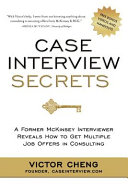
Case Interview Secrets
"A former insider demystifies the consulting case interview, transforming its arcane rituals into a replicable, masterable discipline."
- 1Master a core set of versatile business frameworks. Success hinges not on a vast library of models, but on deep, flexible fluency in a few—profitability, business situation, and M&A frameworks—that can be adapted to dissect any corporate dilemma.
- 2Treat practice as a non-negotiable, quantitative investment. Competence requires 50-100 hours of deliberate practice; this volume internalizes mental models and builds the unflappable confidence needed to perform under the intense scrutiny of the interview room.
- 3Structure your communication with ruthless clarity. The interviewer evaluates your thought process, not just your answer. A structured, hypothesis-driven approach—articulated step-by-step—demonstrates logical rigor and executive-grade problem-solving aptitude.
- 4Differentiate between candidate-led and interviewer-led cases. The dynamics and expectations shift dramatically between these formats. Adapting your pace, depth of inquiry, and leadership in the conversation is critical for navigating each successfully.
- 5Synthesize quantitative analysis with qualitative insight. Moving seamlessly from number-crunching to strategic implication shows you can translate data into actionable business judgment, which is the essence of the consultant's role.
The management consulting case interview remains one of the most formidable and opaque gateways in professional recruitment, a high-stakes performance where elite firms like McKinsey, Bain, and BCG assess raw intellectual horsepower and structured thinking. Victor Cheng’s Case Interview Secrets operates as a master key to this process, written from the privileged vantage point of a former McKinsey interviewer who has also coached hundreds of candidates. It systematically deconstructs the interview from both sides of the table, revealing not just what answers are sought, but how the evaluation apparatus functions—the hidden criteria, the common pitfalls, and the subtle signals that separate a pass from an offer.
The book’s methodology is grounded in a pragmatic, framework-based approach. Cheng argues against memorizing dozens of generic models, advocating instead for deep mastery of a few core frameworks—particularly those for profitability, general business situations, and mergers & acquisitions—that can be flexibly applied across myriad scenarios. He provides concrete examples and dissects the anatomy of a perfect response, emphasizing a hypothesis-driven structure where candidates must vocalize their logic, guide the analysis, and drive toward a synthesized recommendation. Crucially, it distinguishes between candidate-led and written case formats, outlining tailored strategies for each.
Beyond theory, Cheng insists on practice as the non-negotiable differentiator, quantifying the commitment required for fluency. The text is augmented with references to online resources for further framework elaboration and math drill, positioning the book as the central node in a broader preparation ecosystem. This transforms abstract advice into a actionable training regimen.
Case Interview Secrets is less a book to be read than a manual to be executed. Its primary audience is the serious aspirant to top-tier consulting firms, but its value extends to anyone seeking to hone their problem-solving communication under pressure. It has achieved canonical status in its niche precisely because it replaces anxiety with a replicable process, demystifying the elite interview into a discipline that can be learned, practiced, and mastered.
The consensus positions this book as the indispensable, field-tested manual for consulting recruitment. Readers universally praise its practical, no-nonsense framework from an authoritative insider, crediting it with transforming a nebulous challenge into a structured process. The primary critique, albeit minor, notes that its intense focus and dry tone serve a specific, high-stakes purpose rather than general reading. It is hailed not for literary merit, but for its singular efficacy in achieving its stated goal: securing job offers.
- 1The critical importance of the recommended 50-100 hours of deliberate practice versus simply reading the theory.
- 2The effectiveness of Cheng's core profitability and M&A frameworks across a wide variety of actual case interviews.
- 3The value of the insider perspective from a former McKinsey interviewer in demystifying evaluation criteria.

How to Win Friends & Influence People
Dale Carnegie

Sapiens: A Brief History of Humankind
Yuval Noah Harari

No Rules Rules: Netflix and the Culture of Reinvention
Reed Hastings, Erin Meyer

The Creative Habit
Twyla Tharp, Mark Reiter

Chip War: The Quest to Dominate the World's Most Critical Technology
Chris Miller

Transformation in Christ
Dietrich Von Hildebrand

Breakthrough: The Quest for Life-Changing Medicines
Dr William Pao

The Artist's Way
Julia Cameron

Permanent Record
Edward Snowden

Just Listen: Discover the Secret to Getting Through to Absolutely Anyone
Mark Goulston
The Essays of Warren Buffett: Lessons for Corporate America
Lawrence A. Cunningham, Warren Buffett

The Intelligent Investor
Benjamin Graham