
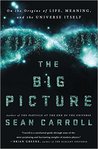
The Big Picture: On the Origins of Life, Meaning, and the Universe Itself
"A rigorous framework for finding human meaning within a vast, purposeless cosmos governed by natural law."
- 1Embrace Poetic Naturalism as a complete worldview. This philosophy accepts a single, natural reality described by physics while acknowledging that multiple, equally valid stories—from quantum fields to human purpose—emerge at different levels of description, each with its own vocabulary and meaning.
- 2Reject the Principle of Sufficient Reason for fundamental facts. Not every event or property of the universe requires a deeper reason or purpose. Some aspects, like the mass of fundamental particles, may simply be brute facts without further explanation, challenging our innate desire for narrative causality.
- 3Distinguish between how the world works and how it feels. The objective, scientific description of reality (the motion of atoms) and the subjective, human experience (love, pain, meaning) are different emergent layers of the same underlying physics. Both are real, but they answer different kinds of questions.
- 4Construct meaning through emergent, higher-level stories. Purpose and morality are not written into the laws of physics but emerge from complex interactions. We create meaning through conscious agents making choices within a framework of values, which is a legitimate and necessary way to talk about our world.
- 5Apply Bayesian reasoning to update beliefs about meaning. Our understanding of ethics, purpose, and the nature of reality should be provisional and updated in light of new evidence, using the probabilistic tools of Bayesian inference to navigate uncertainty in both science and philosophy.
Sean Carroll’s The Big Picture is an ambitious work of scientific humanism that seeks to construct a coherent, naturalistic worldview capable of accommodating everything from the Big Bang to human morality. Carroll, a theoretical physicist, argues that a single layer of fundamental reality—described by the laws of quantum field theory and general relativity—gives rise to the multitude of phenomena we experience. The book’s central project is to demonstrate how concepts like life, consciousness, and meaning are not magical additions but natural emergences from this physical substrate, challenging the perceived divide between the scientific and the humanistic.
Carroll meticulously builds his case by delineating different domains of discourse: the quantum, the cosmic, and the human. He introduces the framework of 'poetic naturalism,' which posits that while there is only one world (naturalism), we can tell many different, equally valid stories about it (the poetic aspect). These stories—whether about particles, organisms, or societies—utilize distinct vocabularies appropriate to their level of emergence. The book navigates through the origins of the universe, the arrow of time, the evolution of life, and the emergence of consciousness, consistently applying this layered view of reality.
The final movement of the argument addresses the most pressing human concerns: how do ethics, purpose, and meaning fit into this vast, impersonal cosmos? Carroll contends that values are not discovered but constructed by thinking, feeling agents. He argues against supernatural or cosmic purpose, proposing instead that meaning is a real, emergent property of complex systems like human brains and cultures. Our capacity to understand the universe and to create stories that matter within it becomes the source of redemption in an otherwise indifferent expanse of space and time.
The Big Picture synthesizes cutting-edge physics, philosophy, and biology into a sweeping narrative. Its primary audience is the intellectually curious layperson or specialist seeking a unified, scientifically-grounded perspective on existential questions. The book stands as a significant contribution to the tradition of public scientific philosophy, aiming to replace existential anxiety with a profound, evidence-based awe for the interconnectedness of all things.
The consensus celebrates Carroll's lucid synthesis of profound scientific and philosophical concepts, hailing the book as a monumental achievement in public intellectualism. Readers are particularly captivated by the elegant framework of 'poetic naturalism,' which provides a satisfying, non-reductive path from physics to meaning. Criticisms are minor but pointed: some find the middle sections on physics and entropy overly detailed for a general audience, creating a pacing dip before the compelling payoff on ethics and purpose. The work is broadly deemed accessible to the determined non-specialist, though it demands—and rewards—sustained intellectual engagement.
- 1The clarity and utility of 'Poetic Naturalism' as a philosophical framework for reconciling science with human experience.
- 2Debates over the book's pacing, particularly whether the deep dives into entropy and quantum mechanics are essential or tangential to the core argument.
- 3The persuasive power of Carroll's argument against cosmic purpose and for locally-constructed, emergent human meaning.
- 4Appreciation for the accessible explanation of complex physics concepts, such as the arrow of time and quantum field theory, for a lay audience.

Code: The Hidden Language of Computer Hardware and Software
Charles Petzold
The Artist's Way
Julia Cameron

The Almanack of Naval Ravikant
Naval Ravikant, Eric Jorgenson
The Uplift War (The Uplift Saga, #3)
David Brin

The Art of Contrarian Trading
Carl Futia
Transformation in Christ
Dietrich Von Hildebrand

How to Win Friends & Influence People
Dale Carnegie
Breath: The New Science of a Lost Art
James Nestor
Outliers: The Story of Success
Malcolm Gladwell
Just Listen: Discover the Secret to Getting Through to Absolutely Anyone
Mark Goulston

Chip War: The Quest to Dominate the World's Most Critical Technology
Chris Miller

Permanent Record
Edward Snowden