
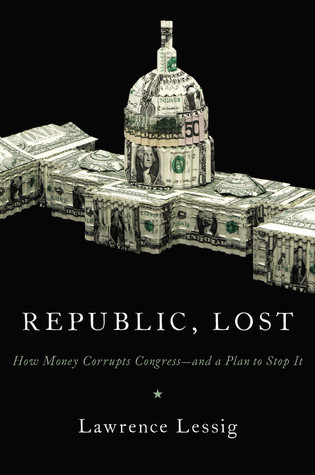
Republic, Lost: How Money Corrupts Congress--and a Plan to Stop It
"Diagnoses the systemic corruption of American democracy by institutionalized dependence on campaign cash and offers a constitutional remedy."
- 1Distinguish traditional bribery from systemic dependence corruption. The core problem is not quid-pro-quo deals but a system where legislators become dependent on funders for re-election, subtly skewing priorities and distorting governance even without explicit criminality.
- 2Recognize that perception of corruption is as destructive as its reality. When citizens believe policy is for sale, trust in government evaporates, delegitimizing the entire democratic process and fostering widespread cynicism and disengagement from civic life.
- 3Trace the crisis to fundamental shifts in campaign finance law. Legal frameworks from the 1970s onward, culminating in decisions like Citizens United, transformed elections into a permanent money chase, making legislators full-time fundraisers rather than public servants.
- 4Reject the false dichotomy between Left and Right on this issue. Dependence corruption is a transpartisan failure that equally undermines conservative and liberal goals, making reform a necessary precondition for any substantive policy victory.
- 5Demand a new Constitutional Convention to enact fundamental reform. Piecemeal legislative fixes are insufficient; only a constitutional amendment can permanently sever the link between private wealth and public electioneering to restore citizen sovereignty.
- 6Mobilize a cross-ideological movement around corruption as a common enemy. Effective change requires building a broad coalition that prioritizes systemic integrity over any single policy agenda, uniting citizens across the political spectrum.
Lawrence Lessig’s Republic, Lost is a forensic examination of the most profound crisis facing American democracy: its corruption by money. The book argues that the fundamental problem is not the old-fashioned bribery of individual officials, but a more insidious "dependence corruption"—a systemic condition where Congress is institutionally dependent on the funders who ensure its members' re-election. This dependency, Lessig contends, has created a economy of influence that systematically distorts policymaking away from the public interest, regardless of the individual virtue of any legislator.
Lessig meticulously traces the legal and historical architecture of this corruption, beginning with the campaign finance reforms of the 1970s that inadvertently professionalized fundraising. He details how subsequent Supreme Court decisions, treating political spending as protected speech, have unleashed a flood of corporate and special interest money. The analysis is grounded in concrete examples, from telecommunications policy to climate science, demonstrating how the need to secure funding creates a pervasive filter through which all policy must pass, privileging donor interests over electoral mandates.
The work distinguishes itself by appealing to first principles shared across the political spectrum, framing corruption not as a partisan issue but as a structural failure that precludes genuine self-governance. Lessig dissects the psychology of the system, showing how good people operating within broken incentives produce corrupted outcomes, and how the mere appearance of corruption erodes public trust as destructively as its reality.
Ultimately, Republic, Lost is both a dire warning and a pragmatic manifesto. Lessig concludes that incremental reform is futile against such an entrenched system. His proposed solution is radical: a call for a new Constitutional Convention to propose amendments that would fundamentally restructure campaign finance, most notably through systems like publicly funded elections. The book is aimed at any citizen, activist, or scholar seeking to understand the root cause of political dysfunction and is equipped with a clear, if daunting, pathway to reclaiming a representative republic.
Readers unanimously praise the book's brilliant and nuanced diagnosis of systemic political corruption, finding its analysis both intellectually rigorous and critically accessible. The central complaint is not with the argument's power but with its presentation; many find Lessig's reliance on meticulous logic over emotional rhetoric makes the vital subject feel dry and unlikely to spark the mass mobilization he advocates. The work is celebrated for providing essential context for movements like Occupy Wall Street and for making a complex legal-political issue comprehensible to a general audience.
- 1The book's prescient anticipation of the Occupy Wall Street movement and its value in explaining the underlying systemic grievances.
- 2Debate over whether Lessig's reasoned, academic tone is a strength of clarity or a weakness in failing to inspire necessary public passion.
- 3The distinction between illegal 'bribery' and legal but destructive 'dependence corruption' as the book's core conceptual breakthrough.
- 4The feasibility and radical nature of Lessig's proposed solution: a new Constitutional Convention to amend campaign finance rules.

Amusing Ourselves to Death: Public Discourse in the Age of Show Business
Neil Postman
Out of Control
Kevin Kelly
Chip War: The Quest to Dominate the World's Most Critical Technology
Chris Miller
The Psychology of Money: Timeless Lessons on Wealth, Greed, and Happiness
Morgan Housel
The Almanack of Naval Ravikant
Naval Ravikant, Eric Jorgenson
Radical Markets: Uprooting Capitalism and Democracy for a Just Society
Eric A. Posner, E. Glen Weyl

The Artist's Way
Julia Cameron
Sapiens: A Brief History of Humankind
Yuval Noah Harari

Permanent Record
Edward Snowden
The Road to Financial Freedom
Bodo Schäfer
Breath: The New Science of a Lost Art
James Nestor
The Creative Habit
Twyla Tharp, Mark Reiter