
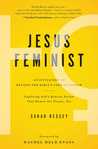
Jesus Feminist: An Invitation to Revisit the Bible’s View of Women
"A prophetic call to reclaim the Bible's liberating vision of gender equality within the Christian tradition."
- 1Define feminism as the simple belief in human equality. The book anchors feminism not in cultural polemics but in the foundational conviction that men and women possess equal dignity, worth, and humanity, a principle it argues is inherently biblical.
- 2Interpret restrictive biblical passages within their historical context. Scriptural texts often used to silence women, like Paul's directives, are examined as situational advice for specific first-century churches, not universal, timeless mandates for all Christian practice.
- 3Move beyond apologetics toward active, loving participation. Rather than exhausting energy in defensive arguments for inclusion, women are invited to simply begin loving, teaching, caring, and leading within their communities as an expression of their calling.
- 4Dismantle the idol of prescribed 'Biblical Womanhood'. The book challenges rigid, culturally constructed ideals of gender roles, advocating for a more expansive vision that welcomes diverse expressions of womanhood, including single women and working mothers.
- 5Locate Jesus's ministry as inherently feminist in impulse. Through his interactions with women, Christ consistently subverted patriarchal norms, offering dignity, inclusion, and authority, thereby establishing a kingdom ethic that fundamentally affirms women's full humanity and agency.
Sarah Bessey's 'Jesus Feminist' emerges as a lyrical and theologically grounded manifesto, born from the tension between evangelical faith and the pursuit of gender justice. It confronts the long-standing debate over women's roles within Christianity not with polemical fury, but with a poet's cadence and a pastor's heart, issuing a freedom call to those who feel constrained by man-made traditions. Bessey positions the work as an invitation—a personal testimony of how a deep commitment to following Jesus inevitably led her to embrace feminism.
Central to the book's argument is a deliberate, thoughtful re-examination of the biblical text. Bessey navigates complex passages, particularly Pauline epistles like 1 Corinthians 14, by situating them within their specific historical and cultural contexts. She argues that directives for women's silence were addressed to particular situations in the early church, not intended as universal ordinances. This exegetical work is paired with a celebratory recovery of the myriad women who prophesied, led, and ministered throughout Scripture, from the judges to the apostles, constructing a counter-narrative of active female participation in God's story.
The book's power lies in its constructive vision. It moves beyond deconstruction of restrictive complementarian theology to imagine a church that fully welcomes women's diverse gifts, voices, and life experiences. Bessey explicitly extends this welcome to single women, working mothers, and those who do not fit the idealized mold of 'Biblical womanhood,' advocating for a community defined by love and service rather than gender-based hierarchy. The prose itself becomes a form of witness, modeling the integrative, compassionate, and biblically saturated voice it champions.
Ultimately, 'Jesus Feminist' serves as a bridge text, aimed squarely at Christians—particularly women—within evangelical and conservative traditions who sense a dissonance between their faith and their longing for equality. It seeks to demonstrate that a robust feminist ethic is not an alien import but is rooted in the life and teachings of Jesus, offering a path toward wholeness for individuals and the collective body of the church. Its legacy is one of pastoral invitation, urging a movement from anger or exclusion toward empowered, loving action within the kingdom of God.
The consensus positions this as a vital, accessible entry point for Christian women exploring feminism, praised for its compassionate tone and biblical focus. Readers from evangelical backgrounds find it revolutionary and affirming, while those from more progressive traditions sometimes view its arguments as foundational rather than groundbreaking. Criticisms occasionally surface regarding the depth of its historical exegesis or a desire for more concrete ecclesial strategy, but the overwhelming sentiment celebrates it as a healing and empowering catalyst for personal and theological integration.
- 1The book's definition of feminism as simple belief in equality, separating it from contentious political debates like abortion.
- 2The contextual interpretation of Paul's letters, especially the 'women be silent' passages, as situational rather than universal commands.
- 3Its role as a bridge for evangelical women feeling conflicted between their faith and a desire for gender equality.
- 4The challenge to rigid 'Biblical Womanhood' ideals and the welcoming of diverse female experiences into church life.
- 5The author's evangelical and literalist background making her feminist argument particularly persuasive within conservative circles.

Amusing Ourselves to Death: Public Discourse in the Age of Show Business
Neil Postman

Permanent Record
Edward Snowden

How to Win Friends & Influence People
Dale Carnegie

Code: The Hidden Language of Computer Hardware and Software
Charles Petzold

The Road to Financial Freedom
Bodo Schäfer

The Essays of Warren Buffett: Lessons for Corporate America
Lawrence A. Cunningham, Warren Buffett
Transformation in Christ
Dietrich Von Hildebrand

The Art of Contrarian Trading
Carl Futia

The Almanack of Naval Ravikant
Naval Ravikant, Eric Jorgenson

Sapiens: A Brief History of Humankind
Yuval Noah Harari

Radical Markets: Uprooting Capitalism and Democracy for a Just Society
Eric A. Posner, E. Glen Weyl

Chip War: The Quest to Dominate the World's Most Critical Technology
Chris Miller