
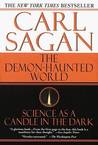
The Demon-Haunted World: Science as a Candle in the Dark
"Arm yourself with the scientific method to defend democracy against the seductive darkness of superstition and pseudoscience."
Nook Talks
- 1Cultivate a baloney detection kit for daily life. Sagan provides a set of logical and rhetorical tools to identify fallacious arguments, enabling individuals to skeptically interrogate extraordinary claims and separate reliable information from manipulative noise.
- 2Recognize science as a profound source of wonder. The book reframes the scientific endeavor not as a cold, sterile process, but as a deeply human and poetic pursuit that reveals a reality more astonishing than any comforting myth.
- 3Understand the existential threat of credulity to democracy. A populace unable to think critically becomes vulnerable to demagoguery and authoritarian control. The health of democratic institutions is inextricably linked to the public's commitment to rational inquiry.
- 4Apply skeptical scrutiny to your own cherished beliefs. True intellectual honesty requires subjecting one's own assumptions to the same rigorous standard demanded of opposing views, preventing ideology from hardening into dangerous dogma.
- 5Distinguish between the openness of science and the closure of pseudoscience. Science thrives on doubt, testing, and revision, while pseudoscience protects its core tenets from falsification, creating closed systems immune to evidence and reason.
In an era increasingly saturated with misinformation and magical thinking, Carl Sagan’s The Demon-Haunted World posits the scientific method as our most vital tool for societal and personal survival. It is a passionate plea for reason, not as a dry academic exercise, but as a necessary candle held against a vast and frightening darkness of ignorance. Sagan frames the conflict between science and superstition as a recurring historical drama, where the stakes are nothing less than human freedom and progress.
Sagan constructs his argument by casting a wide net through history and culture, meticulously debunking past and present enchantments—from the witch hunts of early modern Europe to contemporary claims of alien abduction and channeled past lives. He demonstrates that the psychological and social mechanisms underlying these beliefs are remarkably consistent: a longing for comfort, a susceptibility to anecdote, and a failure to apply skeptical inquiry. The book is, in essence, a user's manual for the "baloney detection kit," a set of cognitive tools designed to help individuals identify fallacious arguments and evaluate evidence.
The work is equally a celebration of the scientific spirit, which Sagan portrays with characteristic poetic awe. He argues that a grasp of the scientific method fosters not cynicism, but a profound and humbling sense of wonder at the genuine complexity of the universe. This cultivated skepticism is presented as the foundation of a healthy democracy, creating an informed citizenry resistant to the manipulations of demagogues and unscrupulous authorities who prey on credulity.
Ultimately, Sagan’s treatise is a foundational text for the scientifically literate citizen, targeting anyone navigating the complexities of a technology-driven world. Its enduring legacy lies in its urgent, eloquent defense of critical thinking as a moral imperative, making it a timeless guide for preserving both intellectual integrity and the very fabric of civil society.
The critical consensus venerates this work as an essential, accessible, and morally urgent manifesto for scientific skepticism. Readers are universally impressed by Sagan's ability to marry rigorous logic with compassionate wonder, finding the book both intellectually galvanizing and deeply humane. The primary critique, mentioned by a minority, is that its examples can feel dated, though most argue its core principles remain devastatingly relevant. It is championed as required reading for its clear-eyed blueprint on defending reason in an irrational age.
- 1The book's prescient relevance in today's 'post-truth' era of misinformation and conspiracy theories.
- 2Sagan's unique fusion of rigorous scientific skepticism with a palpable sense of poetic wonder and compassion.
- 3Discussions on whether the specific case studies (e.g., UFOs) feel dated or remain effective illustrations of timeless principles.
- 4The forceful argument that scientific literacy is a non-negotiable pillar for the survival of democratic society.

The Road to Financial Freedom
Bodo Schäfer

The Artist's Way
Julia Cameron
The Creative Habit
Twyla Tharp, Mark Reiter

Outliers: The Story of Success
Malcolm Gladwell

Chip War: The Quest to Dominate the World's Most Critical Technology
Chris Miller

Code: The Hidden Language of Computer Hardware and Software
Charles Petzold

Amusing Ourselves to Death: Public Discourse in the Age of Show Business
Neil Postman

How to Win Friends & Influence People
Dale Carnegie

Permanent Record
Edward Snowden

The Almanack of Naval Ravikant
Naval Ravikant, Eric Jorgenson
The Psychology of Money: Timeless Lessons on Wealth, Greed, and Happiness
Morgan Housel
Radical Markets: Uprooting Capitalism and Democracy for a Just Society
Eric A. Posner, E. Glen Weyl