
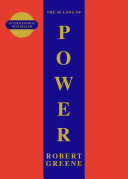
The 48 Laws Of Power
"Master the timeless, amoral game of influence by studying history's greatest strategists, seducers, and statesmen."
Nook Talks
- 1Master the art of emotional detachment and strategic patience. Power accrues to those who control their impulses and time their actions precisely. Emotional reactions reveal weakness and surrender strategic advantage to observant opponents.
- 2Cultivate an aura of mystery by concealing your true intentions. Complete transparency makes you predictable and manipulatable. Strategic ambiguity forces others to engage on your terms, allowing you to control the narrative and the pace of revelation.
- 3Never appear too perfect; selectively reveal minor flaws. Flawless superiority breeds envy and resentment. A calculated, harmless vulnerability makes you relatable, disarms critics, and deflects the hostility that unadulterated perfection inevitably attracts.
- 4Treat social and professional life as a theatrical performance. Power is a function of perception. Consciously adopt roles and personas suited to your objectives. The courtier, the sage, or the gracious winner are all masks chosen for strategic effect.
- 5Always plan multiple steps ahead and maintain contingency options. Rigidity leads to defeat. The strategic mind anticipates reversals and prepares alternative paths to the same goal. Your Plan B ensures that a single setback does not become a terminal failure.
- 6Learn to crush your enemies totally when you are forced to act. Half-measures invite prolonged conflict and future retaliation. Decisive, conclusive action eliminates the threat permanently and serves as a stark deterrent to other potential adversaries.
- 7Use historical precedent as your ultimate strategic textbook. Human nature and the dynamics of power are constants across millennia. The triumphs and failures of past masters—from Medici to Bismarck—provide an inexhaustible repository of tactical wisdom.
The 48 Laws of Power is a stark, uncompromising excavation of the mechanics of influence, distilling three millennia of political, military, and social history into a single, operational code. Robert Greene constructs a grand unified theory of power by synthesizing the ruthless pragmatism of Machiavelli, the strategic deception of Sun Tzu, and the psychological warfare of Clausewitz. The book operates from a foundational premise: power is not a moral condition but an amoral game, with rules observable in the courts of Renaissance Italy, the corporate boardrooms of the twentieth century, and every hierarchical human institution in between.
Each of the 48 laws is presented as a self-contained maxim—"Never Outshine the Master," "Conceal Your Intentions," "Crush Your Enemy Totally"—supported by a tapestry of historical vignettes. Greene illustrates these principles through the cunning of Catherine de' Medici, the seductive manipulations of Cleopatra, the brutal efficiency of Bismarck, and the strategic patience of Abraham Lincoln. The methodology is forensic, treating each historical episode as a case study in applied power dynamics, where success and failure are measured solely by the acquisition and retention of control.
The book's intellectual architecture is built upon the recognition that power operates independently of virtue. It systematically dismantles naive notions of fairness, arguing that appeals to morality are often themselves power moves in disguise. Instead, it offers a toolkit for navigating a world it perceives as fundamentally competitive and often predatory. The laws cover the full spectrum of strategic action, from self-presentation and alliance-building to offensive maneuvers and defensive fortifications.
Its significance lies in its brutal honesty and encyclopedic scope, serving as both a manual for the ambitious and a defensive primer for the innocent. The target audience spans the aspiring executive, the political operative, the artist seeking patronage, and anyone who wishes to understand the hidden architecture of social authority. More than a simple guide, it is a mirror held up to the often-ugly realities of human ambition, leaving readers to decide whether to adopt its teachings or merely to recognize them in the world around them.
The consensus positions the book as a compelling yet morally fraught masterclass. Readers universally praise its dense historical analysis and actionable insights, describing it as an indispensable education in realpolitik and human nature. However, a significant critical thread condemns its overt amorality, warning that its teachings, if internalized without ethical guardrails, can cultivate paranoia and cynicism. The prose is celebrated for its clarity and authority, though some find the sheer volume of laws and examples overwhelming, making the text more a reference manual than a cover-to-cover narrative.
- 1The ethical dilemma of applying its amoral strategies in personal and professional life.
- 2Its value as a historical survey versus its utility as a practical manual for modern power dynamics.
- 3Debates over whether the book promotes strategic wisdom or merely teaches manipulation and sociopathy.
- 4The challenge of internalizing all 48 laws versus selectively applying a few key principles for self-defense.

How to Win Friends & Influence People
Dale Carnegie

Permanent Record
Edward Snowden

Chip War: The Quest to Dominate the World's Most Critical Technology
Chris Miller

The Road to Financial Freedom
Bodo Schäfer

The Psychology of Money: Timeless Lessons on Wealth, Greed, and Happiness
Morgan Housel

Sapiens: A Brief History of Humankind
Yuval Noah Harari

Amusing Ourselves to Death: Public Discourse in the Age of Show Business
Neil Postman
The Creative Habit
Twyla Tharp, Mark Reiter
Stumbling on Happiness
Daniel Gilbert

The Fifth Discipline
Peter M. Senge
Radical Markets: Uprooting Capitalism and Democracy for a Just Society
Eric A. Posner, E. Glen Weyl

Out of Control
Kevin Kelly