
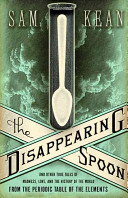
The Disappearing Spoon: And Other True Tales of Madness, Love, and the History of the World from the Periodic Table of the Elements
"Reveals the human drama of scientific discovery, where every element holds a story of obsession, genius, and historical consequence."
- 1Understand science as a profoundly human endeavor. Scientific progress is driven not by abstract logic alone, but by rivalry, ego, love, and sheer obsession. The personalities of discoverers are as integral to the story as their discoveries.
- 2See the periodic table as a narrative map of civilization. Each element’s history is interwoven with wars, art, economics, and myth. Silicon built the digital age, mercury poisoned explorers, and rare earth metals fuel geopolitical tensions.
- 3Appreciate the serendipity and error behind major discoveries. Many elemental breakthroughs occurred by accident or through misinterpretation. The messy, trial-and-error nature of science is more common than the myth of flawless, linear progress.
- 4Recognize the intimate link between elements and the human body. Our biology is a precise chemical orchestra. Elements like iodine and iron are essential, while others like arsenic and cadmium are lethal, highlighting a fine line between medicine and poison.
- 5Grasp the ongoing evolution of the periodic table. The table is not a static relic but a living document. The discovery of new, unstable elements continues to challenge and expand our understanding of matter's fundamental architecture.
Sam Kean’s The Disappearing Spoon dismantles the perception of the periodic table as a mere chart of inert boxes. Instead, he reconstructs it as a sprawling epic, where each element serves as a protagonist in tales of madness, love, betrayal, and world-altering innovation. The book argues that the history of the elements is inseparable from the history of humanity itself, tracing a lineage from the primordial furnaces of the Big Bang to the cutting-edge labs of the twenty-first century.
Kean organizes his narrative not by atomic number but by thematic connections, weaving together anecdotes that reveal the human character behind scientific progress. We encounter the poignant rivalry between Mendeleev and Meyer, the tragic radium girls, and the flamboyant showmanship of chemists who ate sodium to impress audiences. The prose illuminates how gallium spoons vanish in tea, a prank on arrogant hosts, and how tellurium inspired a doomed gold rush in Transylvania, demonstrating that chemical properties directly shape historical events and personal fates.
The work delves into the dark corners of this history, exploring elements as tools of war and instruments of poison, while also celebrating their role in art, medicine, and exploration. It explains the cosmic origins of heavy elements in supernovae and the painstaking, often dangerous, process of isolating new ones. Kean makes clear that the table’s structure—its periods and groups—itself tells a story of repeating chemical behaviors, a hidden pattern that guided discovery.
Ultimately, the book functions as both a masterful work of scientific storytelling and an accessible gateway to chemistry. It targets the curious layperson and the seasoned student alike, revealing the discipline not as a dry collection of formulas, but as a deeply human pursuit filled with brilliance, folly, and relentless curiosity about the fabric of the universe.
The critical consensus celebrates the book's brilliant conceit and engaging, story-driven approach, which successfully demystifies chemistry for a broad audience. Readers consistently praise its wealth of fascinating anecdotes and the author's witty, accessible prose. However, a significant contingent finds the narrative structure occasionally digressive and disjointed, wishing for a more linear or systematic exploration of the periodic table alongside the tales.
- 1The book's anecdotal, non-linear structure is praised for being engaging but criticized for feeling disjointed and lacking a clear narrative thread.
- 2Accessibility for non-scientific readers is highly commended, though some with chemistry backgrounds find the content overly simplistic.
- 3The quality and depth of the historical and biographical stories are universally highlighted as the book's greatest strength and primary appeal.
Outliers: The Story of Success
Malcolm Gladwell

Chip War: The Quest to Dominate the World's Most Critical Technology
Chris Miller

Just Listen: Discover the Secret to Getting Through to Absolutely Anyone
Mark Goulston

The Road to Financial Freedom
Bodo Schäfer

Permanent Record
Edward Snowden

Out of Control
Kevin Kelly
The Art of Contrarian Trading
Carl Futia
The Creative Habit
Twyla Tharp, Mark Reiter

How to Win Friends & Influence People
Dale Carnegie
Breath: The New Science of a Lost Art
James Nestor
Sapiens: A Brief History of Humankind
Yuval Noah Harari
The Lessons of History
Will Durant